What Is Halogen Free PCB Material?
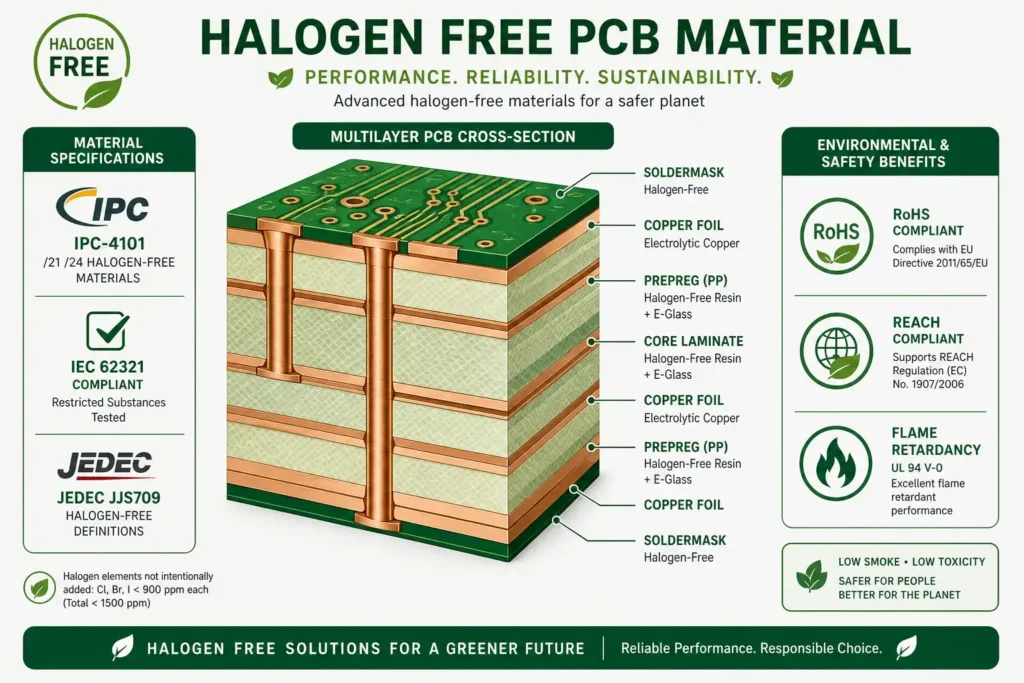
Halogen free PCB material is a copper-clad laminate or prepreg system formulated without intentionally adding traditional halogenated flame retardants and controlled to a low concentration of chlorine and bromine. In practice, the term normally focuses on bromine and chlorine because these elements have historically been used in flame-retardant packages and can form corrosive or irritating combustion products under severe fire conditions.
A finished PCB contains more than laminate. Solder mask, silkscreen, component bodies, adhesives, cables, connectors, and assembly materials can all have their own substance declarations. Therefore, a halogen-free laminate does not automatically make the complete product halogen-free. Product compliance must be evaluated at the level defined by the customer or applicable standard.
Halogenated and Halogen-Free Materials
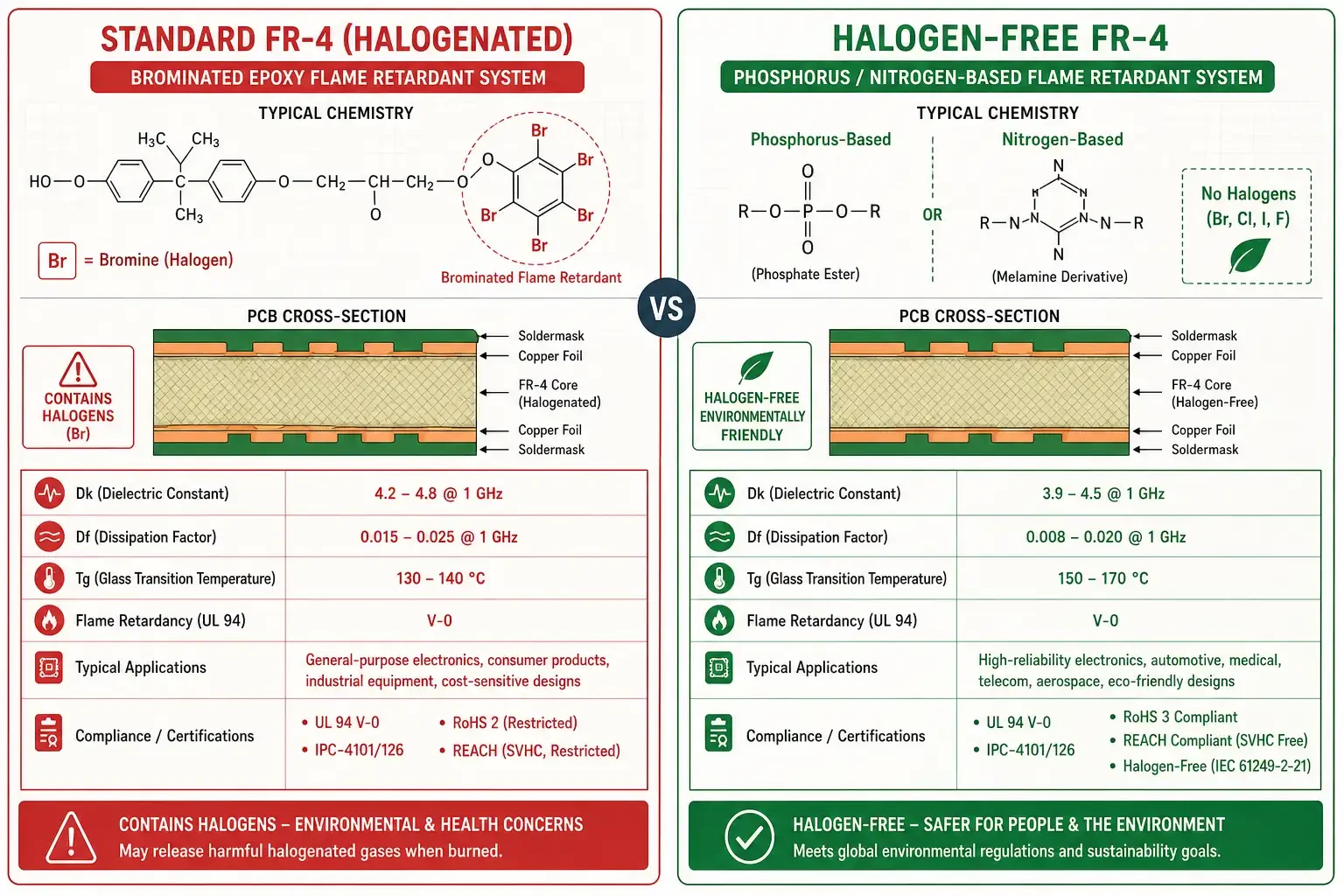
Conventional FR-4 is a performance category, not a complete chemical description. A standard FR-4 board can use a brominated epoxy flame-retardant system, while a halogen-free FR-4-compatible laminate can use a phosphorus-, nitrogen-, mineral-, or hybrid-based flame-retardant approach. Both can satisfy the design need for a rigid glass-reinforced epoxy board, but their datasheet values and processing behavior may differ.
“Halogen-free” also should not be confused with “low-halogen.” Low-halogen may indicate a reduced concentration without meeting the customer’s halogen-free threshold. Always request the actual limits, test method, sample definition, and certificate rather than relying on a marketing label.
Why Does Halogen-Free Matter?
Environmental and Product Requirements
Many OEMs use restricted-substance lists, material declarations, and supplier scorecards that go beyond statutory minimums. A halogen-free specification can simplify product-material policy, support market-access documentation, and align with customer requirements for electronics used in offices, homes, vehicles, or enclosed equipment.
This is a design and procurement requirement, not proof that a product has no environmental impact. Resin production, glass fiber, copper, fabrication chemicals, energy use, and end-of-life handling still matter. A complete environmental evaluation should consider the entire bill of materials and the product life cycle.
Fire and Smoke Considerations
Flame retardancy is a safety property. Halogenated flame-retardant systems can be highly effective, but under certain fire conditions combustion products may include hydrogen halides and other corrosive species. Halogen-free chemistry seeks to achieve the required flammability rating through a different package. The result is not automatically safer in every fire scenario; performance depends on the formulation, enclosure, fire exposure, and certification.
For a PCB designer, the practical requirement is to verify the laminate’s UL rating, flammability classification, glow-wire or other application-specific requirements, and system-level fire test. Do not infer fire performance from the words “halogen-free” alone.
Reliability and Long-Term Performance
A good halogen-free laminate can deliver robust reliability, but the resin system must be matched to the application. Important properties include glass transition temperature (Tg), decomposition temperature (Td), coefficient of thermal expansion (CTE), time to delamination, moisture absorption, copper peel strength, CAF resistance, and thermal-stress performance.
The chemistry can also affect drilling, desmear, press flow, resin filling, and reflow behavior. Qualification should therefore use the actual laminate and prepreg construction, not a generic assumption that all FR-4 materials behave alike.
Halogen-Free Standards and Specifications
IPC-4101
IPC-4101 is the key IPC specification family for base materials used in rigid and multilayer printed boards. It establishes material requirements and designation frameworks used by laminate suppliers and PCB manufacturers. When specifying a halogen-free material, identify the applicable IPC material designation or slash-sheet requirement and pair it with the supplier’s current datasheet and certificate of compliance.
IPC-4101 does not eliminate the need to state the board-specific requirements. Include the required Tg or thermal class, flammability rating, copper foil type, thickness tolerance, Dk/Df data at the relevant frequency, and any CAF or reliability requirement.
IEC 62321
The IEC 62321 series provides methods for determining certain substances in electrotechnical products. Relevant analytical methods can be used to determine bromine and chlorine, including screening and confirmatory approaches appropriate to the material and concentration range. IEC 62321 is a test-method family, not a blanket declaration that a product complies with every environmental law.
For purchasing, ask whether the supplier’s certificate identifies the test method, laboratory, date, sample, detection limit, and result. If a customer specification defines a particular edition or method, that requirement takes precedence.
JEDEC JJS709
JEDEC JJS709 is commonly referenced in electronics supply chains for halogen-related definitions and requirements. Because standard scope and revision status can change, confirm the current document directly with JEDEC or your customer before using it as the sole basis for a compliance statement. In an RFQ, write the actual chlorine, bromine, and total-halogen limits and request supporting test evidence.
SMTA Resources
The SMTA provides technical resources, conferences, and education for electronics assembly and manufacturing professionals. Its resources can help teams evaluate material selection alongside soldering, reliability, and process-control considerations. SMTA guidance should complement, not replace, the governing IPC, IEC, JEDEC, regulatory, or customer specification.
Halogen-Free Material Properties
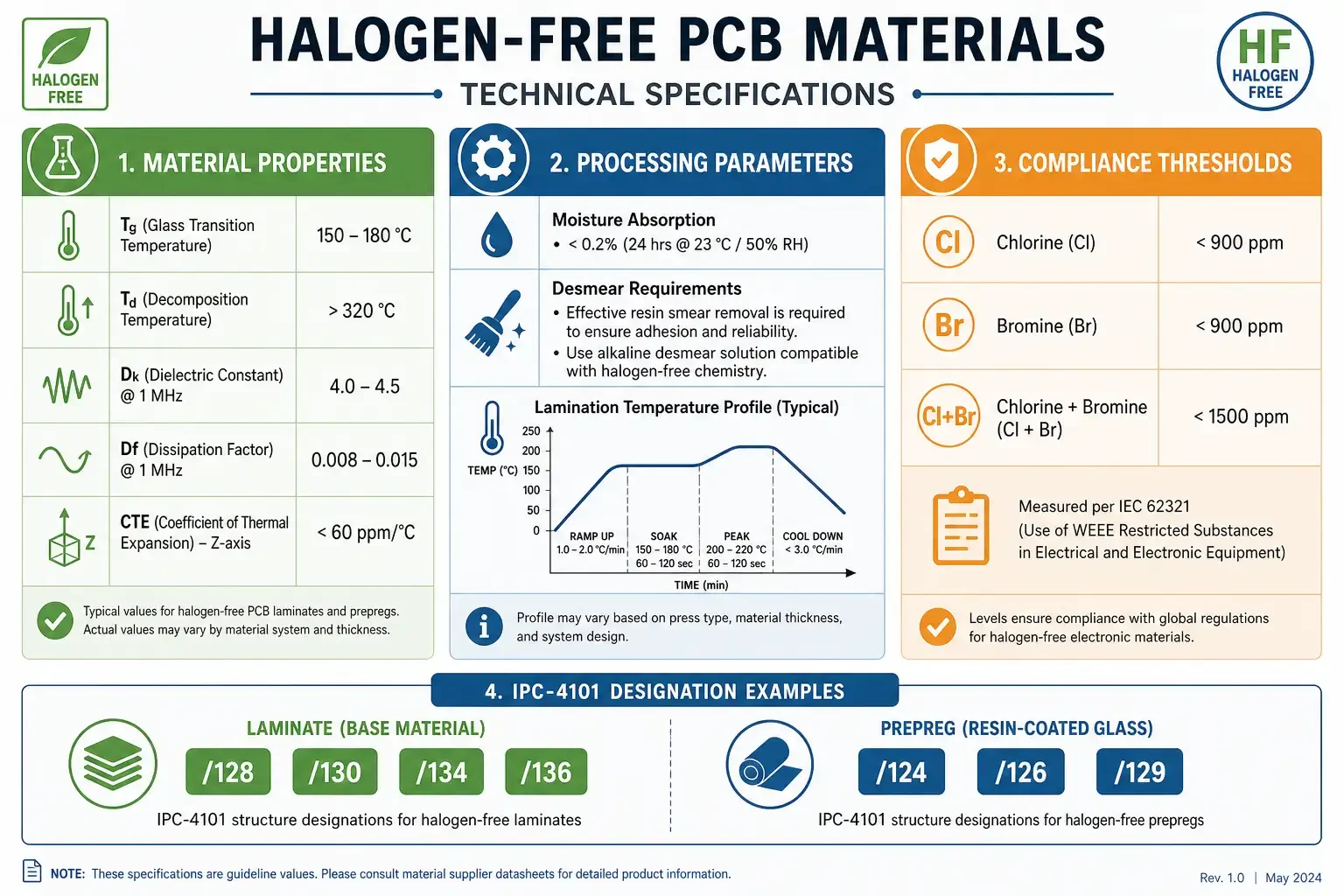
The following values are design categories rather than universal datasheet values. Resin content, glass style, frequency, test method, copper construction, and supplier grade can change the result.
| Property | Typical Standard FR-4 | Typical Halogen-Free FR-4 | Design Implication |
|---|---|---|---|
| Flame-retardant chemistry | Often brominated epoxy; grade-dependent | Non-halogenated phosphorus, nitrogen, mineral, or hybrid package | Verify UL recognition and fire test data |
| Halogen content | May exceed halogen-free limits | Commonly below 900 ppm Cl, below 900 ppm Br, below 1,500 ppm total | Confirm exact customer threshold and test method |
| Tg | Approximately 130–180°C depending on grade | Approximately 140–180°C depending on grade | Select for assembly cycles and operating temperature |
| Td | Supplier- and chemistry-dependent | Supplier- and chemistry-dependent; verify by TGA method | Important for lead-free reflow and repeated assembly |
| Dk / Df | Broad FR-4 range; frequency-dependent | Comparable range, but formulation and glass style can shift values | Recalculate controlled impedance with supplier data |
| CTE | Depends on resin content and construction | Depends on resin system and glass construction | Affects vias, thermal cycling, and registration |
| Moisture absorption | Grade-dependent | Grade-dependent; do not assume lower or higher | Control storage, baking, and reflow exposure |
| Cost and availability | Broadest supply base | Often moderate premium and fewer equivalent grades | Confirm approved sources and alternate materials |
For controlled impedance, do not copy a trace width from a standard FR-4 stack-up. Use the halogen-free laminate’s design Dk, resin content, pressed dielectric thickness, copper thickness, and manufacturer tolerance. If the material is substituted, rerun the field-solver model and obtain a revised impedance coupon plan.
Applications That Commonly Require Halogen-Free Materials
Halogen-free requirements are most common where the OEM, market, or end-user specification explicitly calls for them. Typical examples include:
- Consumer electronics: laptops, phones, displays, chargers, and home equipment with corporate material policies.
- Networking and data equipment: switches, routers, storage, and servers where high layer count, thermal load, and supply-chain documentation overlap.
- Automotive electronics: control modules, infotainment, lighting, and sensor systems subject to customer-specific material restrictions and thermal cycling.
- Industrial and medical equipment: products installed in occupied spaces or governed by strict customer qualification procedures.
- Rail, aerospace, and transportation: applications where smoke, fire, traceability, and system safety requirements are tightly controlled.
- Green procurement programs: products sold under a manufacturer’s restricted-substance or environmental product policy.
The requirement may apply only to the laminate, to all homogeneous materials, or to the complete product. Clarify the boundary before sourcing.
Halogen-Free vs Standard FR-4
Halogen-free is not a direct replacement category for every standard FR-4 board. Standard FR-4 describes a broad performance family, while halogen-free describes a chemical-content requirement layered onto a material system. Some halogen-free grades are designed as drop-in alternatives; others require a new stack-up, press cycle, or qualification plan.
| Selection Factor | Standard FR-4 | Halogen-Free PCB Material |
|---|---|---|
| Primary reason for selection | Cost, availability, general performance | Restricted-substance or customer requirement plus required PCB performance |
| Flame-retardant package | Often brominated, but grade-specific | Non-halogenated chemistry, grade-specific |
| Electrical design | Usually well characterized across many suppliers | Must use the selected supplier’s Dk/Df data |
| Thermal performance | Available from standard to high-Tg grades | Available from standard to high-Tg grades; verify Td and delamination data |
| Manufacturing | Familiar process window | May require revised drilling, desmear, lamination, or moisture controls |
| Sourcing | Usually broad | Depends more strongly on region, volume, and approved vendors |
| Compliance meaning | Does not imply halogen-free | Does not automatically imply RoHS or complete-product compliance |
If an existing design changes from brominated FR-4 to halogen-free laminate, review dielectric thickness, impedance, via reliability, press flow, solderability, thermal stress, and assembly yield. Treat the conversion as a material change, not just a purchasing substitution.
Manufacturing Considerations
Lamination and Pressing
Halogen-free resin systems can have different melt viscosity, cure behavior, and flow characteristics. The fabricator should confirm the press recipe, prepreg selection, resin content, copper balance, and final dielectric thickness. An old press cycle may produce resin starvation, excessive squeeze-out, void risk, or unexpected thickness.
Drilling and Desmear
Drill quality depends on glass style, resin chemistry, board thickness, copper stack, and tool condition. Confirm drill wear, hit count, smear removal, and hole-wall quality during qualification. The desmear chemistry must remove resin residue without damaging the glass bundle or reducing plated-through-hole reliability.
Moisture and Reflow
Moisture can contribute to blistering, measling, delamination, and popcorning during assembly. Store laminate and prepreg according to the supplier’s handling instructions. Define floor life, bake conditions, and reflow exposure for the actual material. Lead-free profiles with peak temperatures commonly around 240–260°C make Td, delamination time, and moisture control particularly important, but the assembly house’s validated profile governs.
Impedance and Stack-Up
Use the selected material’s pressed construction in the impedance model. Resin content changes after lamination, and the same nominal prepreg designation may produce different dielectric thicknesses under different copper patterns. Coordinate with the multilayer PCB manufacturer before releasing the stack-up.
Surface Finish and Assembly
Halogen-free laminate does not prescribe a surface finish. Select HASL, ENIG, ENEPIG, immersion silver, OSP, or another finish based on soldering, contact, shelf-life, wire bonding, and environmental requirements. Compare options in this PCB surface finish comparison. Also confirm that solder mask, legend, adhesives, and components meet the intended product-level substance policy.
Cost and Availability
Halogen-free material may cost more than the most common commodity FR-4, but the premium is not fixed. It depends on board thickness, Tg, copper foil, laminate brand, order volume, panel size, region, qualification requirements, and whether the fabricator stocks the grade. A stocked halogen-free high-Tg material can be more economical than a special-order standard grade.
To control cost, define the compliance threshold before requesting quotes, accept equivalent materials only through an engineering change process, and ask for approved alternates. Include material grade, thickness, Tg, UL rating, halogen limits, Dk/Df data, copper weight, finish, quantity, and testing in the PCB quote requirements. For difficult builds, work with a custom PCB manufacturer early rather than specifying a material unavailable at production volume.
Practical Specification Checklist
Before approving a halogen-free PCB material, confirm:
- The exact laminate and prepreg manufacturer and grade.
- IPC-4101 designation or applicable customer material specification.
- Chlorine, bromine, and total-halogen limits with test method and certificate.
- Tg, Td, CTE, time to delamination, moisture absorption, and thermal-stress data.
- UL recognition and flammability classification where required.
- Dk/Df values, frequency, test method, and design values for impedance modeling.
- Storage, bake, floor-life, lamination, drilling, and desmear instructions.
- Approved alternates, minimum order quantities, and expected production lead time.
- Qualification plan for via reliability, soldering, thermal cycling, and cleanliness.
- Product-level compliance boundaries for solder mask, components, and assembly materials.
Frequently Asked Questions
Is halogen-free PCB material the same as lead-free PCB material?
No. Halogen-free controls chlorine and bromine content in the defined material or product boundary. Lead-free concerns lead content and solder/finish choices. A board may be halogen-free but not meet a particular lead restriction, or lead-free but use a halogenated laminate. Evaluate both requirements independently.
Does halogen-free mean that a PCB contains no halogens?
Usually no. The industry term commonly refers to concentration thresholds for chlorine and bromine, often below 900 ppm each and below 1,500 ppm combined. The exact definition depends on the customer or governing specification. Request the supplier’s measured values rather than treating the label as absolute absence.
Can halogen-free laminate support high-speed or controlled-impedance PCBs?
Yes. Halogen-free laminate can support high-speed and impedance-controlled designs, but its Dk and Df must be modeled at the relevant frequency. Resin content, glass style, pressed thickness, copper roughness, and manufacturing tolerance all affect impedance and loss. Recalculate the stack-up when changing material grade.
Is halogen-free FR-4 more reliable than standard FR-4?
Not automatically. Reliability depends on the complete construction and process: resin system, glass architecture, Tg/Td, CTE, moisture handling, plating, lamination, and assembly profile. A qualified halogen-free material can be highly reliable, but the supplier’s test data and the board’s qualification results are the evidence.
Does changing to halogen-free material require a PCB redesign?
Sometimes. A drop-in grade may preserve the existing geometry, but a different Dk, Df, resin flow, pressed thickness, CTE, or thermal profile can change impedance, via stress, warpage, and assembly results. Review the PCB stack-up design and obtain a manufacturer’s material-substitution review before release.
How should I specify halogen-free material in an RFQ?
Name the exact grade or acceptable equivalents, state the chlorine/bromine/total-halogen limits, identify the test method, and list Tg, Td, CTE, UL rating, thickness, copper, impedance, finish, and qualification requirements. Ask for current datasheets and certificates. Avoid writing only “halogen-free FR-4,” because that phrase leaves important performance and compliance details undefined.
References
- IPC — IPC standards and base-material resources, including IPC-4101.
- IEC — IEC standards resources, including IEC 62321 methods for certain substances in electrotechnical products.
- JEDEC — JEDEC standards resources, including JJS709 references used in halogen-related electronics specifications.
- SMTA — Electronics manufacturing education and technical resources.
Further Reading
- PCB Stack-Up Design — Coordinate dielectric materials, layer arrangement, and impedance.
- FR-4 vs High-Tg PCB — Compare thermal material grades.
- PCB Quote Requirements — Document material and compliance requirements in an RFQ.
- Multilayer PCB Manufacturer — Review multilayer fabrication considerations.
- Custom PCB Manufacturer — Coordinate material selection with production capability.
- PCB Surface Finish Comparison — Select a finish for assembly and reliability.
Shanghai Huangte Technology Co., Ltd. | Author: Mike Huang | Published: 2026-07-26
This article provides general engineering guidance. Material designations, analytical methods, compliance thresholds, and availability should be confirmed against the current customer specification, applicable standard edition, supplier datasheet, and manufacturer qualification data.