
Halogen Free PCB Material: Standards, Properties, and Selection Guide
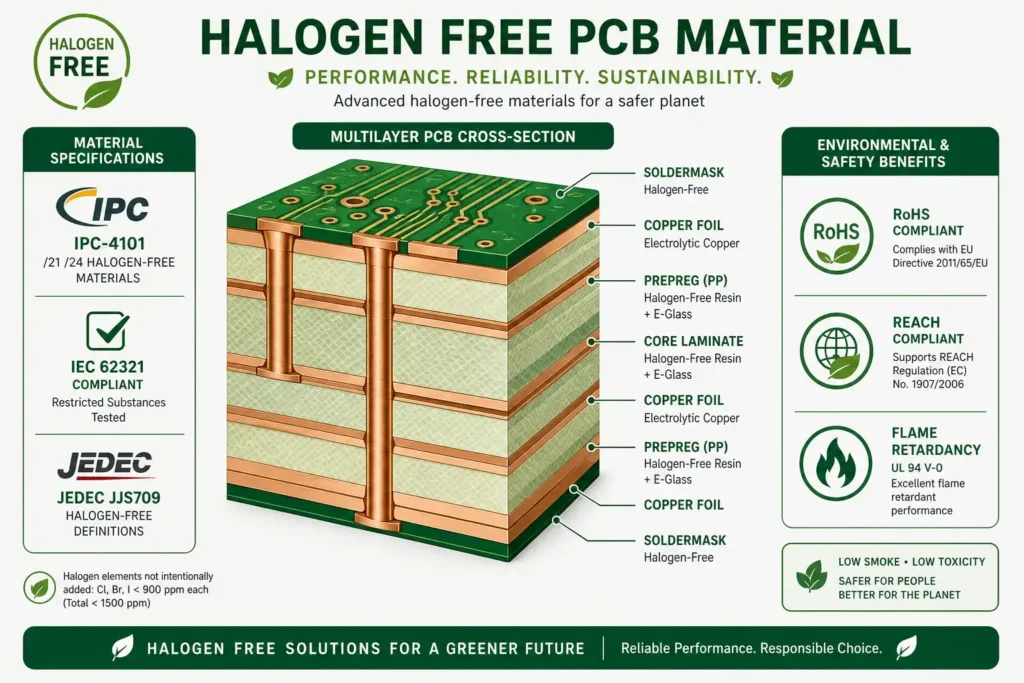
Key Takeaways Halogen-free usually means controlling chlorine and bromine concentration; it does not mean the material contains no halogens whatsoever. Common industry thresholds are below 900 ppm chlorine, below 900 ppm bromine, and below 1,500 ppm total chlorine plus bromine, but the governing customer specification controls. Halogen-free is not synonymous with lead-free, RoHS-compliant, REACH-compliant, non-toxic, […]
4 Layer PCB Stack-Up: Configuration, Plane Design, and Impedance Best Practices
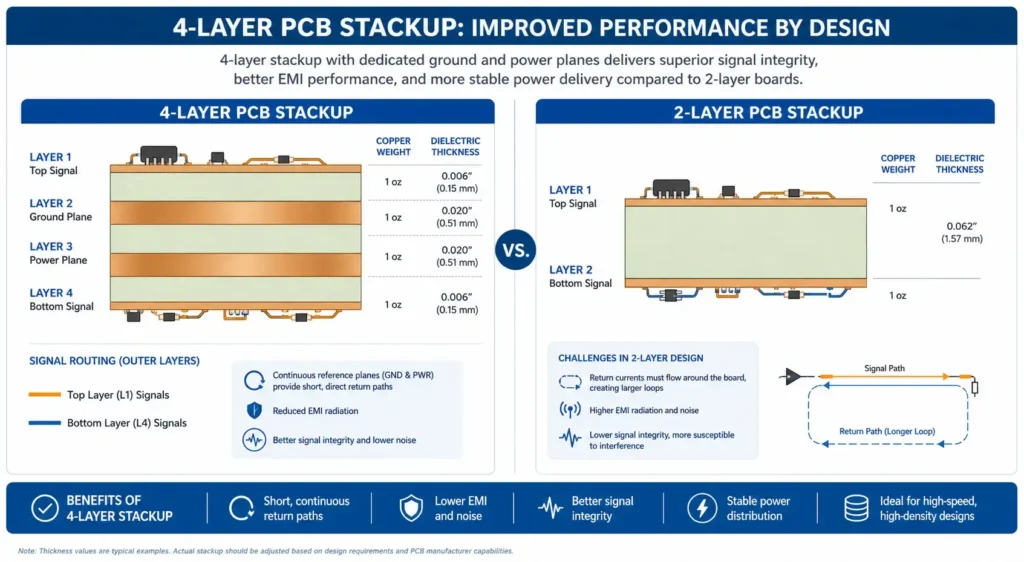
Key Takeaways A 4-layer stack-up typically uses Signal–Ground–Power–Signal (S-G-P-S) arrangement for the best return paths and EMI performance Ground plane placement on layer 2 directly under the top signal layer minimizes loop area for high-speed signals Controlled impedance is achievable on 4-layer boards using top microstrip and bottom microstrip; inner stripline requires an alternate G-S-S-G […]