Why Surface Finish Matters
A PCB surface finish serves three primary functions. First, it protects exposed copper pads from oxidation during storage and shipment. Second, it provides a solderable surface for component attachment during assembly. Third, it ensures reliable mechanical and electrical connections throughout the product’s operational life.
The choice of surface finish influences multiple factors: initial assembly yield, field reliability, signal integrity at high frequencies, wire bonding compatibility, and total manufacturing cost. According to industry standards set by IPC, each surface finish has defined thickness requirements and performance criteria that manufacturers must meet.
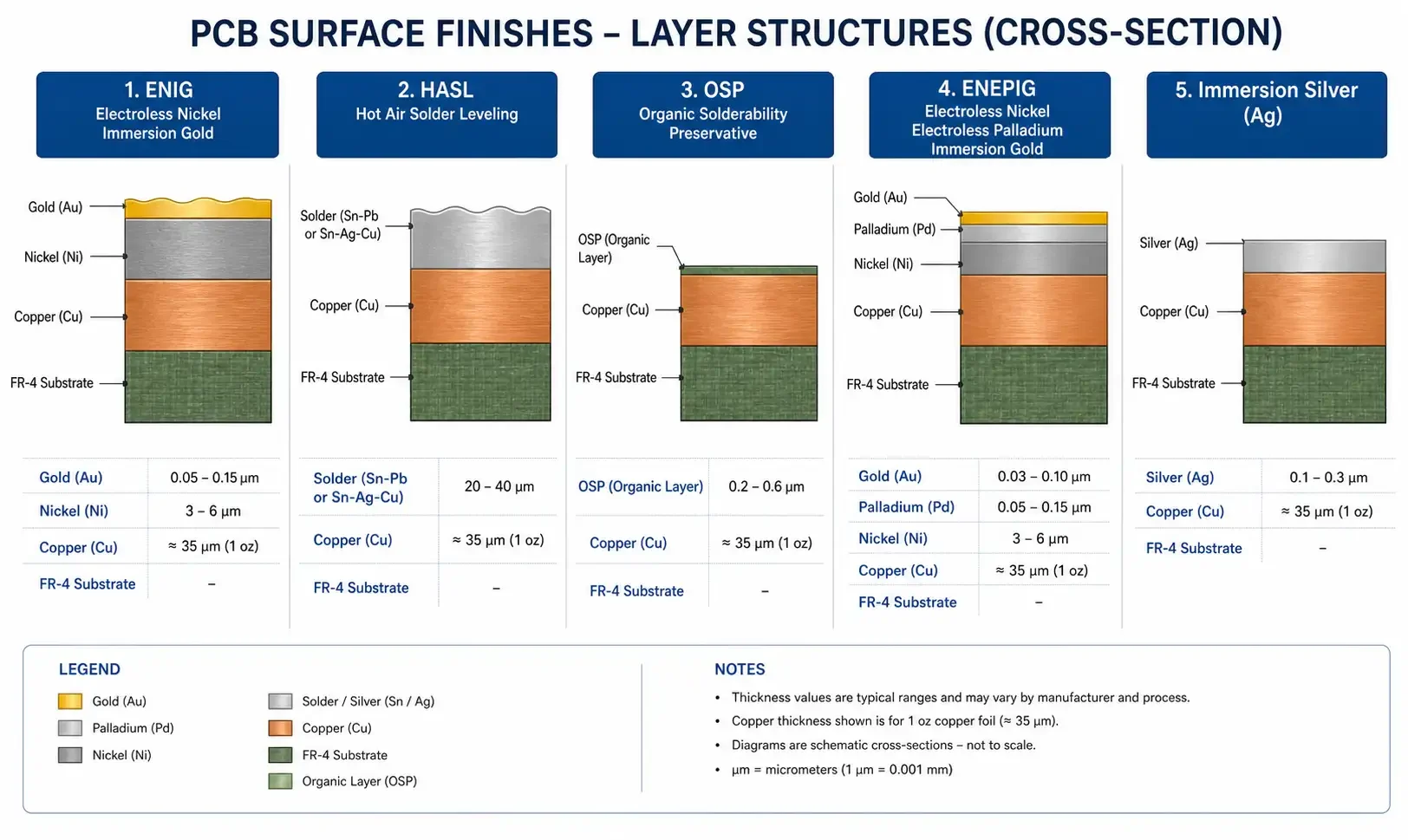
For example, ENIG (Electroless Nickel Immersion Gold) finish must comply with IPC-4552 specifications, which define nickel thickness of 3–6 µm and gold thickness meeting statistical process control requirements. These specifications exist because even minor deviations in finish properties can cause assembly defects or long-term reliability issues.
Overview of Common PCB Surface Finishes
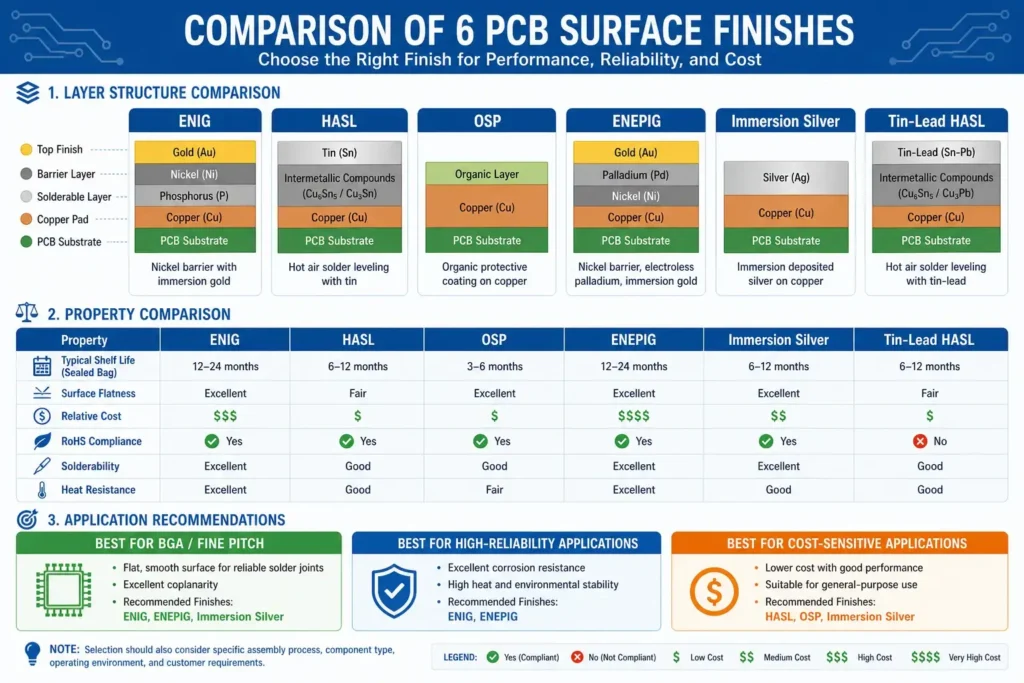
Six surface finishes dominate current PCB manufacturing practice. Each uses a different chemistry and deposition process, resulting in distinct performance characteristics.
Electroless Nickel Immersion Gold (ENIG) applies a layer of electroless nickel followed by a thin immersion gold cap. This process produces an exceptionally flat, uniform surface with excellent solderability and good shelf life.
Lead-Free Hot Air Solder Leveling (LF-HASL) coats the board with lead-free solder (typically tin-copper-nickel) applied via hot air knife leveling. It provides good solderability at moderate cost.
Organic Solderability Preservative (OSP) applies an organic coating that protects copper pads temporarily. It is the lowest-cost finish option and provides excellent coplanarity.
Electroless Nickel Electroless Palladium Immersion Gold (ENEPIG) adds a palladium layer between nickel and gold, enabling both solderability and gold-wire bonding.
Immersion Silver (ImmAg) deposits a thin silver layer directly on copper through an immersion chemical process. It offers good solderability and is RoHS compliant.
Tin-Lead HASL (SnPb HASL) uses traditional tin-lead solder and is not RoHS compliant, but remains available for legacy or military applications.
PCB Surface Finish Comparison Matrix
| Property | ENIG | LF-HASL | OSP | ENEPIG | ImmAg | SnPb HASL |
|---|---|---|---|---|---|---|
| Shelf Life | 12+ months | 6–12 months | 6–12 months | 12+ months | 6–12 months | 12+ months |
| Surface Flatness | Excellent | Fair | Excellent | Excellent | Excellent | Fair |
| Wire Bonding | Yes | No | No | Yes | No | No |
| Solderability | Good | Good | Good | Excellent | Good | Excellent |
| Cost Index | Medium-High | Low | Low | High | Medium | Low |
| RoHS Compliant | Yes | Yes | Yes | Yes | Yes | No |
| Fine-Pitch Suitability | Excellent | Limited | Good | Excellent | Good | Limited |
| High-Frequency Performance | Good | Fair | Good | Good | Good | Fair |
| Multiple Reflow Cycles | Yes | Limited | Single | Yes | Yes | Yes |
| BGA Compatibility | Excellent | Limited | Good | Excellent | Good | Limited |
ENIG: Electroless Nickel Immersion Gold
ENIG is a two-layer metallic finish consisting of electroless nickel (typically 3–6 µm thickness per IPC-4552) capped with a thin immersion gold layer (0.05–0.125 µm typical). The nickel provides a diffusion barrier preventing copper migration, while gold protects the nickel from oxidation and provides a solderable surface.
Advantages of ENIG
- Exceptional surface flatness ideal for BGA and fine-pitch components
- Extended shelf life exceeding 12 months under proper storage
- Excellent for multiple reflow cycles
- Good high-frequency electrical performance
- Supports gold-wire bonding (though aluminum wire is more common)
Limitations of ENIG
- Higher cost compared to HASL and OSP
- Risk of “black pad” nickel corrosion if process is not properly controlled
- Gold thickness must be controlled—excessive gold can cause brittle solder joints
Best Applications for ENIG
- High-density designs with BGA, CSP, and fine-pitch QFP components
- Multilayer boards requiring multiple assembly cycles
- Applications demanding long shelf life before assembly
- High-reliability products in aerospace, medical, and automotive sectors
The IPC-4552B specification provides detailed requirements for ENIG process control, including XRF measurement methodology for thickness verification and acceptance criteria for nickel phosphorus content.
Lead-Free HASL
Lead-free HASL uses tin-based solder alloys (commonly tin-copper-nickel or tin-copper-bismuth) applied through a hot air solder leveling process. The board is immersed in molten solder, then leveled with hot air knives to remove excess material.
Advantages of LF-HASL
- Cost-effective for larger pad sizes and through-hole applications
- Good solderability with proven industry track record
- Excellent for wave soldering and through-hole assembly
- Provides visual inspection of solder coverage
Limitations of LF-HASL
- Uneven surface topography due to hot air leveling process
- Not ideal for fine-pitch BGA or components with small pad sizes
- Thermal stress during processing may affect sensitive components
- Less suitable for multiple reflow cycles
Best Applications for LF-HASL
- Through-hole dominant designs
- Large-pitch components (0.65 mm pitch and larger)
- Cost-sensitive consumer electronics
- Single-reflow assembly processes
OSP: Organic Solderability Preservative
OSP is a water-based organic compound that selectively bonds to exposed copper surfaces, forming a molecular protective layer. This ultrathin coating (typically 0.2–0.5 µm) protects copper from oxidation while remaining solderable during assembly.
Advantages of OSP
- Lowest cost among all surface finishes
- Excellent coplanarity—no uneven surfaces
- RoHS and REACH compliant
- Environmentally preferable chemistry (water-based)
- Multiple processing options (standard, ENTEK, etc.)
Limitations of OSP
- Limited shelf life (typically 6–12 months depending on storage)
- Single thermal exposure—cannot withstand multiple reflow cycles without re-application
- Not suitable for wire bonding applications
- Requires nitrogen purging during soldering for best results
Best Applications for OSP
- High-volume consumer electronics with predictable assembly schedules
- Fine-pitch components where flatness is critical
- Designs with short production cycles and immediate assembly
- Cost-sensitive applications with controlled storage conditions
OSP finish must be specified with assembly timeline in mind. Boards should be assembled within the manufacturer’s stated shelf life to avoid solderability issues.
ENEPIG: Electroless Nickel Electroless Palladium Immersion Gold
ENEPIG adds an electroless palladium layer between the nickel and gold, creating a three-layer finish. The palladium serves as a barrier layer that prevents nickel corrosion (the “black pad” failure mode seen in ENIG) and enables gold-wire bonding in addition to solderability.
Advantages of ENEPIG
- Supports both solder assembly and gold/aluminum wire bonding
- Excellent shelf life and multiple assembly cycle capability
- Reduced risk of nickel corrosion compared to ENIG
- Suitable for aggressive thermal cycling environments
Limitations of ENEPIG
- Highest cost among common surface finishes
- Process complexity requires experienced manufacturers
- Extended processing timeline compared to simpler finishes
Best Applications for ENEPIG
- High-reliability electronics requiring wire bonding
- Complex multilayer boards with mixed assembly processes
- Automotive and aerospace applications with extended temperature range requirements
- Defense and medical electronics with stringent reliability specifications
Immersion Silver
Immersion silver deposits a thin silver layer (typically 0.1–0.4 µm) directly onto copper through an immersion chemical reaction. Silver provides good solderability and electrical conductivity while offering RoHS compliance.
Advantages of Immersion Silver
- Good surface flatness for fine-pitch components
- RoHS compliant without special handling
- Lower cost than ENIG or ENEPIG
- Good high-frequency electrical performance
Limitations of Immersion Silver
- Susceptible to silver migration and whiskering under certain conditions
- Can tarnish or discolor if not properly stored
- Not suitable for wire bonding applications
- May develop surface contamination affecting solderability
Best Applications for Immersion Silver
- High-speed digital applications where signal integrity matters
- Consumer electronics with fine-pitch components
- Applications requiring balance of cost and performance
Tin-Lead HASL
Tin-lead HASL uses traditional 63% tin / 37% lead solder, providing the best solderability of all finishes. However, it is not RoHS compliant and is restricted to specific applications where lead is permitted.
Applications for Tin-Lead HASL
- Legacy electronics and repair/rework operations
- Military and aerospace applications exempt from RoHS
- Through-hole designs where maximum solderability is required
- Products with extended lead-time requirements
Note: Tin-lead HASL should only be specified when regulatory compliance allows or when legacy system compatibility requires it.
How to Choose the Right Surface Finish
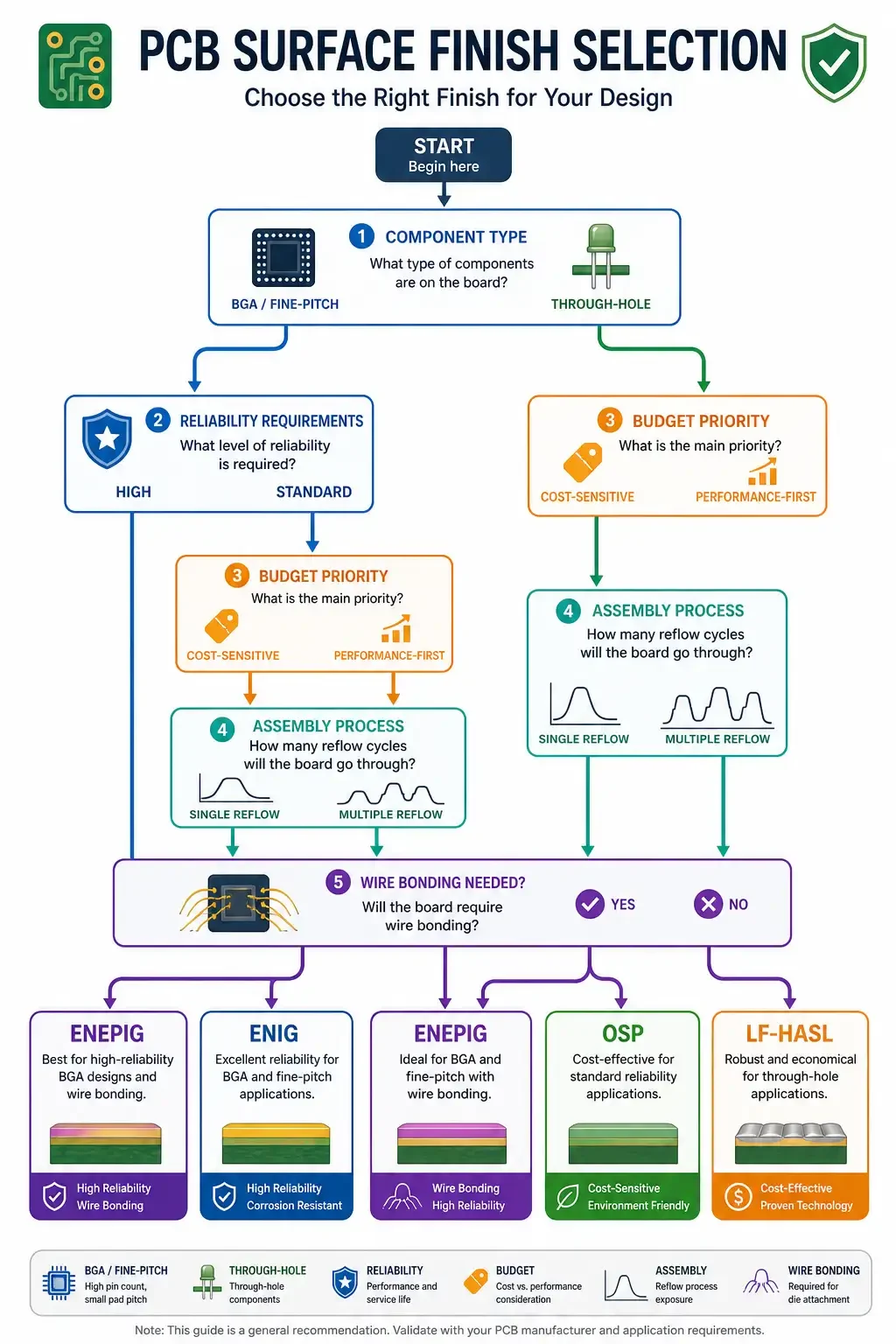
Selecting the optimal surface finish requires balancing multiple factors specific to your application, components, and manufacturing process.
For BGA and Fine-Pitch Components
Choose ENIG, ENEPIG, or OSP. The surface flatness of these finishes ensures proper solder joint formation for fine-pitch components. LF-HASL and SnPb HASL cannot guarantee coplanarity requirements for BGA packages with pitch below 0.65 mm.
For High-Reliability Applications
ENIG or ENEPIG provide the best combination of shelf life, multiple assembly cycle capability, and long-term reliability. ENEPIG is preferred when wire bonding is also required.
For Cost-Sensitive Consumer Electronics
OSP or LF-HASL offer the lowest cost options. OSP is preferred for fine-pitch components; LF-HASL for through-hole dominant designs. Ensure assembly scheduling aligns with OSP shelf life limitations.
For High-Frequency or RF Applications
ENIG or immersion silver provide consistent impedance characteristics. Avoid HASL finishes where surface topography can affect high-frequency signal integrity.
For Wire Bonding Requirements
ENEPIG is the primary choice, with ENIG as a secondary option for aluminum wire bonding. Standard OSP and HASL finishes do not support wire bonding.
For Lead-Free Compliance
All finishes except tin-lead HASL are RoHS compliant. Verify specific alloy compositions with your manufacturer, as some lead-free options may contain restricted substances under specific regulations.
Frequently Asked Questions
Which PCB surface finish is best for BGA components?
ENIG or ENEPIG are the recommended finishes for BGA components. Both provide the flat surface necessary for proper solder joint formation under BGA packages. The flatness of HASL finishes cannot guarantee coplanarity requirements for fine-pitch BGAs, which may result in opens or weak solder joints.
What is the shelf life of OSP-finished PCBs?
OSP-finished PCBs typically have a shelf life of 6–12 months when stored in controlled conditions (sealed packaging, low humidity). Extended storage beyond the manufacturer’s specified shelf life may result in degraded solderability requiring re-cleaning or re-application of OSP before assembly.
Can OSP boards be reworked after multiple reflow cycles?
OSP is designed for single thermal exposure. If boards undergo multiple reflow cycles or require rework, the OSP coating on affected areas will be consumed. Some manufacturers offer “reworkable OSP” formulations, but standard OSP requires careful process control to avoid assembly failures.
What is the difference between ENIG and ENEPIG?
The primary difference is the palladium layer in ENEPIG. This layer acts as a barrier preventing nickel corrosion (black pad) and enables gold-wire bonding. ENIG supports aluminum wire bonding only. For applications requiring gold-wire bonding or where maximum reliability is critical, ENEPIG is the preferred choice despite its higher cost.
Is ENIG worth the extra cost compared to OSP?
For high-density, fine-pitch designs with BGA or QFN components, ENIG’s superior flatness and extended shelf life often justify the cost premium through improved assembly yield and reduced rework. For simpler designs with large-pitch components and short assembly cycles, OSP may be more cost-effective.
References
- IPC-4552B: Electroless Nickel/Immersion Gold (ENIG) Process Specifications for Printed Circuit Boards
https://www.ipc.org/ - IPC-4553B: Electroless Nickel/Immersion Silver (ENIS) Process Specification
https://www.ipc.org/ - IPC-4554: Electroless Nickel/Electroless Palladium/Immersion Gold (ENEPIG) Process Specification
https://www.ipc.org/ - IPC-4555: Performance Specification for Organic Solderability Preservative (OSP)
https://www.ipc.org/
Further Reading
- Custom PCB Manufacturer — Finding the right supplier for your surface finish requirements
- Multilayer PCB Manufacturer — Multilayer boards and finish considerations
- PCB Quote Requirements — How to specify surface finish in your RFQ
- PCB Stack-Up Design — Coordinating materials and impedance with finish selection
Shanghai Huangte Technology Co., Ltd. | Last updated: 2026-07-21
This article provides general technical guidance for PCB surface finish selection. Specific applications may have unique requirements. Consult with your PCB manufacturer for recommendations tailored to your specific design and production needs.