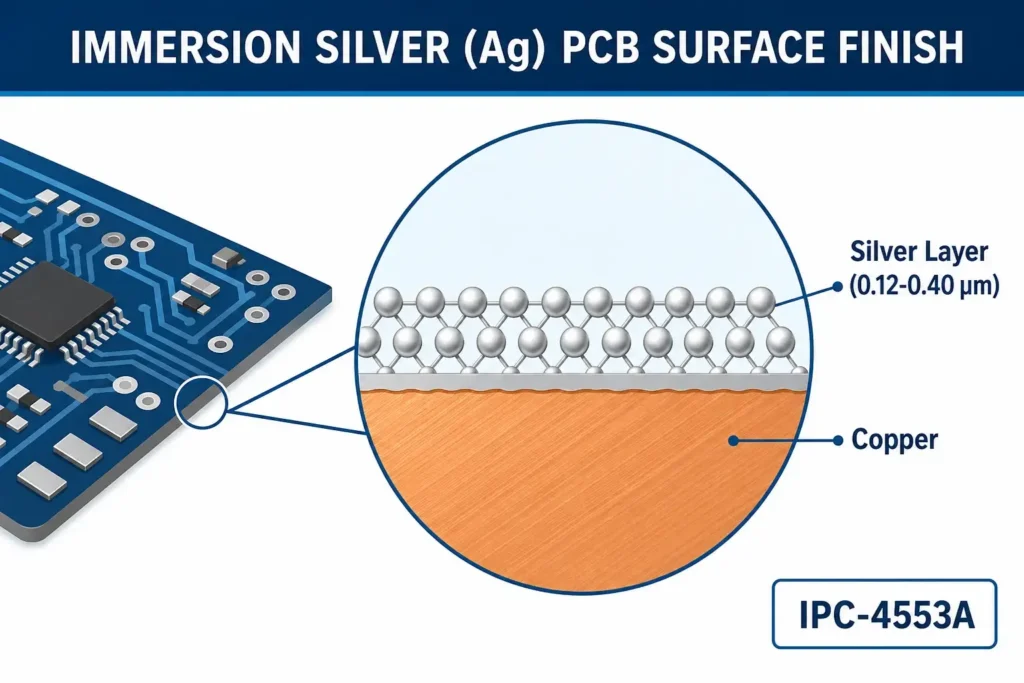
What Is Immersion Silver PCB Finish?
Immersion silver (IAg) is a surface finish applied to printed circuit boards to protect exposed copper pads from oxidation and provide a solderable surface for component assembly. Unlike ENIG, which uses a nickel underlayer, immersion silver deposits pure silver directly onto copper through an electroless (autocatalytic) displacement reaction.
The process is straightforward: when a PCB with exposed copper is immersed in a silver nitrate solution, a chemical reaction causes silver atoms to deposit onto the copper surface. This reaction occurs because silver has a lower ionization tendency than copper—the silver in solution is reduced by copper atoms, which themselves oxidize and go into solution. The reaction naturally stops when the copper surface is completely covered with silver, preventing further deposition and ensuring a uniform coating thickness.
The result is a thin, flat, highly conductive silver layer that offers several advantages over other finishes. According to PCBSync, immersion silver provides “excellent solderability with both SnPb and lead-free alloys” and maintains a flat, coplanar surface suitable for fine-pitch components. The finish is RoHS compliant and widely available from PCB manufacturers worldwide.
Immersion silver is defined by IPC-4553A, “Specification for Immersion Silver Plating for Printed Circuit Boards,” which establishes thickness requirements, process parameters, and quality control measures. This standard ensures consistent performance across manufacturers and provides acceptance criteria for the finish.
The Immersion Silver Process
Understanding the immersion silver process helps engineers specify requirements accurately and recognize quality indicators in fabrication documentation.
Process Chemistry
The immersion silver bath consists primarily of silver nitrate (AgNO₃) in solution with complexing agents, stabilizers, and pH buffers. The complexing agents keep silver ions in solution and control the deposition rate. Stabilizers prevent spontaneous silver precipitation, while pH buffers maintain consistent acidity levels throughout the bath life.
According to IPC-4553A documentation, the process typically operates at temperatures between 50°C and 60°C, with immersion times of 2-4 minutes depending on the desired silver thickness and bath activity. Modern immersion silver solutions have long service lives and are not sensitive to trace halides or light exposure, but require regular monitoring of temperature, pH, and silver concentration.
Process Steps
The complete immersion silver process follows these steps:
- Pre-clean: Remove organic contamination and oxides from copper surface using alkaline cleaning
- Micro-etch: Light etch (1-2 μm copper removal) to activate surface and ensure uniform silver adhesion
- Pre-dip: Acid dip to remove oxides formed after micro-etch and prepare surface for silver bath
- Immersion silver: PCB immersed in silver bath at controlled temperature for specified time
- Rinse: Multiple water rinses to remove residual chemicals
- Drying: Forced-air drying to prevent water spots and moisture retention
Quality Parameters
Critical quality parameters that affect immersion silver performance include silver thickness, bath temperature, pH level, and silver concentration. Thickness is measured using X-ray fluorescence (XRF) spectroscopy on a standardized 1.5mm × 1.5mm test pad as specified by IPC-4553A.
According to IPC-4553A Rev A (2009 revision), the silver thickness specification is:
- Minimum: 0.12 μm (5 microinches) at -4σ from process mean
- Maximum: 0.40 μm (16 microinches) at +4σ from process mean
- Typical target range: 0.20-0.30 μm (8-12 microinches)
Thickness below the minimum risks copper oxidation during assembly, while excessive thickness may weaken solder joints. The specification change from the original 2005 IPC-4553 to Rev A eliminated the distinction between “thin” and “thick” silver products and introduced an upper limit to ensure consistent solder joint reliability.
Post-Process Handling
Immediately after fabrication, immersion silver boards require proper packaging to prevent tarnish. Boards should be packed within 24 hours of plating in sulfur-free, vacuum-sealed packaging with desiccant. The packaging should include humidity indicator cards (target: below 30% RH) and clearly mark the manufacturing date. Shelf life is 12 months maximum per IPC J-STD-003 when handled correctly.
Key Advantages of Immersion Silver
Immersion silver offers several performance and commercial advantages that make it suitable for specific applications.
Superior High-Frequency Performance
The most significant advantage of immersion silver over ENIG is its superior signal performance at high frequencies. According to AtlasPCB, “the nickel underlayer (3-5μm) introduces additional insertion loss above 5 GHz due to nickel’s high magnetic permeability.” At 10 GHz, expect 0.02-0.05 dB/inch more loss compared to immersion silver.
For RF and microwave applications above 5 GHz, immersion silver provides the lowest insertion loss of any standard finish. The signal path is copper-to-silver with no ferromagnetic nickel layer to introduce eddy current losses. This makes immersion silver the preferred choice for RF front-end modules, 5G antenna systems, and high-speed digital designs operating at 25+ Gbps.
Excellent Solderability
Immersion silver provides excellent solderability with both traditional tin-lead (SnPb) and lead-free alloys. According to PCBSync, “silver dissolves rapidly into solder, creating clean metallurgical bonds” with wetting forces exceeding 1.5 mN within 2 seconds. The fresh silver surface ensures reliable wetting even after moderate storage periods.
The flat, coplanar surface of immersion silver supports fine-pitch component assembly. Surface roughness typically ranges from 0.05-0.15 μm Ra, which is suitable for BGA packages at 0.5mm pitch and above. For ultra-fine-pitch BGAs (0.4mm and below), ENIG’s superior planarity (0.05-0.10 μm Ra) becomes advantageous.
Cost-Effectiveness
Immersion silver costs 8-15% more than HASL but 15-30% less than ENIG. According to AtlasPCB, “the cost gap between Immersion Silver and ENIG narrows at higher volumes because the fixed chemistry costs are amortized over more boards. At 10,000+ pieces, expect the difference to shrink to 10-15%.”
The lower cost compared to ENIG comes from fewer process steps (no nickel bath, no gold displacement) and lower material costs (silver nitrate versus nickel sulfate and gold chloride). This makes immersion silver attractive for cost-sensitive consumer electronics and high-volume production runs where ENIG’s additional benefits are unnecessary.
Environmental Compliance
Immersion silver is fully RoHS compliant and does not contain lead, hexavalent chromium, or other restricted substances. The process uses relatively benign chemicals compared to some alternatives, and the thin silver deposit minimizes precious metal usage. For companies with environmental compliance requirements, immersion silver meets all current directives.
Limitations and Considerations
Immersion silver has specific limitations that restrict its suitability for certain applications.
Shelf Life Constraints
Immersion silver boards have a limited shelf life of 6-12 months, compared to 12+ months for ENIG. According to IPC-4553A, “exposure to moisture and air contaminants, such as sulfur and chlorine, may negatively impact the useful life of the deposit. The impact can range from a slight discoloration of the deposit to the pads turning completely black.”
Silver tarnishes rapidly when exposed to hydrogen sulfide (H₂S), carbonyl sulfide (COS), and other sulfur compounds present in atmospheric pollution. High humidity accelerates the reaction. Proper packaging (vacuum-sealed anti-tarnish bags with desiccant) is essential, and boards should be assembled within 6 months for best results.
Reflow Cycle Limitations
Immersion silver is suitable for 2-3 reflow cycles maximum. According to AtlasPCB, “the silver layer degrades with multiple thermal cycles as the surface oxidizes and intermetallic compounds form.” For complex assemblies requiring multiple reflow passes or selective assembly processes, ENIG’s tolerance of 4-6 reflow cycles makes it a more reliable choice.
Sulfide Sensitivity
In high-sulfur environments, immersion silver is prone to creep corrosion. According to AtlasPCB, “creep corrosion risk exists in industrial settings near paper mills, volcanic regions, or other high-sulfur atmospheres.” For applications in such environments, ENIG or alternative finishes provide better long-term reliability.
Not Wire Bondable
Immersion silver cannot be used for wire bonding applications. Gold wire bonding requires an ENIG or Hard Gold surface, as the silver-to-gold interface does not provide reliable bond adhesion. If your design includes wire-bonded ICs or test points, specify ENIG or discuss alternative finishes with your manufacturer.
Immersion Silver vs Other Surface Finishes
The following comparison table summarizes key differences between immersion silver and other common PCB surface finishes.
| Parameter | Immersion Silver | ENIG | OSP | HASL |
|---|---|---|---|---|
| Silver/Nickel thickness | 0.12-0.40 μm Ag | 3-6 μm Ni + 0.05-0.15 μm Au | N/A (organic coating) | 25-50 μm solder |
| Shelf life | 6-12 months | 12+ months | 3-6 months | 12+ months |
| Reflow cycles | 2-3 | 4-6 | 1-2 | Unlimited |
| Signal loss at RF | Lowest | Moderate (Ni loss) | Lowest | Low |
| Planarity | Good (0.05-0.15 μm Ra) | Excellent (0.05-0.10 μm Ra) | Excellent | Uneven |
| Wire bonding | No | Yes (Au wire) | No | No |
| Cost vs HASL | +8-15% | +20-35% | -10% to +5% | Baseline |
| Fine-pitch BGA | Acceptable (≥0.5mm) | Preferred (≤0.4mm) | Acceptable | Not recommended |
| IPC standard | IPC-4553A | IPC-4552B | IPC-7802 | J-STD-003 |
When to Choose Immersion Silver
Choose immersion silver when:
- Your design operates above 5 GHz and signal integrity is critical
- You need better high-frequency performance than ENIG provides
- Your board will be assembled within 6 months of manufacture
- You require RoHS compliance at moderate cost
- Your design uses BGAs at 0.5mm pitch or larger
- You need a cost-effective alternative to ENIG with most of its benefits
When to Choose ENIG Instead
Choose ENIG when:
- Your boards must remain in storage for 12+ months before assembly
- Your design requires wire bonding capability
- You use ultra-fine-pitch BGAs (0.4mm or below)
- Your assembly process requires 4+ reflow cycles
- Long-term reliability in harsh environments is critical
- You cannot guarantee controlled storage conditions
Applications and Use Cases
Immersion silver suits specific applications where its advantages outweigh its limitations.
RF and Microwave Applications
For RF applications above 5 GHz, immersion silver provides measurable performance advantages. According to AtlasPCB, “at 10 GHz on standard FR-4, the nickel layer in ENIG adds approximately 0.02-0.05 dB/inch of additional insertion loss.” For low-noise amplifier front ends, filter structures, and antenna feed networks in 5G and radar systems, this difference is meaningful.
At 25+ Gbps data rates for SerDes links, immersion silver gives measurable margin for designs with tight loss budgets. If your trace lengths exceed 2 inches at these frequencies, immersion silver is the technically superior choice.
Consumer Electronics
Consumer electronics with moderate shelf life requirements (6 months or less) benefit from immersion silver’s cost advantage over ENIG. Smartphones, gaming devices, and IoT products with high-volume production runs can achieve significant cost savings while maintaining assembly quality.
The flat surface of immersion silver supports dense BGA and QFN packages common in consumer electronics. For cost-sensitive designs that can control their supply chain timeline, immersion silver provides excellent value.
LED Lighting
Silver has higher reflectivity (95%+) than gold at visible wavelengths, making immersion silver preferred for LED PCBs where the board surface contributes to light output. According to AtlasPCB, “silver has higher reflectivity at visible wavelengths, making Immersion Silver preferred for LED PCBs.”
For LED lighting applications without extended storage requirements, immersion silver offers both performance and commercial advantages.
Automotive Radar
Automotive radar modules at 24 GHz and 77 GHz require immersion silver or OSP on high-frequency materials like Rogers substrates. According to AtlasPCB, “for automotive radar modules (24 GHz, 77 GHz), Immersion Silver or OSP on Rogers materials is standard because the nickel loss is unacceptable at millimeter-wave frequencies.”
If your automotive design operates at these frequencies, immersion silver on appropriate substrates provides the required signal performance.
Storage and Handling Guidelines
Proper storage and handling maximize immersion silver shelf life and ensure reliable assembly.
Packaging Requirements
Upon receipt from the manufacturer, immersion silver boards should remain in their original anti-tarnish packaging until assembly. According to PCBSync, specify the following in your fabrication notes: “Surface Finish: Immersion Silver per IPC-4553A, thickness 0.12-0.40 μm (typical 0.20-0.30 μm). Boards to be packed within 24 hours of plating in sulfur-free, vacuum-sealed packaging with desiccant. Manufacturing date to be marked on packaging. Shelf life: 12 months maximum.”
Storage Conditions
Store immersion silver boards in climate-controlled environments with low humidity (below 30% RH) and minimal sulfur compounds. Do not open anti-tarnish bags until immediately before assembly. If humidity indicator cards show moisture exposure, inspect boards for surface discoloration before use.
Handling Precautions
Wear gloves when handling immersion silver boards. Sulfur compounds from skin oils accelerate tarnish formation. Handle boards by edges only and avoid touching pad surfaces. Static-sensitive boards require standard ESD precautions throughout storage and assembly.
Quality Verification
Before assembly, inspect immersion silver boards for discoloration, tarnish, or oxidation. Light golden-brown discoloration is normal and does not affect solderability. Dark spots, black pads, or greenish discoloration indicate contamination or extended storage—these boards may require re-plating or should be rejected.
Decision Flowchart
Use this decision logic to select immersion silver or an alternative finish:
- Does your design require wire bonding? If yes → Use ENIG or Hard Gold.
- Does your design operate above 5 GHz with trace lengths exceeding 1 inch? If yes → Use Immersion Silver (or OSP if shelf life is not a concern).
- Will assembled boards sit in inventory for more than 6 months before use? If yes → Use ENIG.
- Does your BOM include BGAs at 0.4mm pitch or finer? If yes → Use ENIG.
- Is cost a primary driver with manageable logistics? If yes → Use Immersion Silver.
- Is your application high-frequency radar (24/77 GHz)? If yes → Use Immersion Silver on appropriate substrates.
If you cannot answer these questions definitively, ENIG is the safer default choice that works across most applications.
Frequently Asked Questions
Q1: What is the shelf life of immersion silver PCBs?
Immersion silver PCBs have a shelf life of 6-12 months when stored in sealed anti-tarnish packaging with desiccant. The IPC J-STD-003 standard specifies 12 months maximum shelf life for Class 2 applications when handled per IPC-4553A requirements. For best solderability, assemble boards within 6 months of manufacture. Exposure to high humidity or sulfur compounds reduces effective shelf life.
Q2: Can immersion silver be used for wire bonding?
No. Immersion silver cannot be used for wire bonding. Wire bonding requires ENIG (for gold wire) or aluminum wire bonding on aluminum pad structures. The silver surface does not provide reliable bond adhesion for gold or aluminum wire. If your design includes wire-bonded ICs or test points, specify ENIG or Hard Gold instead.
Q3: How does immersion silver compare to ENIG for high-frequency applications?
Immersion silver provides superior signal performance above 5 GHz compared to ENIG. The nickel barrier layer in ENIG introduces magnetic permeability losses (approximately 0.02-0.05 dB/inch at 10 GHz). At 25+ Gbps data rates or RF frequencies above 5 GHz, immersion silver’s lower insertion loss provides meaningful performance advantages. For standard frequencies below 3 GHz, the difference is negligible.
Q4: What IPC standards apply to immersion silver?
The primary standard is IPC-4553A, “Specification for Immersion Silver Plating for Printed Circuit Boards.” This standard defines thickness requirements (0.12-0.40 μm), process parameters, and quality control measures. IPC J-STD-003 covers solderability testing, and IPC-6012 addresses rigid PCB qualification and performance requirements. The Global Electronics Association (formerly IPC) maintains these standards at electronics.org.
Q5: Why does immersion silver tarnish?
Immersion silver tarnishes due to chemical reactions with atmospheric contaminants, primarily hydrogen sulfide (H₂S) and other sulfur compounds. Silver sulfide (Ag₂S) forms on the surface, initially appearing as discoloration and potentially progressing to black spots in severe cases. High humidity accelerates tarnishing. Proper packaging (vacuum-sealed anti-tarnish bags with desiccant) and controlled storage conditions prevent tarnish formation.
Q6: Is immersion silver RoHS compliant?
Yes. Immersion silver is fully RoHS (Restriction of Hazardous Substances) compliant. It does not contain lead, mercury, cadmium, hexavalent chromium, polybrominated biphenyls (PBB), or polybrominated diphenyl ethers (PBDE). The finish meets all current environmental directives for electronics in the EU and other jurisdictions with similar regulations.
References
- IPC-4553A: Specification for Immersion Silver Plating for Printed Circuit Boards. Global Electronics Association (formerly IPC).
https://www.electronics.org/ - IPC J-STD-003: Solderability Tests for Printed Boards. Global Electronics Association.
- IPC-4552B: Specification for Electroless Nickel/Immersion Gold (ENIG) Plating for Printed Circuit Boards. Global Electronics Association.
- PCBSync. “Immersion Silver PCB Finish: Complete Guide to Process, Benefits & Best Practices.”
https://pcbsync.com/immersion-silver-pcb/ - AtlasPCB. “Immersion Silver vs ENIG: Surface Finish for High Reliability.”
https://www.atlaspcb.com/blog/immersion-silver-vs-enig-surface-finish-high-reliability/ - Hemeixin PCB. “HASL vs. ENIG vs. Immersion Silver.”
https://www.hemeixinpcb.com/company/news/hasl-vs-enig-vs-immersion-silver.html - AllPCB. “Is Immersion Silver the Right Choice for Your PCB?”
https://www.allpcb.com/blog/pcb-knowledge/is-immersion-silver-the-right-choice-for-your-pcb-a-comprehensive-comparison-with-enig.html
Further Reading
- PCB Surface Finish Comparison: ENIG, HASL, OSP, ENEPIG — Comprehensive guide to all PCB surface finishes
- ENIG vs ENEPIG: Premium PCB Surface Finishes Compared — Detailed comparison of nickel-gold finishes
- OSP vs HASL: PCB Surface Finish Selection Guide — Alternative finish comparison
- Custom PCB Manufacturer: How to Choose the Right Partner — Finding a qualified PCB supplier for your finish requirements
- PCB Quote Requirements: Files and Specifications Needed — Specifying immersion silver in your RFQ
Shanghai Huangte Technology Co., Ltd. | Last updated: 2026-07-25
This article is for informational purposes and does not constitute professional engineering or legal advice. Specific PCB requirements should be verified with qualified manufacturers and reviewed by a licensed professional engineer.