Understanding Budget-Friendly Surface Finishes
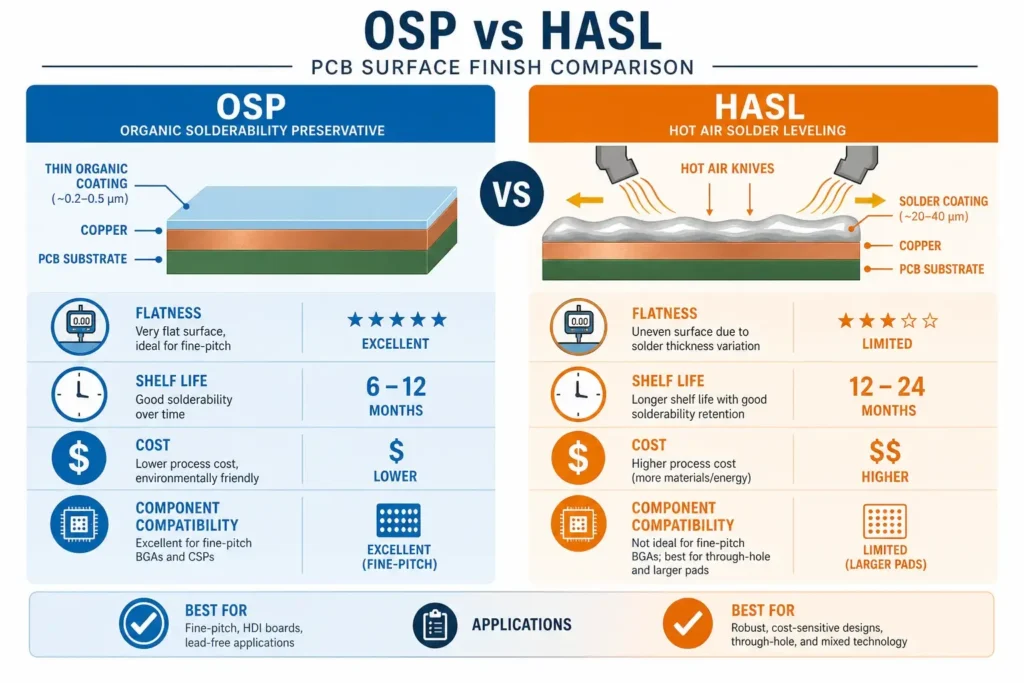
Surface finishes serve three critical functions in PCB manufacturing: protecting exposed copper from oxidation, maintaining solderability during storage and assembly, and providing a reliable interface for solder joint formation. Among the available options, OSP and HASL stand out as the most cost-effective choices, making them popular for consumer electronics, industrial controls, and budget-sensitive applications where extreme environmental conditions are not a primary concern.
The global PCB surface finish market continues to evolve as lead-free regulations drive adoption of alternative coatings. According to industry analysis, lead-free HASL has gained significant market share since RoHS compliance became mandatory, while OSP usage has expanded due to its environmental benefits and compatibility with lead-free assembly processes. Understanding the fundamental differences between these finishes enables engineers to make informed decisions that balance technical requirements with economic constraints.
Both OSP and HASL have established track records spanning decades of industrial use. HASL dominated PCB finishing from the 1970s through the early 2000s, while OSP emerged in the 1990s as a lead-free compatible alternative. Today, manufacturers offer both options, and the choice often depends on specific application requirements, assembly capabilities, and supply chain considerations.
What is OSP (Organic Solderability Preservative)
OSP, formally known as Organic Solderability Preservative and sometimes referenced by the brand name Entek, is a water-based organic compound that forms a thin, uniform coating over exposed copper surfaces. The organic molecules bond to copper atoms, creating a protective layer typically ranging from 0.1 to 0.6 microns in thickness. This coating is essentially invisible, preserving the copper’s original surface characteristics while preventing oxidation during storage.
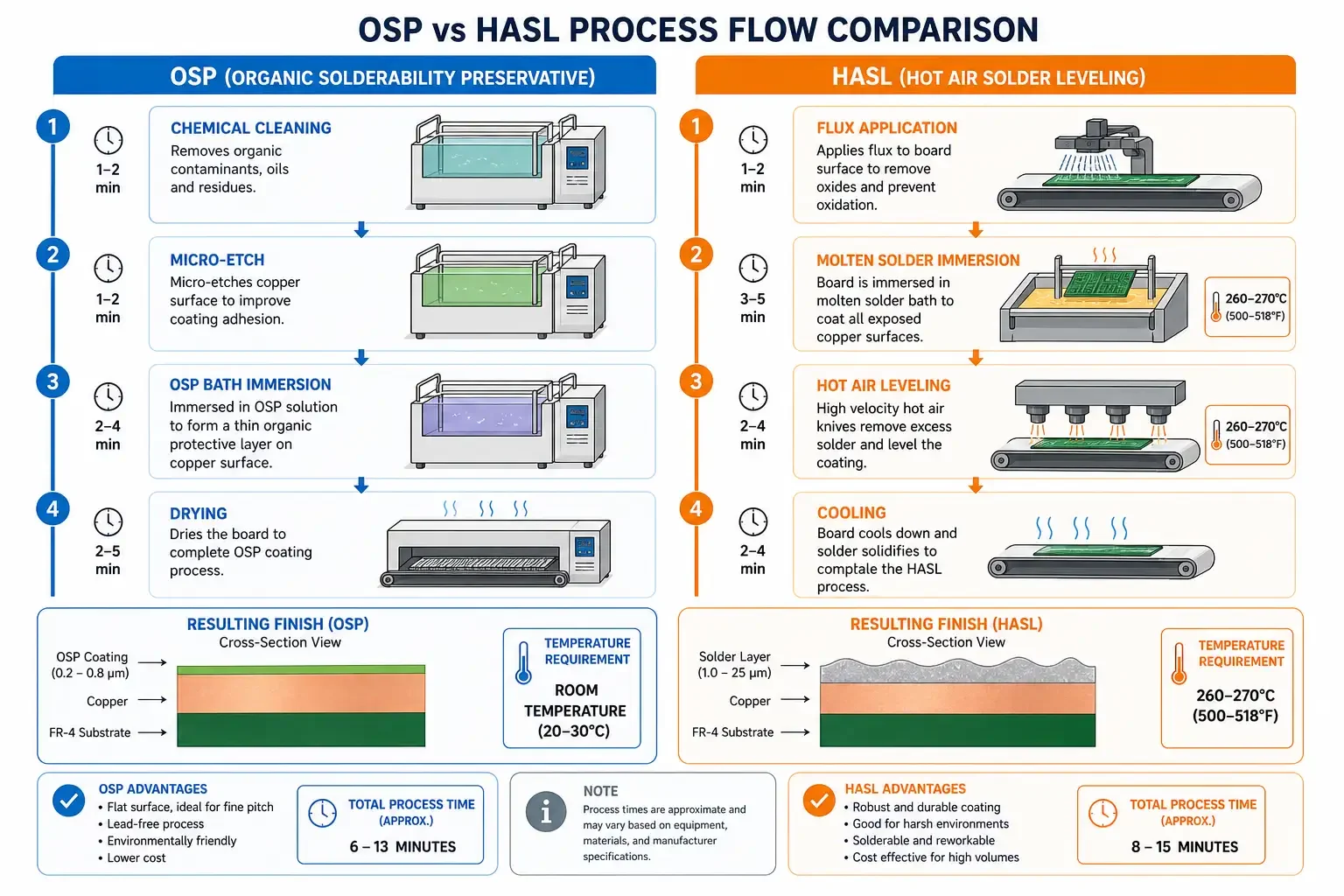
The OSP application process involves multiple stages: chemical cleaning to remove oxides, micro-etching to ensure proper adhesion, and immersion in the OSP solution bath. The coating forms through a self-limiting reaction that naturally terminates when the copper surface is fully covered, ensuring consistent thickness across the board. Following application, boards undergo drying in controlled environments to cure the coating and ensure proper bonding.
OSP formulations have evolved significantly since their introduction. First-generation benzotriazole-based treatments offered basic protection but limited shelf life. Second-generation imidazole derivatives provided improved storage stability and thermal resistance. Modern third-generation OSP chemistries incorporate proprietary additives that enhance multiple reflow cycle compatibility and improve resistance to handling damage. These advances have expanded OSP applicability beyond initial single-reflow limitations.
The organic coating performs a critical function during assembly: it dissolves or decomposes when exposed to flux activators and solder at elevated temperatures, exposing fresh copper for immediate wetting. This mechanism enables rapid solder joint formation while leaving no residual coating material that could interfere with joint integrity. However, once the coating is consumed, the underlying copper becomes vulnerable to re-oxidation, necessitating careful process control.
OSP finish provides several notable advantages that make it attractive for specific applications. The coating produces an exceptionally flat surface that supports accurate component placement and reflow, particularly beneficial for BGA and QFN packages. The process is environmentally preferable, using water-based chemistry without heavy metals. Component rework remains straightforward, as fresh OSP can be applied to repaired areas. Additionally, OSP does not introduce additional lead or other restricted materials, simplifying RoHS compliance documentation.
What is HASL (Hot Air Solder Leveling)
HASL is a PCB surface finish that applies a layer of solder to exposed copper through a controlled immersion and leveling process. The technique involves dipping boards into a molten solder pot—historically Sn63Pb37 (63% tin, 37% lead) and now commonly SAC305 (96.5% tin, 3% silver, 0.5% copper) for lead-free compliance—followed by rapid removal and leveling with precision hot air knives. This process produces a solder coating typically measuring 1-3 mils (25-75 microns) in thickness.
The HASL process requires careful temperature and timing control to achieve consistent results. Lead-free HASL operates at approximately 260-270°C, significantly higher than the 235°C typical for tin-lead processing. The higher temperature presents challenges including increased board warp, potential delamination in multilayer boards, and greater stress on sensitive components. These thermal considerations influence material selection and process parameters.
Hot air leveling creates characteristic surface topography that distinguishes HASL from other finishes. The solder surface exhibits a slightly irregular texture, with variations across the board depending on copper density and geometry. Dense copper areas tend to retain more solder, while sparse regions may show thinner coverage. This inherent unevenness, while acceptable for many applications, precludes use with fine-pitch components where coplanarity is critical.
HASL finish demonstrates exceptional durability throughout board lifecycle. The solder coating provides robust protection against oxidation, scratches, and handling damage during assembly, test, and field service. Unlike organic coatings that degrade over time, solder remains stable under normal storage conditions, extending practical shelf life without specialized packaging. This durability simplifies logistics and reduces quality concerns related to surface preparation.
The finish exhibits excellent solderability across diverse assembly scenarios. Solder’s inherent metallurgical compatibility with component terminations ensures reliable joint formation without requiring aggressive flux formulations. HASL surfaces tolerate multiple reflow cycles, handling, and rework operations without significant degradation. For applications requiring assembly flexibility or field repairs, this robustness proves valuable.
OSP vs HASL: Key Differences
Understanding the fundamental differences between OSP and HASL enables informed selection based on specific application requirements. The following comparison examines critical parameters that influence finish selection for typical PCB applications.
| Parameter | OSP | HASL |
|---|---|---|
| Thickness | 0.1-0.6 microns | 25-75 microns (1-3 mils) |
| Surface Flatness | Excellent | Moderate (slightly uneven) |
| Shelf Life | 6-12 months | 12-24 months |
| Storage Requirements | Controlled humidity, vacuum sealed | Standard warehouse conditions |
| Fine-Pitch Compatibility | Excellent (<0.3mm pitch) | Limited (>0.5mm pitch) |
| BGA Suitability | Excellent | Not recommended |
| Multi-Reflow Tolerance | Limited (1-2 cycles) | Excellent (multiple cycles) |
| Reworkability | Requires reapplication | Excellent |
| Lead Content | None (lead-free) | SnPb or SAC variants |
| Environmental Impact | Low (water-based) | Moderate (heavy metal) |
| Cost | Comparable | Comparable |
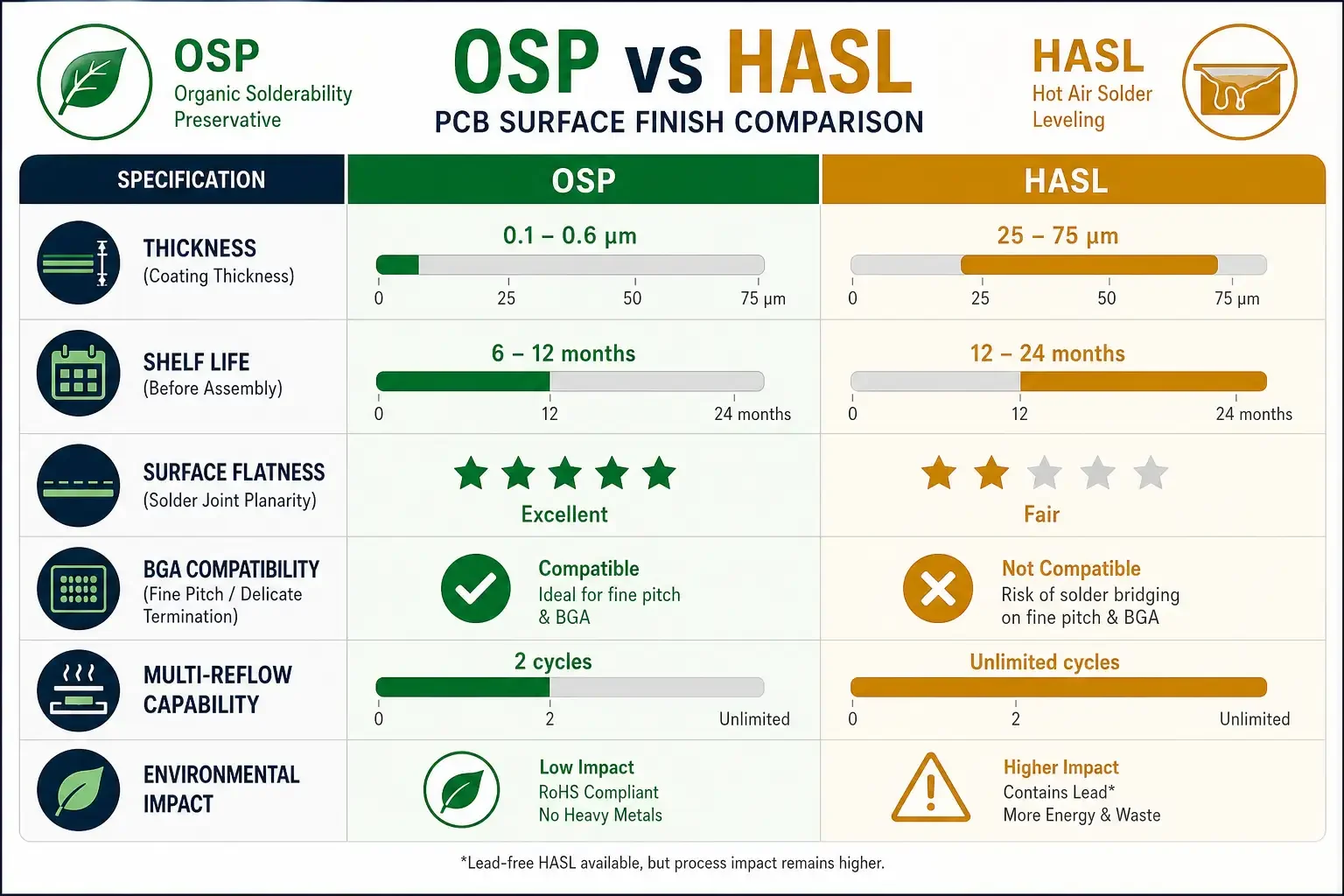
The comparison reveals distinct strengths for each finish. OSP excels in applications requiring superior surface flatness, fine-pitch component support, and environmental responsibility. HASL provides unmatched durability, extended shelf life, and tolerance for demanding assembly environments.
Thickness differences significantly impact assembly outcomes. OSP’s angstrom-level coating contributes no measurable height variation, maintaining coplanarity across the board. HASL’s microns-thick coating introduces cumulative variations that become significant for precision assemblies. Component placement equipment must accommodate these differences in pick-and-place programming and reflow profile development.
Shelf Life Comparison
Shelf life represents a critical consideration for inventory management and supply chain optimization. HASL finish provides substantial advantages in this area, maintaining solderability under standard warehouse conditions for extended periods. The solder coating’s metallurgical stability resists oxidation and environmental degradation, enabling boards to remain assembly-ready for 12-24 months with minimal protection.
OSP presents more demanding storage requirements. The organic coating, while effective initially, gradually degrades under environmental exposure. Typical shelf life ranges from 6-12 months depending on storage conditions and coating formulation. Humidity control proves essential, as moisture penetration can accelerate coating degradation. Many manufacturers specify nitrogen storage for extended OSP board retention.
Temperature cycling during storage affects both finishes differently. HASL maintains stability across typical storage temperature ranges, though extreme conditions may promote intermetallic growth that eventually affects solderability. OSP coatings show greater sensitivity to temperature-humidity combinations, with elevated conditions accelerating degradation through moisture-driven oxidation pathways.
Vacuum packaging significantly extends OSP shelf life by isolating environmental exposure. Sealed moisture barrier bags with desiccant protect boards during transit and storage, enabling longer retention before assembly. This requirement adds packaging cost but remains standard practice for quality-conscious manufacturers. HASL boards typically require only basic anti-static packaging, reducing logistics complexity.
For just-in-time manufacturing scenarios, both finishes accommodate compressed inventory cycles. OSP proves advantageous when rapid turnover prevents shelf life concerns, while HASL better supports extended storage requirements for seasonal products or distributed manufacturing models. Supply chain planners should align finish selection with anticipated inventory turns and storage capabilities.
Assembly Process Compatibility
Assembly compatibility depends on component types, reflow profiles, and process control capabilities. OSP demonstrates excellent compatibility with modern lead-free assembly processes, tolerating peak temperatures of 245-260°C without coating deterioration. The organic material decomposes cleanly during reflow, leaving no residue that could interfere with joint formation. Flux activation supports complete solder wetting within standard profile durations.
Fine-pitch component placement benefits substantially from OSP’s flat surface characteristics. BGA packages, QFN devices, and components with pitch below 0.5mm require highly planar surfaces for reliable self-alignment during reflow. OSP provides the necessary topography, reducing placement requirements and improving yield for these challenging packages. Many high-density consumer electronics manufacturers specify OSP exclusively for this reason.
HASL processing requires consideration of its surface topography during component placement. Standard placement equipment accommodates typical HASL variations, but tight tolerances may require adjustment or verification. Fine-pitch components with pitch below 0.5mm generally should not be placed on HASL surfaces due to coplanarity concerns. Designers should specify OSP or alternative finishes when fine-pitch assembly is anticipated.
Lead-free HASL introduces thermal challenges absent in traditional tin-lead processing. The higher liquidus temperature of SAC alloys (approximately 217°C compared to 183°C for SnPb) requires extended time above liquidus and greater cumulative thermal exposure. These conditions may affect sensitive components, multilayer board integrity, and fine-pitch features. Process engineers should verify compatibility through thermal profiling and reliability testing.
Multiple assembly stages favor HASL durability. Boards undergoing selective soldering, hand repairs, or multiple production lots benefit from HASL’s robust surface that tolerates repeated thermal exposure without degradation. OSP boards may require coating reapplication between assembly stages if extended processing time exceeds coating stability limits. These constraints influence production scheduling and quality assurance protocols.
Application Suitability
OSP finish serves diverse applications where surface flatness and environmental considerations take priority. Consumer electronics including smartphones, tablets, and wearable devices predominantly use OSP due to high component density and fine-pitch requirements. The finish supports the miniaturization trends driving these products while maintaining cost competitiveness. Computer peripherals, automotive electronics, and industrial controls similarly benefit from OSP characteristics.
High-density interconnect (HDI) designs essentially mandate OSP usage for optimal yield and reliability. Microvia-in-pad configurations, build-up multilayer structures, and ultrafine-pitch components require finishes that preserve dimensional precision throughout manufacturing. OSP’s angstrom-level thickness introduces no measurable contribution to stack-up variations, making it the preferred choice for advanced packaging applications.
HASL finish remains appropriate for applications where component pitch, thermal durability, and shelf life outweigh fine-pitch requirements. Through-hole dominant designs, large-pitch surface mount assemblies, and products with extended field life requirements benefit from HASL characteristics. Industrial control systems, power electronics, and automotive modules without fine-pitch components frequently specify HASL for its proven reliability.
Automotive applications demonstrate the trade-off between finish options based on specific requirements. Under-hood electronics exposed to temperature extremes and vibration benefit from HASL’s robust coating. Infotainment systems with high-density assemblies may prefer OSP for fine-pitch component support. Automotive manufacturers often qualify both finishes for different product lines based on respective requirements.
Cost-sensitive applications with straightforward assembly requirements often default to HASL due to its forgiving nature and established supply chain. While OSP pricing has converged with HASL in recent years, total cost of ownership considerations—including storage, handling, and yield impacts—may favor HASL for appropriate applications. Process engineers should conduct total cost analysis rather than focusing solely on finish pricing.
Cost Analysis
Surface finish costs encompass more than per-board pricing, including processing efficiency, storage requirements, and yield impacts. OSP and HASL pricing have converged significantly as manufacturing processes matured, with typical pricing within 5-10% for equivalent board quantities. Large-volume orders may see smaller differentials, while prototype and small-batch orders show greater variation based on process setup requirements.
Processing cost factors favor each finish differently. OSP application requires controlled chemical processes with precise bath management and waste treatment, contributing to operational overhead. HASL processing demands specialized equipment with solder pot maintenance, air knife calibration, and flux management. Both processes have established cost structures, with specific advantages depending on production volume and facility capabilities.
Storage and inventory carrying costs differ substantially between finishes. HASL’s extended shelf life reduces inventory obsolescence risk and simplifies logistics, potentially offsetting higher finish pricing through inventory efficiency gains. OSP’s limited shelf life requires tighter inventory control, potentially increasing carrying costs for distributors and assemblers maintaining buffer stocks.
Yield impacts influence total cost significantly. OSP’s flat surface typically produces higher assembly yields for fine-pitch components, reducing rework and scrap costs that may exceed finish price differentials. HASL’s excellent solderability minimizes wetting failures, particularly beneficial for assemblies with challenging geometries or marginal solderability margins. Process capability assessment should inform finish selection economics.
Quality assurance costs vary with finish characteristics. OSP requires incoming inspection verification and storage condition monitoring that may increase QC overhead. HASL’s durable coating tolerates handling and test probing with minimal damage risk, simplifying quality procedures. However, OSP defects are typically caught during assembly, while HASL issues may manifest later in test or field service, influencing warranty and customer satisfaction costs.
IPC Standards for Surface Finishes
Surface finish quality is governed by industry standards that establish acceptance criteria, performance requirements, and testing methodologies. IPC-4555 addresses OSP performance specifications, defining coating thickness, appearance requirements, and solderability thresholds. Compliance certification provides assurance of finish quality and consistency across suppliers.
OSP thickness specifications in IPC-4555 range from 0.05 to 0.65 microns depending on coating type and application requirements. Measurement methods include X-ray fluorescence (XRF), which provides non-destructive thickness assessment, and coupon comparison techniques for production verification. Thickness verification ensures adequate protection while avoiding excessive coating that could interfere with assembly.
HASL finish quality is addressed through IPC-610, the comprehensive acceptability standard for electronic assemblies. IPC-610 defines acceptable HASL surface conditions, including solder coverage, surface texture, and defect criteria. While not specific to HASL processing, these acceptance criteria establish quality benchmarks that PCB suppliers must meet for assembly-ready boards.
IPC-610D introduced specific guidance for surface mount assembly on HASL finishes, addressing concerns about fine-pitch component placement and solder joint reliability. The standard acknowledges HASL limitations for ultrafine-pitch applications while confirming suitability for standard-pitch components. Designers should reference IPC-610 for acceptance guidance when specifying HASL finishes for specific applications.
Solderability testing methods enable verification of finish performance before assembly commitment. The IPC J-STD-003 standard defines wetting balance and globule tests that assess solderability across different surface conditions. These tests predict assembly performance and identify potential issues with shelf-aged boards, supporting quality assurance protocols for both OSP and HASL surfaces.
Frequently Asked Questions
Is OSP better than HASL for lead-free assembly?
OSP is generally preferred for lead-free assembly due to its excellent compatibility with higher-temperature reflow profiles required for lead-free solders. The organic coating tolerates peak temperatures of 245-260°C without degradation and decomposes cleanly during soldering. HASL finish is available in lead-free formulations (SAC alloys), but the higher processing temperatures increase board stress and may affect multilayer board integrity.
What is the shelf life difference between OSP and HASL?
HASL typically offers 12-24 months of shelf life under standard warehouse conditions, while OSP provides 6-12 months when stored in controlled humidity environments with vacuum packaging. The solder coating’s metallurgical stability makes HASL more forgiving of storage variations. Extended OSP shelf life requires nitrogen storage or refrigeration, adding logistics complexity.
Can OSP and HASL be used interchangeably?
OSP and HASL serve different application requirements and are not universally interchangeable. OSP is required for fine-pitch components below 0.5mm pitch, BGA packages, and applications where surface flatness is critical. HASL suits through-hole dominant designs, large-pitch surface mount assemblies, and applications requiring extended shelf life or multiple thermal processing stages.
Which finish is more environmentally friendly?
OSP is generally considered more environmentally friendly due to its water-based chemistry and absence of heavy metals. The coating contains no lead, cadmium, or other restricted substances, simplifying compliance documentation. HASL processing involves molten metal handling and may use lead-containing or lead-free alloys, with associated environmental and health considerations.
How do I specify surface finish in my PCB design?
Surface finish should be specified in your fabrication drawing or README file, indicating the finish type, variant if applicable (such as lead-free HASL vs SnPb HASL), and any specific thickness requirements. Including both acceptable alternatives and preferred selections provides manufacturing flexibility. Referencing relevant IPC standards (IPC-4555 for OSP, IPC-610 for HASL) ensures clear quality expectations.
What happens if OSP boards are stored too long?
Expired OSP coating allows copper oxidation to progress, potentially creating solderability issues during assembly. Symptoms include poor wetting, incomplete solder joint formation, and field reliability concerns. Assembly yields may drop significantly, and rework costs escalate. If storage time is uncertain, verify solderability through wetting balance testing before committing to production assembly.
References
- IPC-4555, “Performance Specification for Printed Board Organic Solderability Preservative,” IPC International, Inc.
https://www.ipc.org/ - IPC-610D, “Acceptability of Electronic Assemblies,” IPC International, Inc.
https://www.ipc.org/ - J-STD-003, “Solderability Tests for Printed Boards,” IPC/JEDEC International.
https://www.ipc.org/ - “PCB Surface Finish Selection Guide,” Circuits Assembly Magazine.
- IPC Market Research Report, “Global PCB Surface Finish Trends 2025.”
Further Reading
- PCB Surface Finish Comparison: ENIG, HASL, OSP, ENEPIG — Comprehensive guide comparing all major PCB surface finishes
- Custom PCB Manufacturer — Find suppliers for your specific finish requirements
- PCB Quote Requirements — How to specify finishes in your RFQ documentation
- ENIG vs ENEPIG — Premium finish comparison for high-reliability applications
- PCB Copper Weight — Material specifications affecting current capacity and impedance
Shanghai Huangte Technology Co., Ltd. | Last updated: 2026-07-24
This article provides general technical guidance for PCB surface finish selection. Specific application requirements may necessitate alternative recommendations. Consult with qualified engineers and your PCB manufacturer for final design decisions.