What is PCB Fabrication?
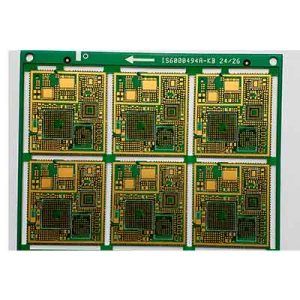
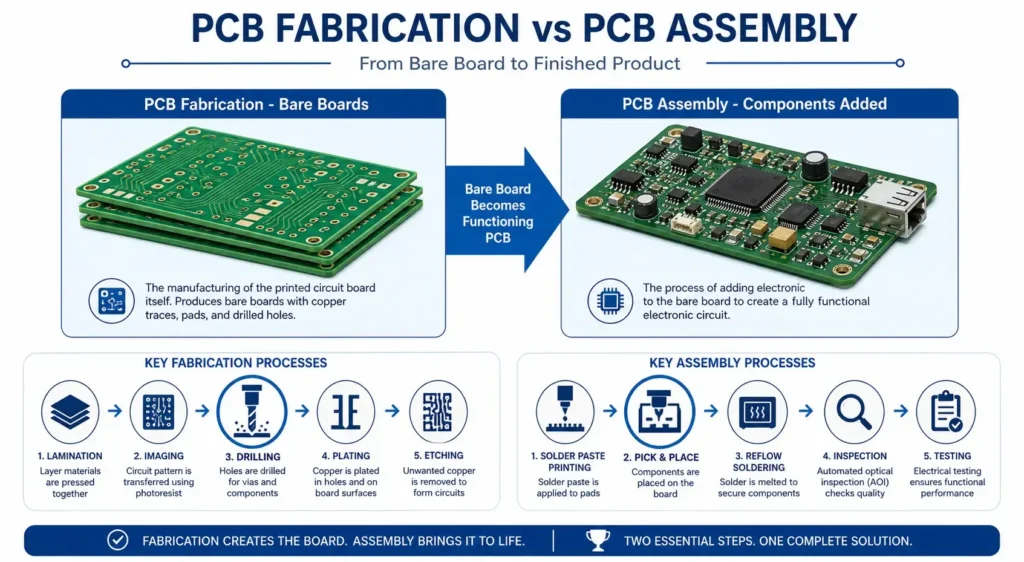
PCB fabrication is the process of manufacturing bare printed circuit boards—substrate panels with copper traces but no electronic components. PCB assembly (PCBA) is the process of soldering electronic components onto these fabricated boards to create functional circuit assemblies. Understanding this distinction is essential for accurate quotes, proper supplier communication, and efficient project planning in electronics manufacturing.
PCB fabrication transforms raw laminate materials into finished circuit boards through a multi-stage manufacturing process. The fabrication facility creates the physical board structure—copper traces, drill holes, vias, and surface features—according to specifications in your design files. The output is a bare board ready for component attachment but containing no electronic parts.
The Fabrication Process
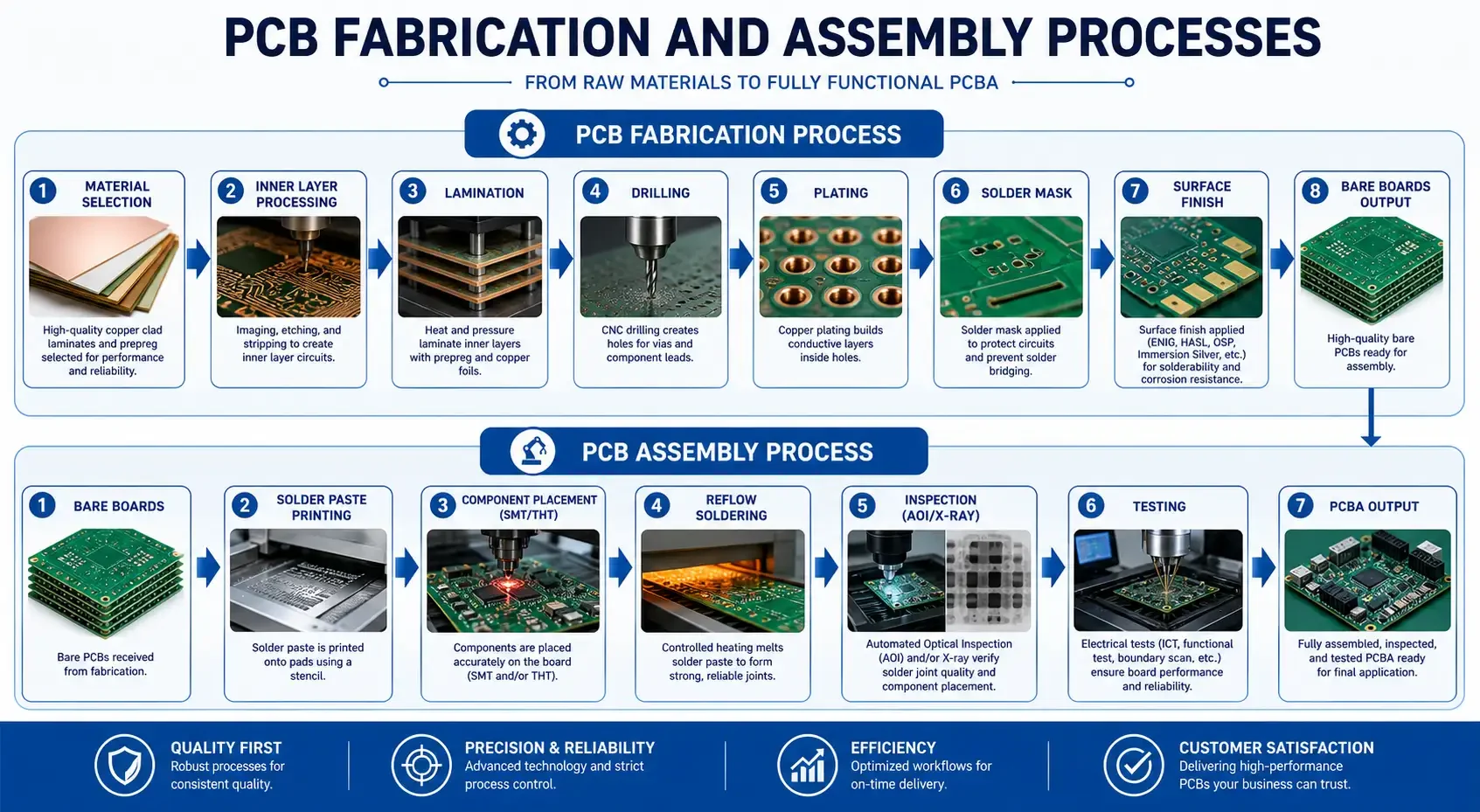
Material Selection: The process begins with selecting the appropriate base material. Standard FR-4 (fire-retardant laminate) is the most common choice for general applications, offering good electrical insulation and mechanical stability at reasonable cost. For high-frequency applications, Rogers or other specialized high-speed laminates provide controlled dielectric properties. High-Tg FR-4 materials offer improved thermal resistance for lead-free assembly processes.
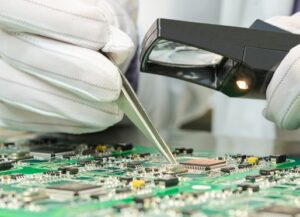
Inner Layer Processing (for multilayer boards): For boards with four or more layers, inner core layers are imaged, developed, and etched to create internal copper pattern. Automated optical inspection (AOI) verifies these layers for defects before proceeding. Any defects in inner layers become embedded and uncorrectable after lamination, making this inspection critical for multilayer board quality.
Lamination: All layers are stacked with prepreg (partially cured fiberglass cloth impregnated with resin) between them. The stack is placed in a lamination press under heat and pressure, which cures the prepreg and bonds all layers into a solid panel. Temperature, pressure, and time must be precisely controlled to achieve proper dielectric thickness and resin flow.
Drilling: CNC drilling machines create all holes in the panel. This includes plated through-holes (PTH) that will receive component leads and connect layers, via holes for interlayer connections, and non-plated through-holes (NPTH) for mechanical mounting. Drill bit quality, tool wear monitoring, and debris removal all affect hole quality and reliability.
Plating: The hole walls are metallized to create electrical connections between layers. This involves a series of chemical processes that deposit copper onto the panel surface and inside the holes. The copper thickness in holes—measured as plating weight or finished hole diameter—is critical for reliable interlayer connections and must meet IPC-6012 specifications.
Patterning: Additional copper is deposited and patterned to build up outer layer traces according to your design. The panel is coated with photosensitive resist, exposed to UV light through your artwork, developed to remove unexposed resist, and etched to remove unwanted copper. The result is the final trace geometry that routes signals across your board.
Solder Mask and Surface Finish: Solder mask protects copper traces from oxidation and prevents solder bridges during assembly. It is applied as a liquid coating or dry film, exposed, and developed to leave openings at component pads. Surface finish is then applied to protect exposed copper pads and ensure good solderability. Common finishes include HASL (hot air solder leveling), ENIG (electroless nickel immersion gold), OSP (organic solderability preservative), and ENEPIG (electroless nickel electroless palladium immersion gold).
Silkscreen and Profiling: Component reference designators, logos, test point markers, and other markings are printed on the board surface using silkscreen or inkjet processes. Finally, boards are routed or v-scored to separate individual panels from the production array. Each finished board is inspected, tested for electrical continuity, and packed for shipment.
Fabrication Deliverables
When you order PCB fabrication only, your supplier delivers bare boards with the following:
- Fabricated circuit boards matching your specifications and tolerances
- Electrical test reports (flying probe or fixture test) verifying continuity and isolation
- DFM reports identifying any manufacturability concerns
- Certificates of conformance documenting IPC class compliance
- Impedance reports if controlled impedance was specified
When Fabrication-Only Makes Sense
Fabrication-only orders are appropriate in several scenarios:
In-House Assembly Capabilities: If your facility includes reflow ovens, paste printers, and pick-and-place equipment—or if you work with a dedicated assembly contractor—you may need only bare board fabrication. Maintaining separate supplier relationships for fabrication and assembly can optimize pricing and specialization for each service.
Consigned Component Arrangement: Companies with existing component inventory, long-running products with stable BOMs, or compliance requirements specifying component sources often prefer to source and supply their own components. Fabrication-only lets you control component procurement while outsourcing board manufacturing.
Prototype and NPI Phases: During new product introduction, design iterations may require board modifications while component sets remain constant. Ordering bare boards allows faster design cycles and reduces per-unit costs for early prototypes that may be modified or discarded.
Specialized Assembly Requirements: Some products require assembly processes that general PCB manufacturers don’t offer—such as specialized underfill for high-reliability applications, conformal coating, potted assemblies, or custom test fixture development. A separate assembly specialist may better serve these niche requirements.
What is PCB Assembly?
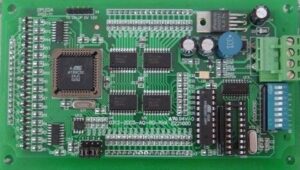
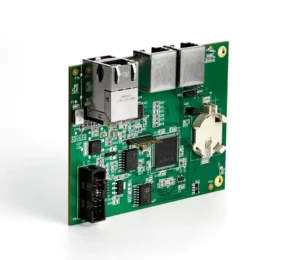
PCB assembly (PCBA) attaches electronic components to fabricated bare boards to create functional electronic assemblies. This service transforms your bare boards into working circuit assemblies ready for testing, integration, and end use. Assembly requires both the bare boards and all components specified in your bill of materials.
Assembly Methods
Two primary assembly methods are used in electronics manufacturing, often in combination:
Surface Mount Technology (SMT) Assembly: Components are placed directly onto the board surface using automated pick-and-place equipment. SMT components have metal terminals that sit on pads without passing through holes, enabling high component density and automated manufacturing. SMT dominates modern electronics production due to its efficiency, suitability for high-volume production, and compatibility with miniaturization trends.
Through-Hole Technology (THT) Assembly: Components with wire leads are inserted into holes drilled through the board and soldered to pads on the opposite side. The solder joint is mechanical as well as electrical, providing superior connection strength. Through-hole is required for certain applications: high-current carrying components requiring robust connections, connectors subject to mating/unmating stress, components exposed to mechanical shock or vibration, and certain semiconductor packages.
Most assemblies use a combination of both methods, with SMT for the majority of components and through-hole selectively for parts requiring mechanical robustness.
Turnkey vs Consigned Assembly
Understanding the component arrangement model is essential for accurate quoting:
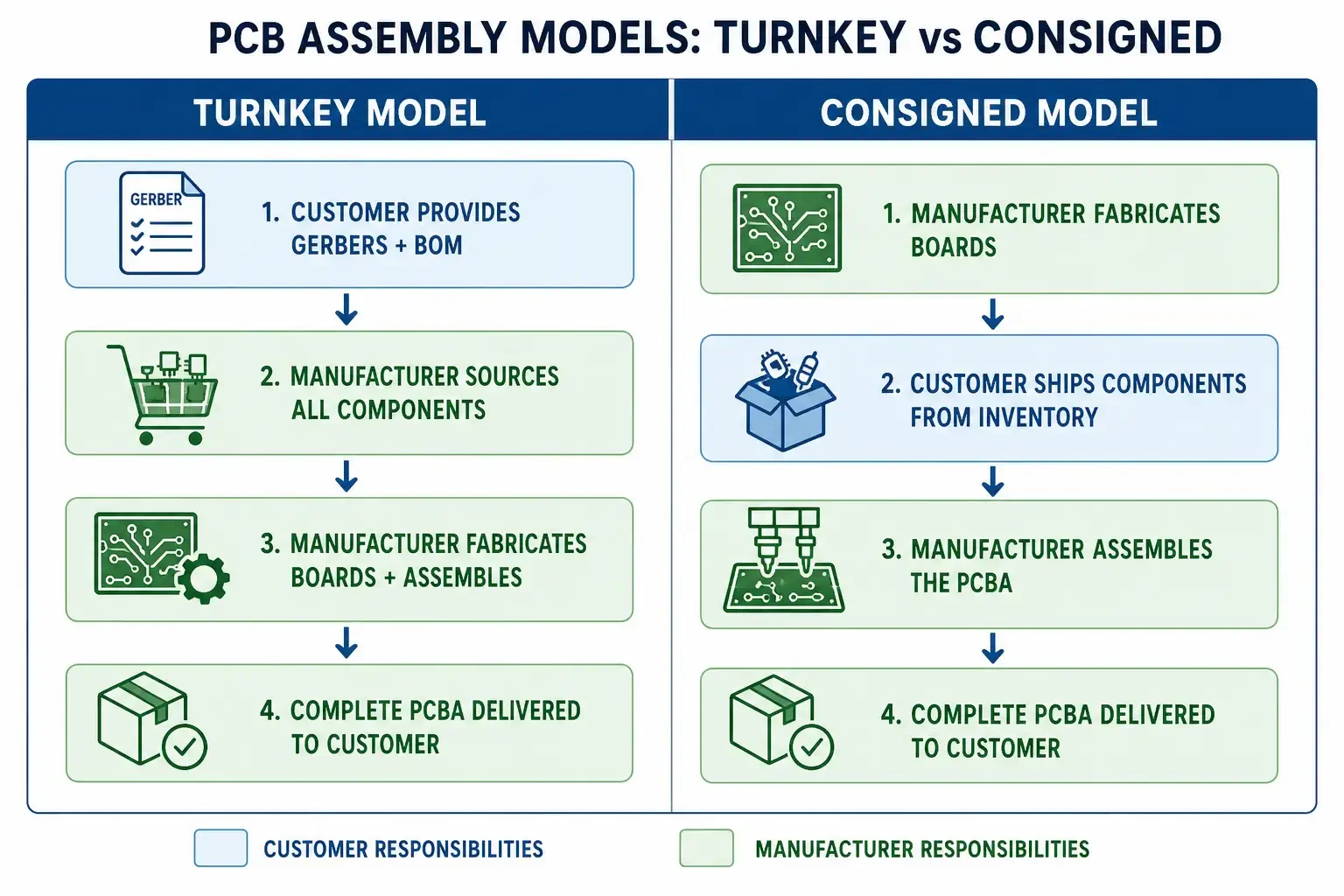
Turnkey Assembly: The assembly supplier sources all components as part of the service. You provide the bare boards (or request fabrication from the same supplier) and a complete bill of materials with manufacturer part numbers. The supplier handles procurement, incoming inspection, kitting, and assembly. This model simplifies your supply chain and is ideal for companies without component sourcing expertise or those wanting single-point accountability.
Consigned Assembly: You supply the components to the assembly facility while they provide fabrication and assembly services. This approach suits companies with existing component inventory, those requiring specific component sources for compliance reasons, or projects where you want direct control over component selection and cost. You bear the risk of component obsolescence, price fluctuations, and supply disruptions.
Assembly Deliverables
When you order PCB assembly services, you receive:
- Completed circuit assemblies with all components soldered to the boards
- Automated Optical Inspection (AOI) and/or X-ray inspection reports documenting assembly quality
- Functional test results if testing services are included
- Component traceability documentation for compliance requirements
- First article inspection reports for first-run verification
Key Differences: Fabrication vs Assembly
| Aspect | PCB Fabrication | PCB Assembly |
|---|---|---|
| Definition | Manufacturing bare circuit boards | Soldering components to boards |
| Output | Bare boards without components | Populated boards (PCBA) |
| Process Stage | Upstream manufacturing | Downstream manufacturing |
| Primary Equipment | Drills, lamination presses, etchers | Pick-and-place, reflow ovens, AOI |
| Key Cost Factors | Material, layer count, surface finish | Component cost, component count, assembly complexity |
| Required Files | Gerber files, drill files, specifications | BOM, centroid file, bare boards |
| IP Concern | Board design only | Components also present |
| Quality Standards | IPC-2221, IPC-6012 | IPC-A-610 |
When to Choose Fabrication Only
Evaluate your situation against these criteria to determine if fabrication-only is appropriate:
In-House Assembly Capabilities: If your facility includes reflow ovens, paste printers, and pick-and-place equipment—or if you work with a dedicated assembly contractor—you likely need only bare board fabrication. Your assembly team handles component mounting while your fabrication supplier focuses on board manufacturing.
Component Inventory Control: Companies with long-running products often maintain component stock to protect against price fluctuations and supply disruptions. If you purchase components in bulk or manage your own supply chain, fabrication-only lets you control when you order boards without tying up capital in components you may already stock.
Prototype and NPI Phases: During new product introduction, you may iterate rapidly on board designs while using the same component set. Ordering bare boards allows faster design cycles and reduces the per-unit cost of early prototypes that may be modified or discarded.
Specialized Assembly Requirements: Some products require assembly processes your fab supplier doesn’t offer—such as specialized underfill for high-reliability applications, conformal coating, or custom test fixture development. Using a separate assembly specialist may better serve these requirements.
When to Choose Turnkey Assembly
Turnkey PCB assembly simplifies your supply chain and is the preferred model for most situations:
Limited Component Sourcing Expertise: Electronics component distribution involves complexity—authorized versus unauthorized channels, part number variations, counterfeit risk, and shelf-life considerations. Turnkey suppliers have established relationships with distributors and can navigate these challenges more efficiently than most companies can manage internally.
Complex BOMs: Products with hundreds of unique component part numbers present significant procurement challenges. A turnkey supplier aggregates demand across many customers, improving their purchasing leverage and ability to source hard-to-find parts. They maintain relationships with franchised distributors and can often secure components that individual buyers cannot find.
Time-Sensitive Projects: When lead times are critical, turnkey suppliers can often parallelize component procurement with board fabrication, reducing overall delivery time. Their purchasing teams know which distributors offer expedited shipping for urgent needs.
Small-to-Medium Batch Production: For production runs under 500 units, managing component inventory is economically inefficient. Turnkey assembly allows you to order exact quantities without minimum component purchases. You pay only for the components actually assembled onto your boards.
Risk Mitigation: Turnkey suppliers assume component obsolescence and price fluctuation risks during the quote validity period. This protection is valuable for products with longer lifecycles where component availability may change over time.
Understanding the Combined Process
Many OEMs choose to source both fabrication and assembly from a single supplier. This approach offers several advantages that can outweigh potential pricing benefits from split sourcing.
Streamlined Communication: When one supplier handles both processes, you communicate design intent once and receive consistent feedback throughout production. DFM issues identified during fabrication can be addressed before assembly begins. Assembly problems can be traced back to fabrication root causes more easily when one team is accountable.
Reduced Handling and Shipping: Separate suppliers mean your boards ship from the fabrication facility to your warehouse or directly to the assembly house, adding handling time, shipping cost, and potential damage risk. Single-supplier sourcing eliminates this intermediary step, reducing lead time and logistics complexity.
Integrated Quality Assurance: When fabrication and assembly teams work together, they share inspection data and process feedback. A fabrication defect that might pass bare-board test could cause assembly problems—a phenomenon called hidden yield loss. The combined supplier catches these issues internally rather than returning boards to you for rework.
Consolidated Documentation: One supplier means one set of quality documentation, one point of contact, and simplified supplier management for your procurement and quality assurance teams. Certificate of conformance, test reports, and inspection data come from a single source.
Frequently Asked Questions
Can I get PCB fabrication and assembly from the same supplier?
Yes, most full-service PCB manufacturers offer both fabrication and assembly as separate services or combined as turnkey solutions. Using a single supplier for both services streamlines communication, reduces shipping, and enables integrated quality assurance. However, you may choose separate suppliers if you have specific requirements that one supplier doesn’t meet or if competitive bidding between specialized shops provides better pricing for high-volume production.
How do I know if I need fabrication only, assembly only, or both services?
Evaluate your internal capabilities and resources: If you have assembly equipment or an existing assembly contractor, you likely need fabrication only. If you have bare boards and need components attached, you need assembly only. If you have neither boards nor assembled assemblies, you need both—either separately or as a turnkey package from one supplier.
What files do I need for each service?
For fabrication only, provide Gerber files (all copper, mask, silkscreen, and paste layers), drill files (Excellon format with PTH/NPTH designation), and board specifications (material, thickness, surface finish, IPC class). For assembly only, provide fabricated bare boards, complete BOM with manufacturer part numbers, centroid/XY data file defining component placement positions, and any assembly-specific drawings or instructions.
What’s the difference between turnkey and consigned assembly?
Turnkey assembly means the supplier sources all components as part of the service. You provide the bare boards and BOM; the supplier handles procurement, quality verification, and assembly. Consigned assembly means you supply the components to the assembly facility. Choose consigned if you have specific component sources required for compliance or existing inventory you want to use.
Does combining fabrication and assembly services save cost?
Combining services can reduce total cost through reduced shipping, simplified procurement, and consolidated quality documentation. However, the primary benefit is convenience and risk reduction rather than price optimization. For very high volumes, competitive bidding between specialized fabrication houses and assembly shops may yield better pricing than a single integrated supplier.
How do lead times compare between fabrication and assembly?
PCB fabrication typically requires 5 to 15 business days depending on board complexity and supplier capacity. PCB assembly typically requires 3 to 10 business days depending on component availability and assembly complexity. When sourcing both from one supplier, total lead time is usually slightly longer than fabrication alone because assembly follows fabrication completion. However, turnkey assembly from a single supplier often has similar or shorter total lead time compared to coordinating separate suppliers because the supplier can begin component procurement while boards are being fabricated.
References
- IPC-2221: Generic Standard on Printed Circuit Board Design
https://www.ipc.org/ - IPC-A-600: Acceptability of Printed Boards
https://www.ipc.org/ - IPC-6012: Qualification and Performance Specification for Rigid Printed Boards
https://www.ipc.org/ - SMTA: Surface Mount Technology Association Technical Resources
https://www.smta.org/
Further Reading
- Custom PCB Manufacturer: How to Choose the Right Partner — Evaluating suppliers for fabrication and assembly services
- PCB RFQ Checklist: Files and Specifications Needed for an Accurate Quote — Documentation requirements for PCB orders
- PCB Prototype Manufacturing: From Design Files to a Testable Board — Prototype production workflows
Shanghai Huangte Technology Co., Ltd. | Last updated: 2026-07-22
This article provides general technical guidance on PCB fabrication and assembly services. Service requirements vary by application, volume, and specifications. Consult with your PCB manufacturer to determine the most appropriate service model for your specific project requirements.