What Is Low-Volume PCB Manufacturing?
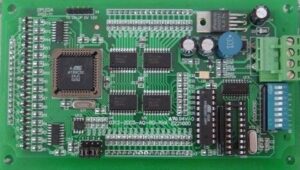
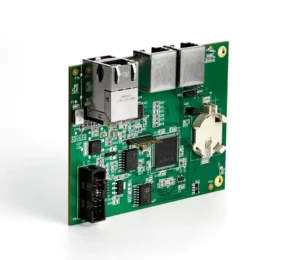
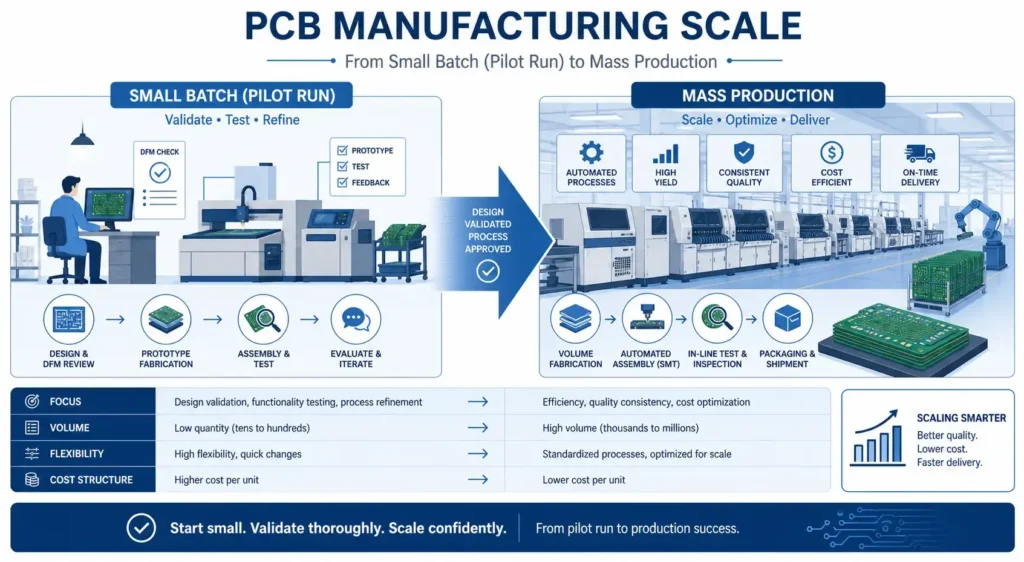
Low-volume PCB manufacturing refers to production runs of typically 5 to 500 boards—quantities too large for prototype pricing but too small to fully absorb mass production tooling amortization. This tier serves several distinct use cases: new product introduction (NPI) pilot runs, design validation beyond the prototype stage, legacy product maintenance builds, and market testing before committing to full-scale production.
The economics of low-volume production differ fundamentally from both prototyping and mass production. Prototype pricing typically applies to 1-10 pieces where the manufacturer charges primarily for setup and engineering time rather than material and processing. Mass production pricing applies to 1,000+ pieces where unit costs drop dramatically as setup costs are distributed across large volumes. Low-volume production occupies the uncomfortable middle ground where per-board costs remain elevated because setup costs are not fully amortized.
In 2026, the PCB industry serves low-volume production through several models: dedicated prototype shops accepting larger runs at prototype-adjacent pricing, contract manufacturers with flexible production lines, and turnkey services combining bare board fabrication with component procurement and assembly. The right model depends on whether you need bare boards, assembled boards, or both.
Pilot Run vs Mass Production: When to Choose Which
The decision between a pilot run and immediate mass production is driven by risk assessment across three dimensions: design maturity, supply chain readiness, and market validation.
When to Run a Pilot First
Execute a pilot run before committing to mass production when any of the following conditions apply:
- Design has not completed full DFM review: Pilot production often reveals issues that desktop DFM review misses—solder paste release from complex pad geometries, component placement conflicts, or thermal issues during reflow. Running 10-50 boards through assembly validates these real-world behaviors.
- Component second sources are not qualified: Single-source component dependency creates supply chain risk that mass production amplifies. A pilot run validates the primary component plus any planned alternates, confirming that alternate parts meet the design’s thermal and electrical requirements.
- Market demand is uncertain: Launching a new product with uncertain demand is a classic inventory risk. A pilot run of 50-200 units tests market response while limiting exposure to write-offs if demand falls below projections.
- First-time manufacturer relationship: Qualifying a new manufacturer with a large production order is high-risk. A pilot run validates the manufacturer’s quality, communication responsiveness, and on-time delivery before committing volume business.
- Regulatory or certification requirements exist: Products requiring CE marking, UL listing, FCC certification, or industry-specific compliance testing benefit from pilot-run boards dedicated to testing and certification. Burning these boards in certification avoids consuming production inventory.
When Mass Production May Be Appropriate
Bypass the pilot run when:
- The design has multiple successful production runs under its belt with identical or near-identical specifications
- Supply chain is fully qualified with redundant sources for all critical components
- Demand is confirmed and committed (firm purchase orders, not forecasts)
- The product is a minor revision of an existing product with established manufacturing process
The key risk of skipping the pilot is accumulating multiple unknowns simultaneously. If a design is new, a manufacturer is new, and components are new, running mass production without a pilot run creates compounding risk. Any one of these factors can generate a respin; all three together almost certainly will.
Typical Quantities and Cost Drivers
Quantity Tiers and Pricing Characteristics
| Order Quantity | Typical Unit Cost Multiplier | Best Use Case |
|---|---|---|
| 1-10 pieces | Baseline (prototype pricing) | Design validation |
| 11-50 pieces | 1.5-3x prototype unit cost | Limited pilot / engineering build |
| 51-200 pieces | 1.2-2x above threshold | Market testing, certification |
| 201-500 pieces | 1.1-1.5x above threshold | NPI completion, initial production |
| 501-1,000 pieces | Approaching mass production pricing | Pre-production, pre-launch inventory |
| 1,000+ pieces | Mass production economics | Full-scale production |
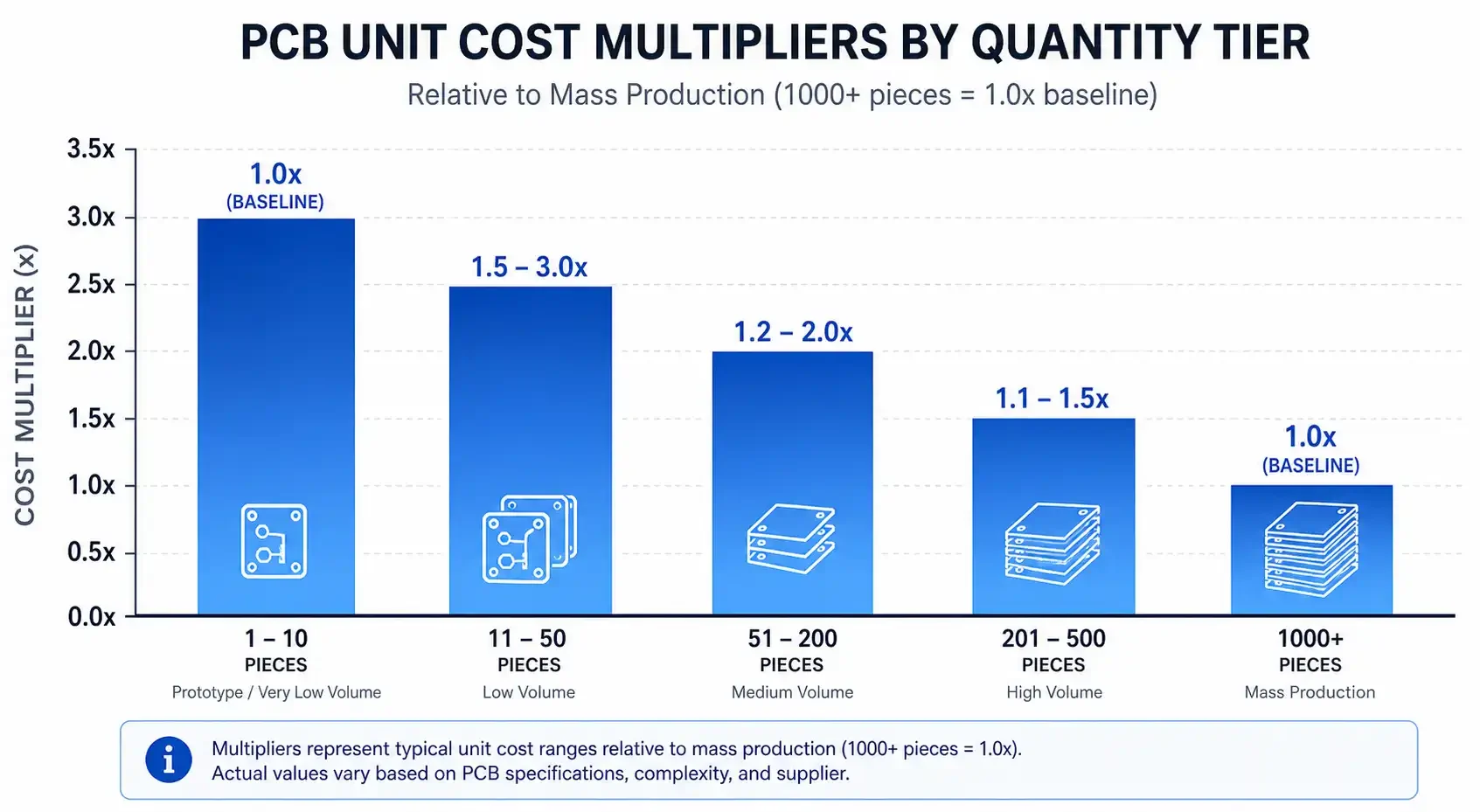
The exact multiplier depends on board complexity, surface finish, testing requirements, and the manufacturer’s volume discount structure. Simple 2-layer boards on standard materials show smaller quantity multipliers than complex multilayer HDI boards where setup costs dominate regardless of quantity.
Cost Drivers Specific to Low-Volume Production
Several factors inflate low-volume unit costs beyond what simple quantity math would suggest:
- NRE (Non-Recurring Engineering) fees: Setup charges for tooling, testing fixtures, and first-article inspection apply regardless of quantity. In mass production, these costs distribute across thousands of units; in low-volume production, they concentrate on each order.
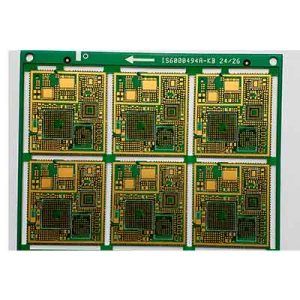
- Panelization inefficiency: Manufacturers produce boards on standard production panels (typically 18″x24″ or similar). A board that occupies a small portion of the panel may result in wasted area. For very small orders, the entire panel cost may be absorbed by the customer.
- Component minimum order quantities (MOQs): Component distributors and manufacturers typically enforce MOQs that exceed low-volume order requirements. Purchasing 10,000 capacitors to build 50 boards is economically painful. Turnkey services with component stocking programs can aggregate demand across customers to reduce MOQ impact, but this comes with a margin.
- Testing economics: 100% electrical testing costs the same whether testing 10 boards or 1,000 boards. Testing cost per board drops as quantity increases—a significant factor for low-volume orders where testing overhead represents a larger percentage of total cost.
Key Considerations for Low-Volume Runs
Design for Manufacturing (DFM) Validation
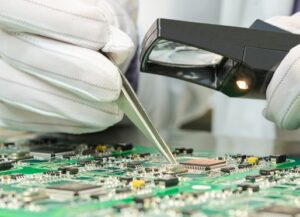
Low-volume production is the last practical opportunity to validate DFM assumptions before committing to mass production tooling. Pay attention to solder joint reliability, test coverage, assembly rework rate, and first-pass yield. Reflow profiling under actual production conditions confirms that components are rated for the thermal exposure. Fine-pitch packages (0.4mm QFP, 0.5mm BGA) are most sensitive. Track the number of components reworked during the pilot run—A rework rate above 1-2% suggests DFM issues that will worsen at mass production scale.
Component Sourcing Strategy
Low-volume production often reveals component sourcing challenges that prototype boards do not surface. Some components available for prototype (from distributor stock) have longer lead times for volume procurement. Distributor pricing for small quantities may not reflect volume pricing tiers. Check component lifecycle status—Parts flagged for obsolescence may be available today but unavailable in 6 months. Verify distributor authorization and consider incoming inspection for critical applications to mitigate counterfeit risk.
Manufacturing Location Considerations
In 2026, low-volume PCB production is split across domestic prototype shops, offshore full-service manufacturers, and hybrid models. Domestic (US/EU) prototype shops are best for very small quantities (1-25 pieces), extremely urgent timelines, or designs requiring confidential handling. China-based full-service manufacturers are best for quantities above 50 pieces when unit cost matters and timeline allows 2-3 weeks for production and shipping. Hybrid models offer domestic engineering and planning with offshore production, balancing cost efficiency with local communication.
For most commercial electronics products in 2026, the China-based full-service model offers the best cost-capability balance for low-volume production (50-500 pieces), provided timeline and intellectual property protection considerations are acceptable.
Transitioning from Prototype to Production
The transition from prototype to low-volume production follows a structured NPI (New Product Introduction) process:
- Design freeze: Lock all schematic and layout changes. Any design modification after pilot run initiation restarts the validation cycle.
- Complete DFM review: Run a final DFM analysis including manufacturing capability verification, assembly compatibility check, and test coverage assessment.
- Qualify components: Confirm distributor authorization, lifecycle status, and lead times for all components. Identify and qualify alternates for single-source parts.
- Select manufacturer: Evaluate candidates against prototype performance, pricing, capability, and quality systems. Qualify the manufacturer with a pilot run before committing volume.
- Pilot production: Run the first low-volume build (typically 10-50 pieces) with full inspection and documentation.
- Analyze pilot results: Document yield, rework incidents, DFM findings, and any process adjustments needed. These findings inform mass production planning.
- Mass production launch: With pilot results validated, transition to production with documented process parameters and quality expectations.
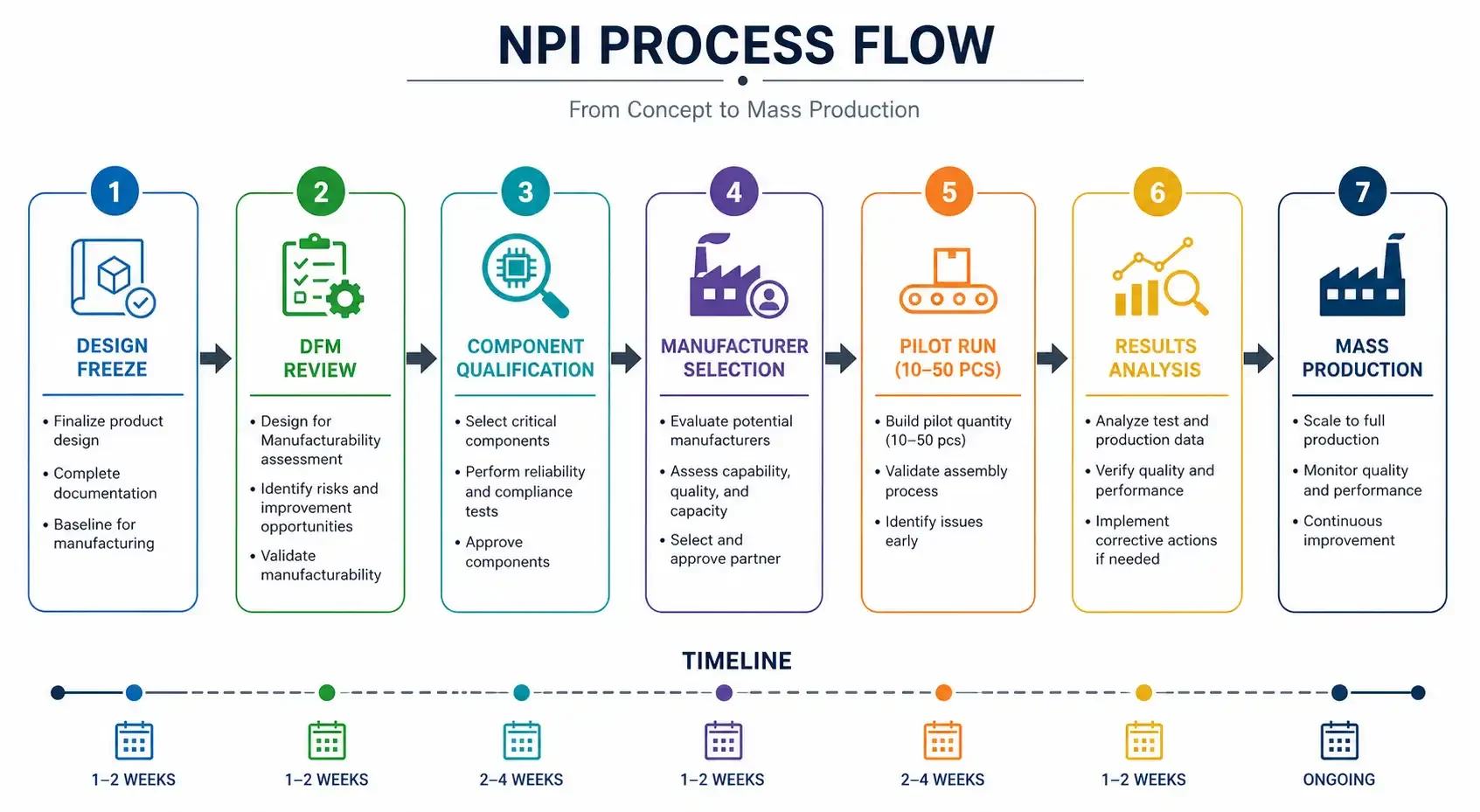
This structured approach typically adds 3-6 weeks to the overall schedule compared to immediate mass production—but prevents the much larger delays and costs associated with production respins.
Frequently Asked Questions
Q1: What is the minimum order quantity for low-volume PCB production?
Most manufacturers accept low-volume orders starting at 5 pieces for bare board fabrication. For turnkey assembly services combining PCB and components, minimums typically start at 5-10 pieces, though some manufacturers accept 1-piece assembly for prototypes. Orders below the manufacturer’s stated minimum may be accepted at prototype pricing with limited availability.
Q2: How much does low-volume PCB production cost compared to mass production?
Unit costs in low-volume production are typically 2-10x higher than mass production unit costs. A board costing $15 per unit at 10,000-piece volume might cost $40-80 per unit at 50-piece quantity. The premium reflects setup cost concentration, panelization inefficiency, and testing overhead. Design optimizations identified during pilot runs can reduce mass production costs by 20-40%—often exceeding the total cost of the pilot program.
Q3: When should I transition from prototype to low-volume production?
Transition to low-volume production when the design has completed functional validation, schematic and layout are stable, and you need more units than prototype pricing covers. Low-volume production is appropriate when you are preparing for market launch, seeking regulatory certification, validating supply chain, or building initial inventory. If you only need 1-5 boards for continued engineering validation, prototype pricing remains more economical.
Q4: Can I use the same manufacturer for prototype and low-volume production?
Ideally, yes. Using the same manufacturer for prototype and low-volume production provides continuity of DFM institutional knowledge, established communication patterns, and verified quality. However, prototype shops and mass production facilities often have different equipment, capabilities, and pricing structures. A manufacturer that excels at 5-piece prototypes may not be optimal for 500-piece production. Evaluate each manufacturer’s sweet spot before committing.
Q5: What documentation should I request from a low-volume production run?
Request: Certificate of Conformance (CoC) showing the build meets specifications, electrical test data for each board, first article inspection (FAI) report with measured vs. specified parameters, material certificates and traceability documentation, and any DFM feedback from the manufacturer. For regulated industries, additional documentation including process traveler, inspection records, and nonconformance reports may be required.
References
- IPC-1710: Generic Standard on the Qualification of Printed Board Manufacturers. IPC.
https://www.ipc.org/ - IPC-A-600: Acceptability of Printed Boards. IPC.
https://www.ipc.org/ - IPC-A-610: Acceptability of Electronic Assemblies. IPC.
https://www.ipc.org/ - SMTA (Surface Mount Technology Association). “Best Practices for New Product Introduction.”
https://www.smta.org/ - Bittele Electronics. “Non-Recurring Engineering (NRE) and Tooling Costs.”
https://www.7pcb.com/blog/nre-tooling-costs - QueenEMS. “What Does NRE Mean on a PCB Quote? Cost Reduction Guide.”
https://www.queenems.com/blog/what-does-nre-mean-how-to-reduce-pcb-setup-tooling-costs/ - LCSC Electronics. “PCB Manufacturing: Volume Production vs Prototypes.”
https://www.lcsc.com/blog/quick-turn-pcb-fabrication
Further Reading
- Custom PCB Manufacturer: How to Choose the Right Partner for Prototype and Production — Comprehensive guide to evaluating and selecting PCB manufacturers
- PCB Prototype Manufacturing: From Design Files to a Testable Board — Step-by-step prototype manufacturing process
- Quick-Turn PCB Prototypes: What Can Be Fast-Tracked and What Cannot — Expedited prototype options
Shanghai Huangte Technology Co., Ltd. | Last updated: 2026-07-19
This article is for informational purposes and does not constitute professional engineering or legal advice. Specific PCB requirements should be verified with qualified manufacturers and reviewed by a licensed professional engineer.