What Is Quick-Turn PCB Prototyping?
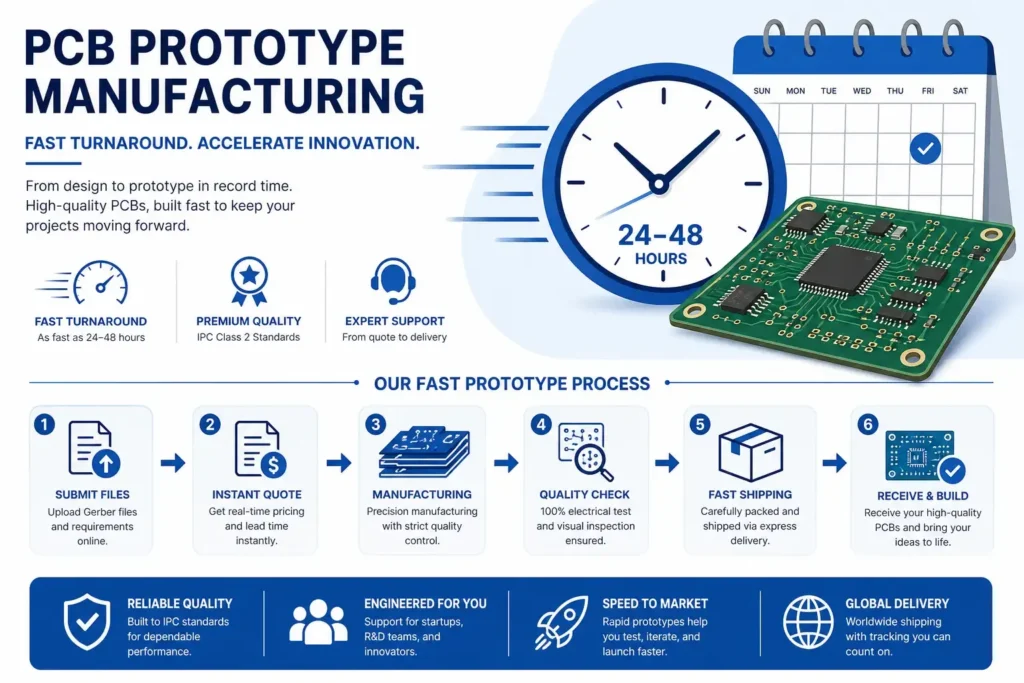
Quick-turn PCB prototyping refers to expedited fabrication services that prioritize your board through the manufacturer’s production queue, reducing standard lead times by 50-90%. A standard 4-layer board might carry a 10-15 business day lead time; quick-turn service delivers the same board in 24-72 hours.
The quick-turn model works by assigning dedicated CAM engineering resources and scheduling the board on a compressed production slot. It requires the manufacturer to divert capacity from standard production runs—hence the premium pricing. In 2026, most prototype-focused manufacturers offer at least three service tiers: standard (5-10 business days), expedited (2-3 business days), and rush/24-hour (same-day or next-day).
Quick-turn service is essential for product development cycles where a 2-week wait for prototype boards creates a critical path bottleneck. Engineers validating schematic changes, software teams waiting for hardware bring-up, and program managers tracking milestones all benefit from accelerated prototype delivery.
Lead Time Matrix: What Can Be Fast-Tracked
The following table summarizes what quick-turn services can realistically achieve across common board types:
| Board Type | Layer Count | Standard Lead Time | Quick-Turn Lead Time | Rush (24-48h) Available |
|---|---|---|---|---|
| Standard rigid (FR-4) | 1-2 layers | 5-10 business days | 24-48 hours | Yes |
| Standard rigid (FR-4) | 4 layers | 10-15 business days | 2-3 business days | Limited |
| Standard rigid (FR-4) | 6 layers | 12-18 business days | 3-5 business days | No |
| Standard rigid (FR-4) | 8-10 layers | 15-20 business days | 5-7 business days | No |
| HDI (1+N+1) | 4-6 layers | 15-25 business days | 5-7 business days | No |
| HDI (2+N+2) | 6-8 layers | 20-30 business days | 10-15 business days | No |
| Flex / Rigid-Flex | 2-4 layers | 15-25 business days | 7-10 business days | No |
| High-frequency (Rogers) | 2-6 layers | 15-30 business days | 10-15 business days | No |
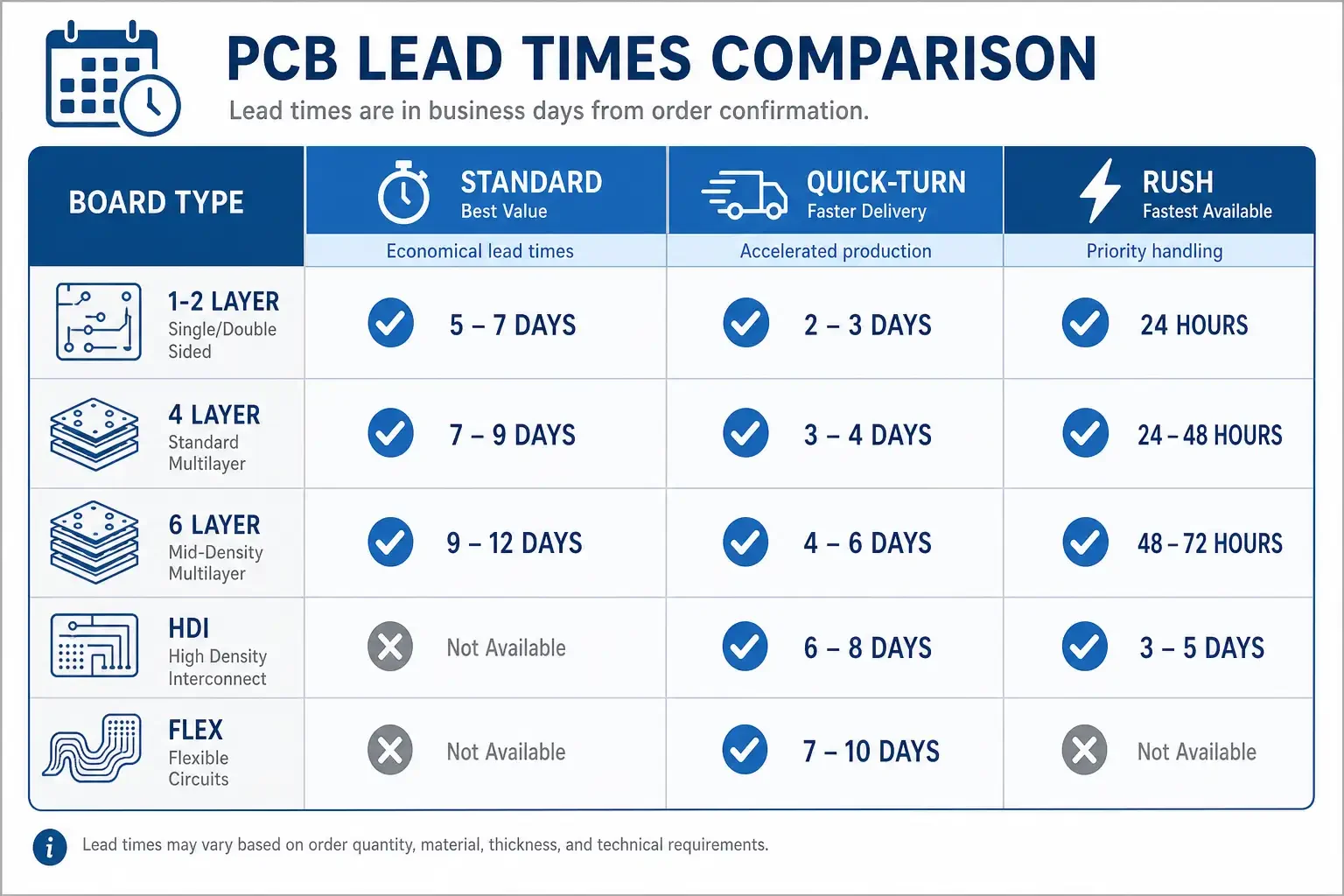
Simple 1-2 layer boards on standard FR-4 are the most amenable to rapid turnaround because the fabrication process involves fewer steps, requires no specialized materials, and fits on small production panels that can be processed quickly. Each additional layer adds processing steps—imaging, etching, and lamination cycles—that cannot be compressed beyond physical limits.
What Cannot Be Expedited: Key Limitations
Several categories of boards have hard limits on how much lead time can be reduced, regardless of how much premium a customer pays.
Material Procurement Lead Time
Boards requiring specialty laminates—Rogers high-frequency materials, polyimide flex substrates, ceramic substrates, or even standard FR-4 variants outside the manufacturer’s regular stock—cannot be quick-turned because material lead time dominates the schedule. Rogers materials typically require 2-4 weeks just for procurement. A manufacturer cannot fabricate a board they do not have substrate for.
High-Tg FR-4 and halogen-free materials may also carry procurement delays if the manufacturer does not stock them in the required thickness and grade. Verify material availability before assuming quick-turn is possible.
HDI and Advanced Structures
HDI boards with microvias (0.1mm diameter or smaller) require additional processing steps including laser drilling, sequential lamination, and via fill-and-capping. These steps have minimum cycle times that cannot be shortened without compromising reliability. A 1+N+1 HDI board requires at minimum 5-7 business days even under expedited conditions. 2+N+2 and beyond structures have a practical minimum of 10-15 business days.
The microvia formation process involves desmear treatment, copper plating, and inspection—all of which are sequential and time-dependent. Attempting to compress these steps risks delamination, voiding in filled vias, and other reliability failures.
High-Layer-Count Boards
Boards with 8 or more layers involve multiple lamination cycles, registration challenges across layer-to-layer alignment, and longer electrical test times. While a 6-layer board might be expedited to 3-5 business days, an 8-10 layer board has a practical minimum of 5-7 business days even under rush conditions.
The lamination process itself requires heating and cooling cycles that follow engineering time-temperature-pressure profiles. Compressing these profiles risks void formation, resin flow inconsistencies, and delamination.
IPC Class 3 and High-Reliability Builds
Class 3 boards require 100% inspection of specified characteristics, cross-section analysis on sample coupons, and full material traceability documentation. These requirements add inspection and documentation time that cannot be eliminated even under expedited service. Class 3 builds typically carry a minimum lead time floor of 5-7 business days regardless of the board’s basic complexity.
Additionally, Class 3 builds require the manufacturer to exercise process controls that may conflict with the expedited scheduling model. For critical aerospace, medical, or automotive safety applications, do not attempt to rush Class 3 production—quality verification is non-negotiable.
Flex and Rigid-Flex Circuits
Flex circuits require additional processing steps including coverlay lamination, stiffener attachment, and flex-specific testing. The polyimide base material requires different handling and processing conditions compared to standard rigid boards. Quick-turn options for flex are limited to 7-10 business days as an absolute minimum, and rigid-flex structures may require longer.
How Quick-Turn Pricing Works
Quick-turn service is not free acceleration—the premium reflects real resource allocation costs:
| Factor | Impact on Premium |
|---|---|
| Queue priority (dedicated production slot) | 30-50% base premium |
| Expedited CAM engineering | 10-20% additional premium |
| Compressed scheduling (overtime labor) | 10-30% additional premium |
| Same-day/24-hour processing | 100-200% premium |
| Holiday/weekend processing | 50-100% additional premium |
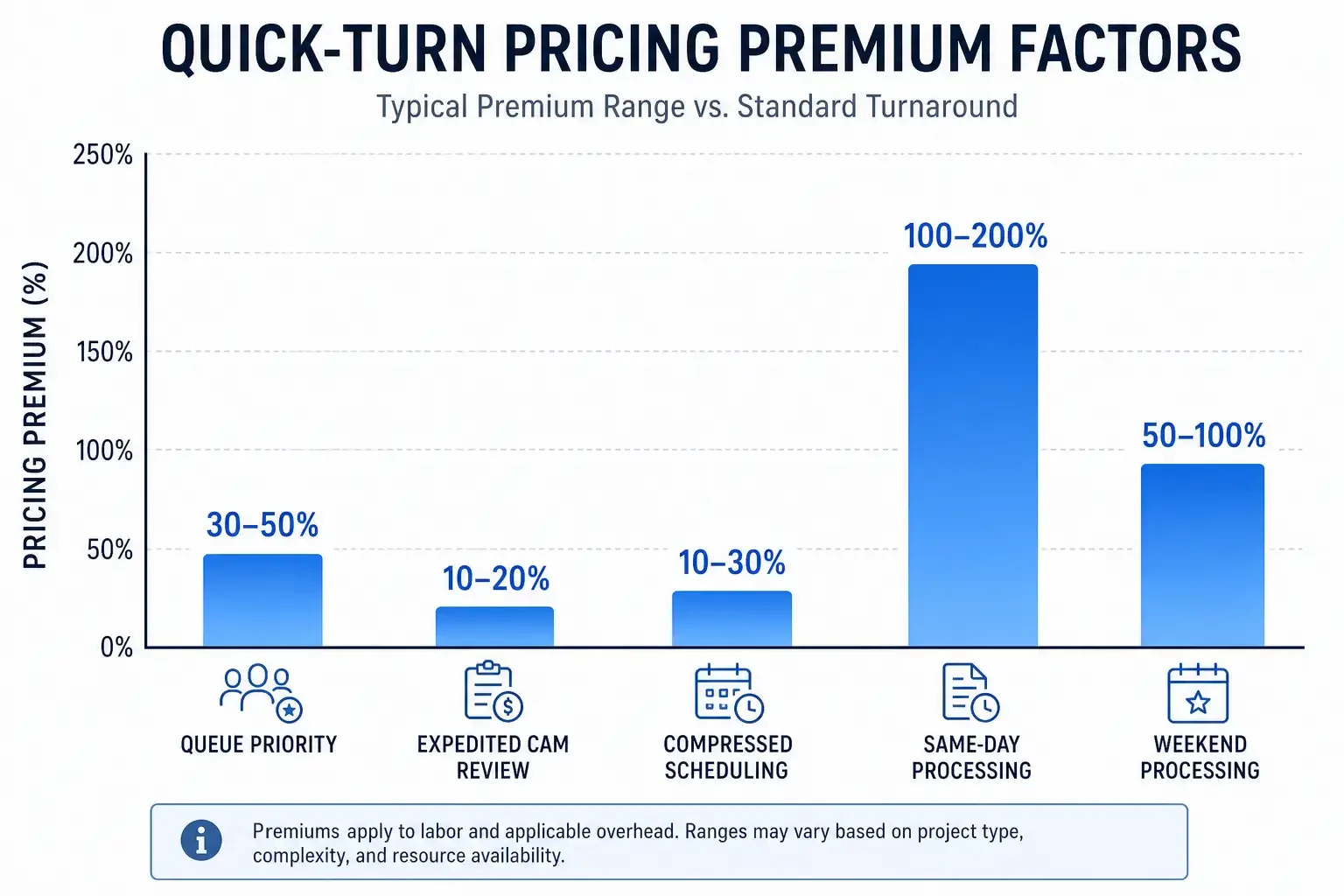
The total quick-turn premium typically ranges from 30% (standard quick-turn, 2-3 day) to 200% (24-hour rush) above standard pricing. This premium is justified by the dedicated capacity allocation—your board occupies production resources that could otherwise generate revenue from standard orders.
For development teams on tight schedules, the cost premium is often worthwhile. A $500 premium on a prototype board that saves 2 weeks of schedule delay is economical if the alternative is delaying an entire engineering team or missing a product launch window.
How to Optimize Your Files for Fast Turnaround
File quality is the single biggest controllable factor in achieving published quick-turn timelines. Incomplete or non-compliant design files trigger back-and-forth communication that consumes days of the available window.
Ensure Design Completeness Before Ordering
Submit complete Gerber packages including all copper layers, solder mask, silkscreen, paste, and board outline. Provide drill files in Excellon format with correct plating specifications (PTH vs NPTH). Include a complete stackup specification for controlled-impedance designs. Attach the bill of materials (BOM) and centroid file if ordering assembly services.
Verify DFM Compliance
Most quick-turn failures originate from design rule violations that require engineering clarification. Run a Design Rule Check (DRC) in your EDA tool before submitting files. Common issues that delay quick-turn orders include annular ring violations where drill holes break out of pad, solder mask dams below manufacturer minimums (typically 2-4 mil), insufficient clearance between traces and board edge, and undefined or conflicting board outline data.
A manufacturer offering free DFM review will catch these issues—but DFM feedback still requires your review and approval time. The fastest path through DFM is submitting DRC-clean files from the start.
Choose Standard Options When Possible
Avoid custom specifications during quick-turn orders. Standard surface finishes (HASL or ENIG), standard FR-4 materials, and standard tolerances process faster than non-standard options. If your design can tolerate HASL over ENIG, or 5-mil tolerances over 3-mil, choose the standard option to maximize turnaround speed.
Communicate Urgency Clearly
Indicate your actual deadline—not just your desire for speed. If you need boards by Thursday for a Friday integration meeting, say so explicitly. Manufacturers can sometimes flex their scheduling to meet specific delivery windows if they understand the true constraint.
Frequently Asked Questions
Q1: Can I get a 10-layer PCB in 24 hours?
No. A 10-layer board has a physical minimum fabrication time of approximately 5-7 business days even under rush conditions. The lamination cycles, registration steps, and electrical testing for a 10-layer board cannot be meaningfully compressed. Attempting to rush such a board risks reliability failures that would require a complete respin—defeating the purpose of the quick-turn order.
Q2: What is the fastest surface finish for quick-turn orders?
HASL (Hot Air Solder Leveling) is the fastest surface finish, typically completing in the same production cycle. OSP (Organic Solderability Preservative) also processes quickly. ENIG (Electroless Nickel Immersion Gold) requires 2-3 additional days for the nickel and gold plating baths. If surface finish is not critical for your prototype, HASL or OSP will deliver faster than ENIG.
Q3: Does quick-turn affect PCB quality?
Quick-turn fabrication follows the same manufacturing processes as standard production—the only difference is queue priority and scheduling compression. Quality is determined by the manufacturer’s process controls and your design’s DFM compliance, not by how fast the board is processed. However, rushed communication around DFM issues can introduce errors if the engineering review is superficial. Choose a manufacturer with documented quick-turn experience rather than one treating your rush order as a distraction from standard production.
Q4: Why do some manufacturers refuse to quick-turn certain board types?
Refusal typically indicates one of two situations: either the manufacturer’s process capabilities genuinely cannot produce that board type within the requested timeframe, or the manufacturer’s quality policy prohibits compressing certain steps. Both responses are legitimate warning signals. A manufacturer that agrees to impossible timelines and then delivers non-functional boards has not done you a favor.
Q5: How do I find a manufacturer that offers true quick-turn service?
Look for manufacturers that specialize in prototype and low-volume production—they typically have the most mature quick-turn processes. Verify their stated capabilities against your requirements before ordering. Request their quick-turn qualification profile including maximum layer count, minimum drill size, and material availability. A reliable quick-turn provider publishes clear limits rather than promising everything and delivering late.
References
- IPC-6012: Qualification and Performance Specification for Rigid Printed Boards. IPC.
https://www.ipc.org/ - IPC-A-600: Acceptability of Printed Boards. IPC.
https://www.ipc.org/ - LCSC Electronics. “Quick-Turn PCB Fabrication: File Optimization Blog.”
https://www.lcsc.com/blog/quick-turn-pcb-fabrication - PCBWay. “Quick Turn PCB Manufacturing Services.”
https://www.pcbway.com/blog/detail/quick-turn-pcb - PCBSync. “How to Choose a PCB Manufacturer: 15 Evaluation Criteria.”
https://pcbsync.com/how-to-choose-pcb-manufacturer/ - Hansphere. “How to Choose a PCB Manufacturer: A Step-by-Step Guide.”
https://www.han-sphere.com/blog/news/how-to-choose-pcb-manufacturer-step-by-step-guide/ - Cadence. “PCB Manufacturing Checklist for Flawless DFM.”
https://resources.pcb.cadence.com/blog/pcb-inspection-checklist-before-and-after-fab/
Further Reading
- Custom PCB Manufacturer: How to Choose the Right Partner for Prototype and Production — Comprehensive guide to evaluating and selecting PCB manufacturers
- PCB Prototype Manufacturing: From Design Files to a Testable Board — Step-by-step prototype manufacturing process
- Low-Volume PCB Manufacturing: When a Pilot Run Is Better Than Mass Production — Pilot run vs mass production decision guide
Shanghai Huangte Technology Co., Ltd. | Last updated: 2026-07-19
This article is for informational purposes and does not constitute professional engineering or legal advice. Specific PCB requirements should be verified with qualified manufacturers and reviewed by a licensed professional engineer.