When many customers develop LED lighting boards, power modules, automotive lighting, or industrial power supplies, they often focus first on whether the circuit can work and whether the components can be soldered properly. But they may overlook one critical issue: can the heat be dissipated effectively?
For ordinary FR-4 PCBs, there is usually no major problem when used for low-power control boards or signal boards. However, for products with high heat generation, such as high-power LEDs, power conversion modules, charging devices, driver boards, and automotive lighting boards, ordinary PCBs may easily face excessive temperature rise, LED decay, component aging, solder joint failure, or even board burnout.
This is where aluminum PCBs show their value.
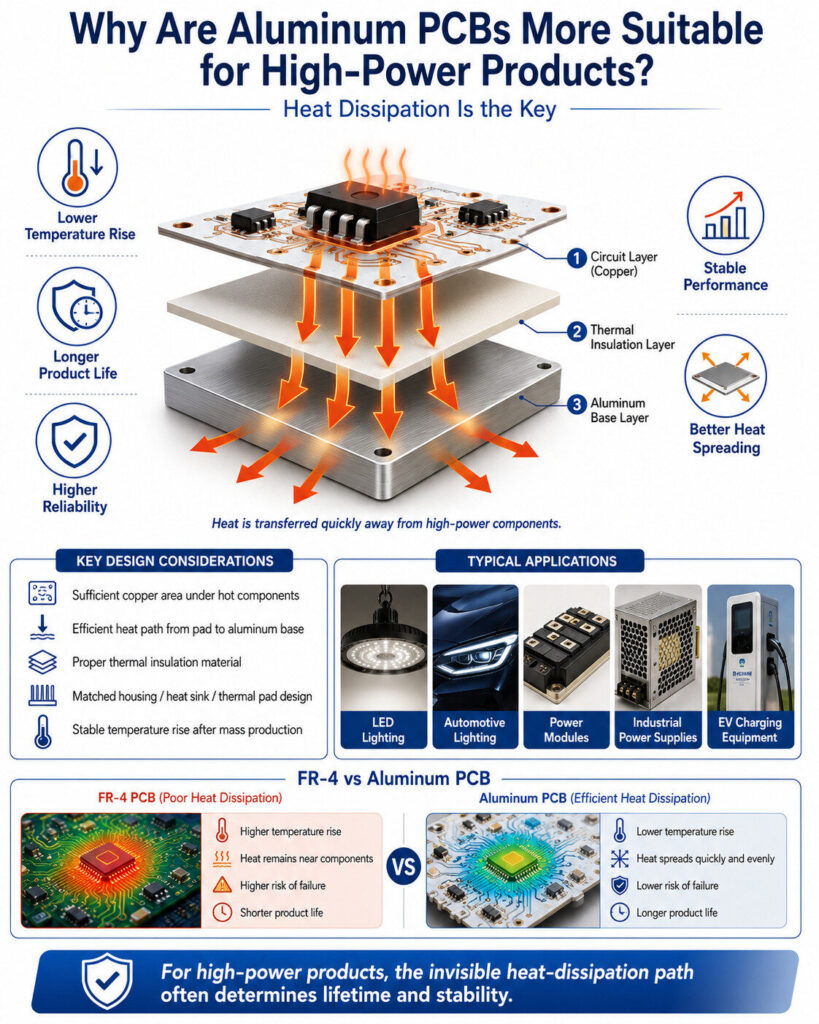
An aluminum PCB is a type of metal-based copper-clad board. Its common structure usually includes three layers: circuit layer, thermal insulation layer, and aluminum base layer. The circuit layer handles electrical connection, the insulation layer provides both heat conduction and electrical insulation, and the aluminum base layer helps spread heat quickly.
Many people think an aluminum PCB simply means “adding a layer of aluminum under the board.” In fact, it is not that simple. The real factors that affect heat dissipation include not only aluminum thickness, but also thermal conductivity, insulation layer thickness, copper thickness, trace width, pad design, component layout, and the final installation method.
For example, two aluminum PCBs may both be 1.5 mm thick, but if the thermal dielectric materials are different, their heat dissipation performance can be very different. Another example: if LED chips are concentrated in a small area and the copper area is not designed properly, the heat path will be unreasonable. Even if aluminum PCB is used, the temperature may still remain high.
So making an aluminum PCB is not just replacing FR-4 with aluminum material. A professional approach should evaluate the product power, working environment, installation structure, heat source position, and heat dissipation path together.
For high-power products, several key points must be considered during PCB design:
First, whether the copper area under the heat-generating components is sufficient.
Second, whether the heat can be transferred quickly from the pad and copper layer to the aluminum base.
Third, whether the thermal insulation layer can support long-term operation.
Fourth, whether the product housing, heat sink, thermal grease, or thermal pad matches the PCB structure.
Fifth, whether the temperature rise test can remain stable after mass production.
Many boards can power on and work during the sample stage, but after mass production, problems such as light decay, dead LEDs, or board burnout may appear. In many cases, the problem is not the circuit itself, but poor thermal design.
Aluminum PCBs are widely used in LED lighting, automotive lamps, power modules, audio amplifiers, charging pile control modules, industrial power supplies, and other driver boards with high heat dissipation requirements. Their biggest value is not that they “look more advanced,” but that they help the product remain stable during long-term operation.
However, aluminum PCBs are not suitable for every product. For example, complex multilayer signal boards, high-speed communication boards, and impedance-controlled boards are usually not solved simply by using standard aluminum PCB material. The right choice depends on the actual application.
For customers, when choosing aluminum PCBs, do not only ask for the price. Key parameters should also be confirmed, such as board thickness, copper thickness, thermal conductivity, withstand voltage requirements, surface finish, processing accuracy, and whether temperature rise testing is needed. If these details are not confirmed, simply comparing prices may lead to many problems later.
When we work on aluminum PCB projects, we usually evaluate the customer’s product power, heat source location, installation structure, and working environment. We do not just manufacture the board; we also pay attention to soldering reliability, heat dissipation paths, and mass production stability.
On the surface, an aluminum PCB is just a carrier for electronic components. But in reality, it forms the thermal foundation of the whole product. For high-power products, if the heat dissipation is not done properly, even a good circuit design may not work reliably.
So when developing high-power products, do not only focus on the circuit diagram.
What truly determines product lifetime and stability is often the invisible heat dissipation path.