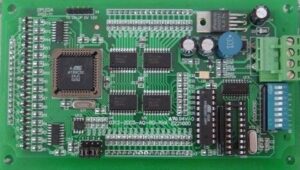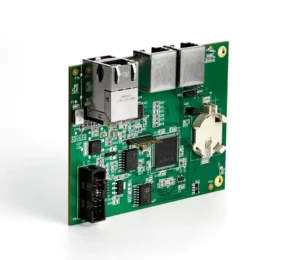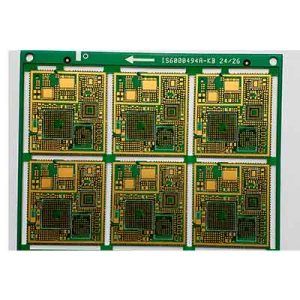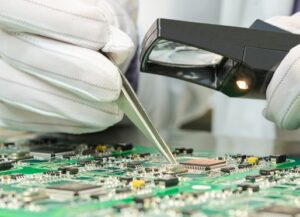
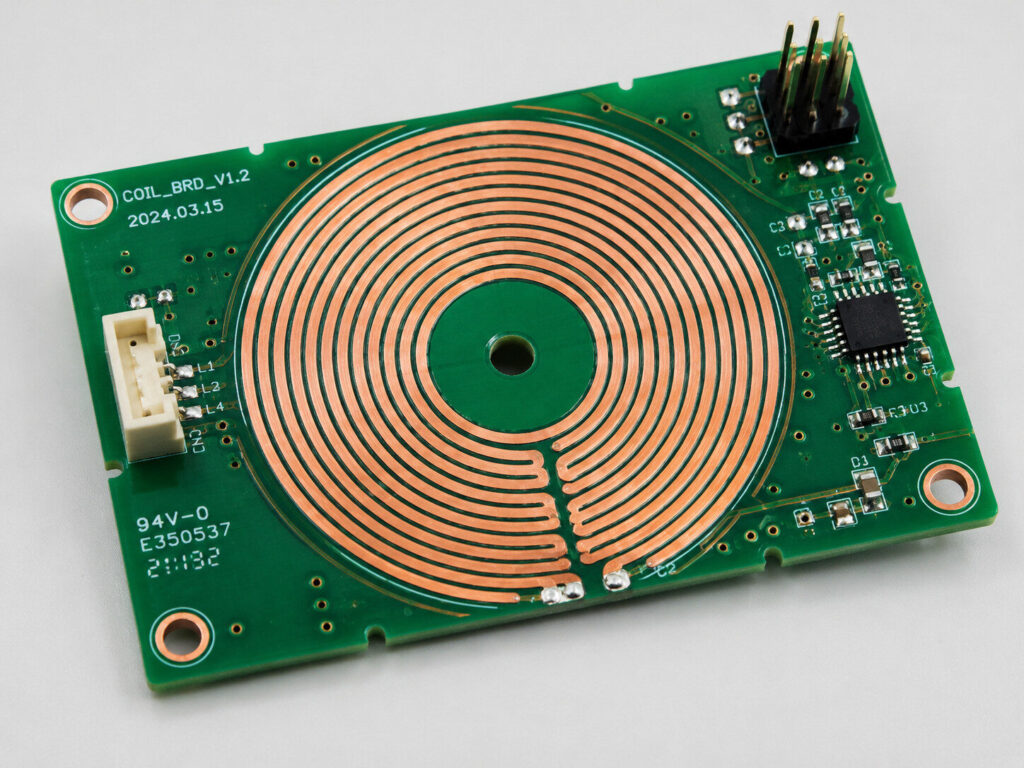
In traditional electronics manufacturing, PCBs are often seen mainly as a carrier for components, used for electrical connection, signal transmission, and structural support. But with the continuous advancement of material technology, microfabrication processes, and electromagnetic design, PCBs are beginning to take on more functional roles. Among them, the PCB coil board is a highly representative example.
A PCB coil board is not simply a coil “drawn” onto a circuit board. Instead, it integrates coil functionality into the surface or internal layers of a PCB through copper traces, laminated structures, material selection, and electromagnetic parameter design. Compared with traditional wound coils, PCB coil boards offer better consistency, smaller size, easier mass production, and higher integration. They are now playing an increasingly important role in medical devices, industrial equipment, aerospace systems, inspection instruments, and wireless power transmission.
1. Material Breakthroughs Enable PCB Coil Boards to Enter Extreme Application Scenarios
The development of PCB coil boards is closely linked to advances in material technology.
In the medical field, PCB coil boards made with special materials can be used in biodegradable electronics, temporary implantable devices, and miniature medical sensors. For example, in temporary pacing, internal monitoring, or short-term treatment devices, biodegradable materials combined with micro coil structures may allow the device to gradually degrade after completing its function, reducing the need for secondary removal surgery.
These applications place extremely high demands on materials, biocompatibility, dimensional control, and reliability. The coil must not only support energy transmission or signal sensing, but also be as small and lightweight as possible while adapting to the complex internal environment of the human body.
In aerospace and other extreme environments, PCB coil boards also have significant application value. Ceramic substrates, metal-based composite materials, and high-temperature-resistant materials can improve stability under harsh conditions such as extreme temperature, radiation, vacuum, and vibration. For space exploration equipment, satellite electronic systems, and lunar detection devices, coil structures must not only operate reliably, but also maintain high precision under extreme conditions.
This is one of the key differences between PCB coil boards and ordinary coils: they are not only designed for electrical conduction, but for stable electromagnetic performance in complex environments.
2. From Passive Power Supply to Wireless Transmission, PCB Coil Boards Are Changing the Way Energy Is Connected
With the development of wireless power, energy harvesting, and low-power electronic devices, PCB coil boards are no longer just sensing components. They are gradually becoming core structures in energy transmission systems.
In flexible electronics and wearable devices, flexible PCB coils can be attached to skin, textiles, or curved surfaces for energy harvesting, wireless power supply, or sensor signal transmission. Devices such as smart bandages, health monitoring patches, and flexible sensors have very limited space and battery capacity. If PCB coils can enable external wireless power or environmental energy harvesting, they can greatly improve device thinness, portability, and ease of use.
In industrial applications, PCB coil boards are often used in rotating equipment, sealed systems, and areas where wiring is difficult. For example, in machine tool spindles, rotating platforms, and robot joints, traditional cables may wear out, become tangled, or affect motion stability. By using coil coupling for wireless power and signal transmission, mechanical contact points can be reduced, improving the continuous operation of equipment.
In high-end manufacturing equipment, downtime can be extremely costly. If PCB coil boards can make power delivery, sensing, and data transmission more stable, their value goes far beyond a single electronic component. They directly affect the efficiency and reliability of the entire production line.
3. Miniaturization and High Precision Bring PCB Coil Boards into Precision Inspection
Another important direction for PCB coil boards is miniaturization and high-precision control.
In precision inspection equipment, available space is often very limited. Traditional wound coils are difficult to optimize simultaneously for size, accuracy, consistency, and mass production. PCB coils, however, can achieve thinner, smaller, and more consistent coil structures through trace design and layer stack-up control.
For example, in wafer inspection, micro-displacement detection, precision sensing, and magnetic field detection equipment, coil boards can be integrated into very thin spaces. When combined with sensors, driver circuits, and signal processing systems, they can support micron-level or even higher precision detection and control.
In high-speed motors, sorting systems, and automated production lines, PCB coil boards can also be used for torque monitoring, position sensing, and speed feedback. Their advantages include stable structure, fast response, and good repeatability, making them suitable for industrial scenarios that require long-term operation and rapid feedback.
4. PCB Coil Boards Require Higher Manufacturing Capabilities
Although PCB coil boards may look like simple “coil-shaped traces,” they are not easy to manufacture properly.
They place higher requirements on both PCB design and production, including trace width and spacing control, copper thickness consistency, interlayer alignment accuracy, impedance and inductance control, material selection, thermal design, and reliability testing. Multi-layer coil boards, flexible coil boards, high-frequency coil boards, and high-precision inspection coil boards require even stronger process capabilities.
If parameters are not properly controlled during the design stage, problems may occur, such as inductance deviation, low coupling efficiency, abnormal heating, signal interference, and poor batch consistency. In applications such as medical devices, aerospace equipment, and industrial systems, even a small deviation may affect the stability of the final product.
Therefore, a PCB coil board is not just a simple processed product. It is an engineering product that requires close coordination between design, materials, manufacturing processes, and testing.
5. From Electronic Component to System Capability, PCB Coil Boards Are Upgrading Industrial Value
The value of PCB coil boards is not only in replacing traditional coils. More importantly, they help electronic systems achieve a higher level of integration.
They can make devices thinner, lighter, and more stable. They can reduce cable connections and improve system reliability. They can support wireless power, energy harvesting, precision sensing, and miniature inspection. They can also provide new solutions for problems that were previously limited by size, structure, or operating environment.
From implantable medical devices to aerospace exploration systems, from smart wearables to industrial automation, and from high-speed rotating equipment to wafer inspection instruments, PCB coil boards are becoming a key foundational component behind many high-end electronic systems.
In the future, as flexible materials, ceramic substrates, high-frequency materials, micro-trace processing, and multi-layer structures continue to develop, the application boundaries of PCB coil boards will keep expanding. They represent not only an innovation in PCB structure, but also the evolution of electronic manufacturing from a “connection carrier” to a “functional integration platform.”