When many customers start a PCBA project, they usually care most about price, lead time, and whether the board can function properly.
But after the board is installed into real equipment and used for a period of time, problems may start to appear. Some boards suffer from leakage due to moisture. Some components fall off after long-term vibration. Some boards become unstable in dusty or oily environments.
At that point, many people realize that these problems could have been reduced at the beginning by applying conformal coating.
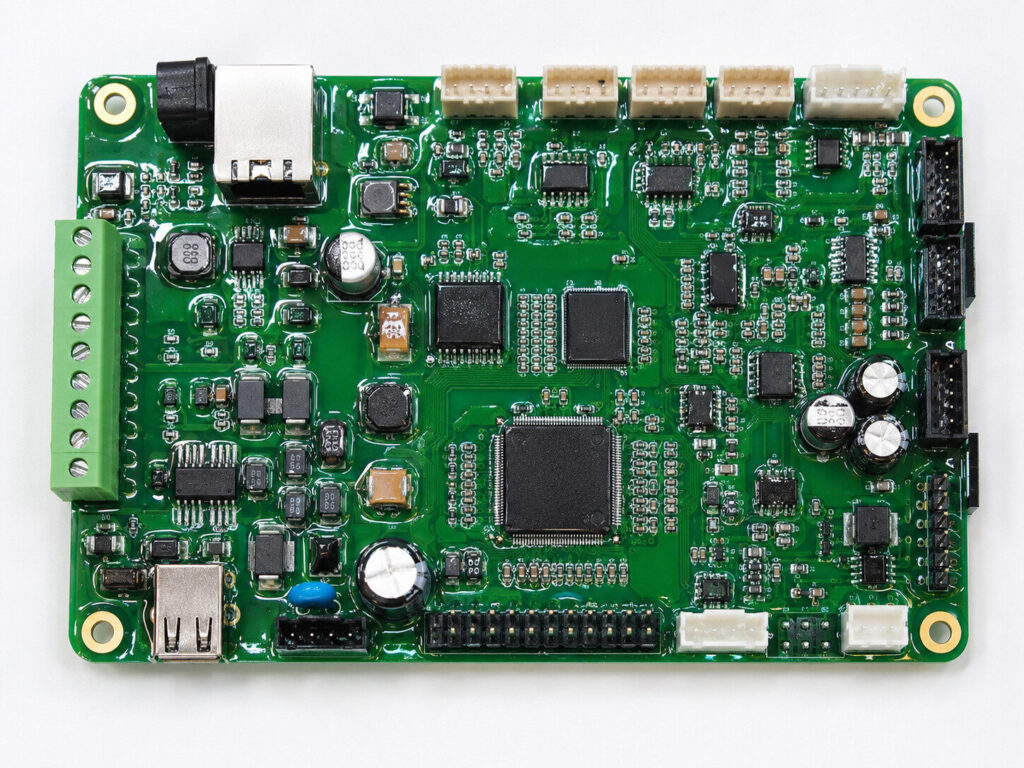
Conformal coating is a protective layer applied to the surface of a circuit board. Its purpose is not to make the board look better, but to improve the reliability of the PCBA in harsh environments.
It helps protect the board from moisture, dust, salt spray, mildew, corrosion, and in some cases, it can also reduce the impact of vibration on solder joints and components.
For industrial control boards, outdoor equipment, automotive electronics, sensor boards, and medical device boards, conformal coating is often not just an optional process. If the product will be used in environments with humidity, dust, condensation, corrosive gases, or long-term vibration, conformal coating can be very important.
We once had a customer whose board was used in an environment with long-term vibration. At the beginning, the board was not coated. The test result looked fine, but after installation, components started falling off and the board had intermittent failures.
At first, the customer thought it was a component quality issue. After inspection, we found that the real problem was the working environment, which kept affecting the solder joints and the board surface.
If conformal coating had been considered earlier, many of these after-sales problems could have been reduced.
However, conformal coating is not just about spraying a layer over the whole board. You need to know which areas can be coated and which areas must be protected.
For example, connectors, buttons, test points, heat dissipation areas, sockets, gold fingers, and adjustable components usually need masking. If coating is applied to the wrong area, it may affect conductivity, plugging, testing, or future repair.
The coating thickness also needs to be controlled. If it is too thin, the protection may not be enough. If it is too thick, it may affect heat dissipation or create stress problems.
A proper conformal coating process usually includes board cleaning, masking key areas, spraying or selective coating, curing, and final inspection.
Some people think conformal coating only increases cost. But for products used in harsh environments, it actually helps reduce after-sales cost.
One board repair does not only cost money. It also costs customer trust, machine downtime, and communication time.
So when making a PCBA project, do not only ask whether the board can power on. You also need to consider where it will be used, how it will be used, and how long it needs to work.
If your product will face humidity, dust, salt spray, vibration, or large temperature changes, conformal coating should be considered from the beginning.
PCBA production does not end when the board is assembled. The real test is whether it can work reliably at the customer’s site for a long time.
Conformal coating may look like a small process, but in many cases, it decides whether the product can remain stable in real use.