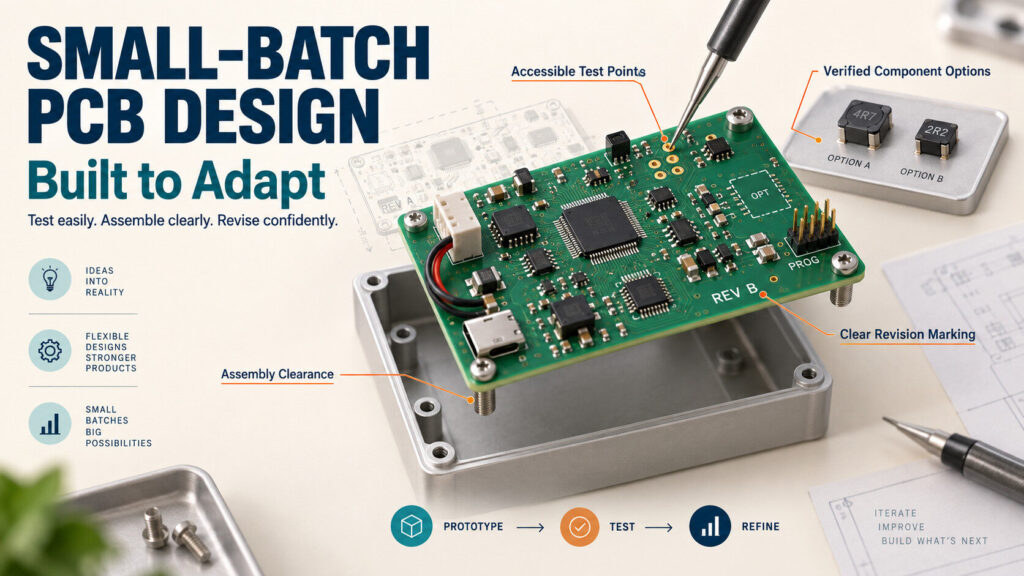
Small-batch electronic products face a distinctive challenge: the design must work today while remaining practical to change tomorrow.
A product built in limited quantities may still be gathering customer feedback. Its enclosure may evolve, a connector may need to move, or a component may become difficult to purchase. Under these conditions, PCB design quality includes how well the board supports learning, testing, and revision.
Leave Room for Investigation
A prototype or early production board should help engineers understand its behavior.
Accessible test points can make it easier to check important power rails and signals. Clearly marked connectors reduce setup mistakes. An accessible programming interface can simplify firmware updates and recovery.
These features occupy board space, so they should be chosen deliberately. The aim is to provide access to the areas most likely to require measurement or intervention.
A board that is slightly easier to investigate may save considerable effort across several development cycles.
Treat Component Alternatives as a Design Question
Component flexibility begins before purchasing.
Two devices may perform similar functions while differing in pin assignments, package dimensions, operating limits, or supporting circuitry. A replacement should therefore be evaluated against the actual design rather than accepted solely because its description looks similar.
Where alternatives are important, engineers can review them early and document the approved options. Some designs may benefit from optional footprints or configurable connections, provided their electrical and physical effects are also assessed.
Flexibility works best when it is planned and verified.
Consider the Person Assembling the Product
A PCB eventually becomes part of a physical assembly.
Connector orientation affects cable routing. Mounting-hole placement influences access to fasteners. Tall components can interfere with enclosure features, and labels may become invisible once the board is installed.
Reviewing the PCB together with the enclosure and wiring arrangement can reveal problems that are difficult to notice in the layout alone.
For small-batch products, where manual assembly may be significant, convenient access can also make production more consistent.
Make Revisions Easy to Identify
When several board versions exist, appearance alone is an unreliable way to distinguish them.
A visible revision marking, supported by matching production records, helps engineers identify the hardware under test. Firmware and configuration records should also indicate which hardware versions they support.
This becomes especially valuable when early units remain in use while an updated design enters production.
Optimize for the Product’s Current Stage
An early small-batch product may benefit more from clear labeling, accessible interfaces, and straightforward assembly than from the smallest possible board outline.
As the design stabilizes, those priorities can be reassessed using actual production and field experience.
Good PCB design supports the next decision as well as the next build. For small-batch products, that ability to adapt is part of what makes a board successful.