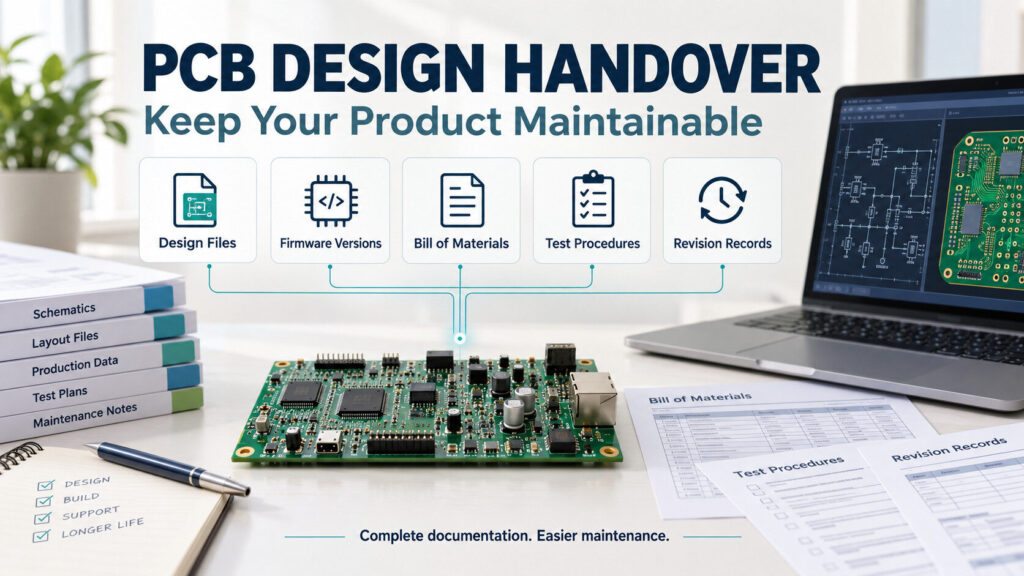
A finished PCB is a physical product. The information needed to reproduce, modify, and maintain it is a separate deliverable.
This distinction becomes important when a product needs a new feature, a component becomes unavailable, or production moves to another supplier. Without suitable documentation, even a small change can become a new engineering project.
A well-planned design handover helps preserve the work completed during development and gives the customer a clear understanding of what can be done next.
Define the Handover Before Development Begins
The required deliverables should be discussed before the project reaches completion.
Some customers only need assembled boards. Others need fabrication files, editable design files, firmware, test procedures, and maintenance information.
Neither arrangement should be assumed. The agreement should identify what will be supplied, in which format, and with what permitted uses.
Clarifying this early also allows the developer to account for documentation work in the schedule and quotation.
Distinguish Production Files from Editable Source Files
Files used to manufacture a PCB are not necessarily the same files used to create or modify the design.
A production package may allow a manufacturer to fabricate and assemble the approved version. Editable schematic and layout files support later design changes, provided the necessary project resources are available.
Customers who expect to modify the product should discuss the relevant design tools, project format, and supporting resources. Receiving a folder is not enough if important dependencies are missing or the files cannot be opened correctly.
A practical handover includes a check that the delivered package can be used for its agreed purpose.
Keep Firmware and Hardware Revisions Connected
When a board contains programmable devices, the relationship between hardware and firmware needs to be documented.
A firmware release may work with one board revision but require changes for another. Programming instructions may also depend on configuration settings or a particular procedure.
The handover should identify which software release belongs to which hardware version. It should also explain whether the delivery includes only programming files or the materials required for further software development.
This prevents later teams from treating every available file as interchangeable.
Preserve the Information Behind Component Choices
A bill of materials should do more than list generic descriptions such as “resistor” or “connector.”
Where the design depends on a particular component, its identity should be clear. Approved alternatives should be distinguished from parts that have not been evaluated.
Brief notes can also help future engineers understand why a component was selected or why a seemingly convenient substitute was rejected.
These records do not need to become an unnecessarily large report. They need to preserve decisions that would otherwise have to be rediscovered.
Include Test Instructions and Known Limitations
A production team needs a repeatable way to determine whether a board meets its requirements.
Useful test documentation describes the setup, necessary connections, operating steps, and acceptance criteria. If a function can only be checked in a complete machine, that limitation should be stated.
Known restrictions should also be recorded. For example, certain operating modes may not have been evaluated, or a feature may require an external accessory.
Clear boundaries make the documentation more useful. They prevent later users from assuming that successful testing in one configuration proves performance in every possible configuration.
Make the Final Package Easy to Navigate
A handover can contain all the required information and still be difficult to use.
Folders should have understandable names, released files should be distinguishable from drafts, and the approved revision should be easy to identify. A short index can explain what each part of the package contains.
The final review should confirm that the documents match the delivered hardware and that unresolved items are explicitly listed.
Good design handover protects the practical value of development work. It allows a product to be supported through future manufacturing, maintenance, and changes instead of depending entirely on the memory of the original project team.