
Introduction: Why PCB BOM Reconstruction Matters
When you’re reverse engineering a printed circuit board, the Bill of Materials (BOM) is just as critical as the schematic or Gerber files. Without a complete, accurate BOM, you can’t manufacture replacement boards—you don’t know what components to order, in what quantities, or from which manufacturers.
Yet BOM recovery is often overlooked or treated as an afterthought.
Here’s the reality: BOM reconstruction is one of the most time-consuming aspects of PCB reverse engineering. Unlike schematics or Gerber files that can be extracted through imaging and tracing, BOM reconstruction requires detailed component analysis, extensive database research, and often creative problem-solving for obsolete parts.
This guide walks you through exactly how professional BOM reconstruction works, what deliverables you receive, and how to handle the inevitable challenge of finding replacement parts for boards that are 10, 15, or even 30 years old.
What Is PCB BOM Reconstruction?
BOM reconstruction is the systematic process of identifying every component on a PCB and documenting it in a structured Bill of Materials format. A complete BOM includes:
- Reference designators (R1, C5, U3, etc.)
- Component values (10kΩ, 0.1µF, etc.)
- Manufacturer part numbers (MPNs) (when determinable)
- Manufacturer names (when known)
- Package types (0402, SOIC-8, QFN-32, etc.)
- Quantity per board
- Alternates/equivalents (for obsolete parts)
The goal is a production-ready document that allows you to source components and manufacture replacement boards with minimal friction.
The BOM Reconstruction Process
Professional BOM reconstruction follows a structured approach designed to maximize identification accuracy while documenting uncertainty where it exists.
Step 1: Component Extraction
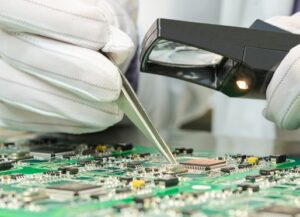
First, we physically identify and catalog every component on the board.
Through-hole components: Can often be lifted and physically examined; values can be measured directly (resistance, capacitance); markings are usually visible on the body; lead pitch and package type are observable.
Surface-mount components: Most require component removal for accurate identification; hot-air rework station for safe removal; microscopic examination of top markings; in-circuit measurement (with compensation factors) where removal is risky.
Integrated circuits: Package markings photographed at high magnification; cross-referenced against manufacturer databases; pin count and pitch measured for identification; function inferred from surrounding circuit context if markings unclear.
Typical duration: 2–5 days depending on component count
Step 2: Value and Specification Verification
Once components are physically identified, values must be verified:
| Component Type | Verification Method | Notes |
|---|---|---|
| Resistors | Measurement in-circuit or lifted | Check tolerance (1%, 5%, 10%) |
| Capacitors | LCR meter measurement | Account for voltage rating |
| Inductors | LCR meter, check saturation specs | Note current rating |
| Diodes | Polarity test, forward voltage | Identify Schottky vs regular |
| Transistors | Pinout test, hFE measurement | Match to known families |
| ICs | Datasheet research | Verify function matches context |
Typical duration: 1–3 days

Step 3: Manufacturer Part Number Research
This is where BOM reconstruction becomes detective work. For each component, we attempt to find exact manufacturer part numbers (MPNs).
Modern components: Direct search of manufacturer markings; DigiKey, Mouser, Arrow database lookup; cross-reference package + value + specifications.
Legacy components: Archive database searches (Octopart, IC Source, FindChips); broker network queries for obsolete stock; manufacturer legacy product search.
Custom or proprietary parts: Function identified by analysis; equivalent determined by specifications; marked as “alternate recommended” in BOM.
Typical duration: 3–7 days (varies widely with obsolescence)
Step 4: BOM Document Creation
With all component data collected, we create a structured BOM document:
Reference | Quantity | Value | Package | MPN | Manufacturer | Alternates | Notes
---------|----------|-------|---------|-----|--------------|------------|------
R1       | 1        | 10kΩ  | 0805    | CRCW080510K0FKEA | Vishay | —
R2       | 2        | 4.7kΩ | 0603    | RC0603FR-074K7L | Yageo | —
C1       | 1        | 0.1µF | 0402    | GRM155R71C104KA88D | Murata | —
U1       | 1        | MCU   | LQFP-32 | STM32F103C8T6 | STMicro | —
Typical duration: 1–2 days
Step 5: Sourcing Verification
Before delivery, we verify component availability: check distributor stock levels, identify long-lead-time items, flag components with limited availability, and recommend alternates for critical path items. This step ensures your BOM won’t leave you unable to build boards due to component shortages.
Typical duration: 1–2 days
Handling Obsolete Components
This is the biggest challenge in BOM reconstruction. Components from old boards are often discontinued, and here’s how we handle it:
Strategy 1: Exact Match First
Always try to find the original or functionally identical part: same manufacturer, same part number; cross-compatible from alternate manufacturer; exact drop-in replacement with same specifications.
Strategy 2: Form-Fit-Function (FFF) Replacement
When exact match is unavailable, find parts that have identical pinout and package, meet or exceed electrical specifications, are currently in production, and require no board modifications.
Strategy 3: Second-Source Equivalents
Many components have multiple manufacturers: verify pinout compatibility, check datasheet for differences, document any variations in BOM notes.
Strategy 4: Alternative Circuit Design
For truly unique or unavailable parts: engineering analysis of component function; redesign section if feasible; document required changes clearly.

BOM Deliverable Formats
We provide BOMs in multiple formats for different uses:
| Format | Use Case |
|---|---|
| Excel (.xlsx) | Sourcing, procurement, modification |
| CSV | Import into ERP/MRP systems |
| Documentation, archival, sharing | |
| EDA format | Import into Altium, KiCad, Eagle |
All BOMs include:
- Complete component listing
- Manufacturer part numbers (or “TBD” where unidentifiable)
- Quantity per board
- Package type
- Alternates/equivalents for obsolete parts
- Notes column for special requirements
BOM Reconstruction vs. Original BOM
Here’s what makes reverse-engineered BOMs different from original manufacturer BOMs:
| Aspect | Original BOM | Reconstructed BOM |
|---|---|---|
| MPN accuracy | High (manufacturer source) | 85–98% (varies by age) |
| Internal part codes | Often present | Not applicable |
| Preferred vendors | Often specified | Not specified |
| Alternates | Sometimes | Always (for obsolete) |
| Cost data | Often included | Not included |
| Revision history | Complete | Start fresh |
Expectation management: We typically achieve 95–98% exact MPN identification for boards manufactured within the last 10 years. Older boards may have lower exact-match rates due to obsolescence.
Factors Affecting BOM Reconstruction Accuracy
Several factors influence how complete and accurate your reconstructed BOM will be:
1. Board Age
| Age | Expected MPN Match Rate | Notes |
|---|---|---|
| < 5 years | 95–98% | Most components still active |
| 5–10 years | 85–95% | Some minor obsolescence |
| 10–20 years | 70–85% | Moderate obsolescence |
| > 20 years | 50–70% | Significant challenges |

2. Component Density
High component density makes extraction more difficult: more components to identify, harder to physically access parts, higher risk of identification errors.
3. Obfuscated Markings
Some manufacturers intentionally obscure part numbers: laser marking without top coating, date codes instead of full MPN, multiple products from single marking.
4. Custom/Proprietary Parts
OEMs sometimes use custom ASICs or programmed MCUs, proprietary connectors, and special-order components. These cannot be directly replaced and may require design workarounds.
BOM Reconstruction Case Study
The board: Industrial PLC module, 2005 manufacture
Components: 142 unique parts (187 total placements)
Challenge: Multiple long-obsolete ICs
What we delivered:
- 136 components with exact MPN match (96%)
- 4 components with alternate recommended
- 2 custom ICs documented with functional description
How we handled obsolescence:
- One microcontroller (EOL) replaced with pin-compatible newer variant
- One memory chip sourced from broker stock (25 pieces available)
- Two op-amps replaced with improved-spec equivalents
Result: Client manufactured 50 replacement boards within 3 months of receiving deliverables.
Related Reverse Engineering Services
A reconstructed BOM is typically combined with two other deliverables for a complete replacement package:
- Schematic recovery — reconstructs the circuit logic (component relationships, signal flow) so engineers can analyze and modify the design
- Gerber recovery — regenerates the manufacturing files (copper geometry, drill files) from the same physical board
For legacy boards where the original design data is completely lost, bundling all three (schematic + Gerber + BOM) gives you a complete replacement package ready for manufacturing. See our PCB reverse engineering deliverables guide for the standard and premium package comparison.
Frequently Asked Questions
How accurate is BOM reconstruction?
For modern boards (<10 years old), expect 95–98% exact MPN identification. For older boards, accuracy decreases due to obsolescence. We always document our confidence level for each component and provide alternates for any parts we cannot match exactly.
What if some components are obsolete?
We have extensive broker networks and obsolescence databases. For obsolete parts, we identify form-fit-function equivalents that will work without board modifications. In rare cases where no equivalent exists, we document the part’s function so your engineering team can evaluate design workarounds.
Can you identify custom or proprietary components?
We identify the package type, pinout, and approximate function for most custom parts. For programmed MCUs or ASICs, we document the pin functions but cannot provide the internal firmware or configuration. Some proprietary parts may require circuit analysis or redesign.
Do you include alternates in the BOM?
Yes. For every component that has known suitable alternates, we include them in the BOM. This provides flexibility in sourcing and protects against future obsolescence.
What’s included in the BOM deliverable?
Standard delivery includes:
- Excel BOM with all components
- PDF version for documentation
- CSV for system import
- Component datasheets (when available)
- Notes on any identification challenges or recommendations
Can you help source the components?
We can provide component sourcing assistance, including:
- Distributor quotes for standard parts
- Broker contacts for obsolete items
- Long-lead-time identification
- Counterfeit risk assessment
Contact us for sourcing services.
Ready to Reconstruct Your BOM?
If you have a board that needs BOM recovery, upload photos and get a detailed quote within 24 hours. Share the approximate component count, board age, and any known challenges (conformal coating, obscure ICs, etc.).
Summary: Key Takeaways
- BOM reconstruction is essential — without a complete, accurate BOM, you can’t manufacture replacement boards.
- Process is systematic — extraction → verification → research → documentation → sourcing check.
- Accuracy varies by board age — newer boards yield 95–98% exact matches; older boards may need alternates.
- Obsolescence is manageable — broker networks, equivalents, and form-fit-function replacements keep projects viable.
- Deliverables include alternates — every BOM includes backup options for parts that may become unavailable.
- Custom parts require workarounds — proprietary ICs are documented but may need engineering evaluation.
Don’t let missing documentation stop your legacy board project. Complete BOM reconstruction brings your supply chain back online.
References
- Global Electronics Association — Component identification and PCB reverse engineering guidelines. https://electronics.org/
- DigiKey — Authorized electronic component distributor and part database. https://www.digikey.com/
- Mouser Electronics — Component database and datasheet repository. https://www.mouser.com/
- Octopart — Electronic component search engine aggregating distributors. https://octopart.com/
Further Reading
- PCB Reverse Engineering Cost — Complete pricing guide
- PCB Reverse Engineering Deliverables — Standard and premium packages
- X-ray PCB Reverse Engineering — Internal layer imaging methods
- Recover Schematic from PCB — Circuit logic reconstruction
- Recover Gerber Files from PCB — Manufacturing file regeneration
- Multilayer PCB Clone Service — Full clone from recovered files
CtrlCPCB Technical Team | Last updated: 2026-08-14
This article provides general technical information about PCB BOM reconstruction. Component identification accuracy depends on board age, marking quality, and part availability. Contact us for a project-specific assessment.