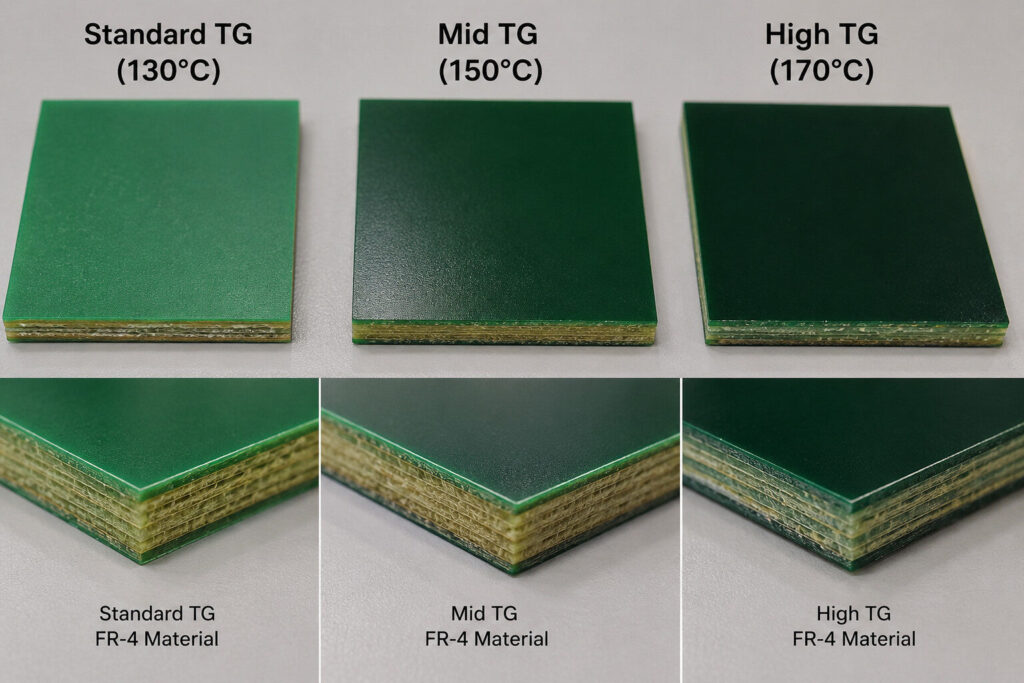
When many customers make PCBs, they often see a parameter called TG value in the material specification and ask: Does a higher TG mean a better PCB?
The answer is not that simple.
TG value, in simple terms, refers to the glass transition temperature of the PCB material. Below this temperature, the material remains relatively stable. Once it gets close to or exceeds this temperature, the mechanical strength, dimensional stability, and Z-axis expansion of the material may change significantly.
To put it simply, TG value affects whether the PCB is more likely to deform, delaminate, crack in the plated holes, or fail under high-temperature conditions.
But TG is not something where “the higher, the better.” It depends on where your product will be used.
For ordinary consumer electronics, standard control boards, and low-heat products, if the working environment temperature is not high, standard TG material is usually enough. Many double-sided boards and four-layer boards can use regular FR-4 material without any problem. There is no need to use high-TG material from the beginning, otherwise it only increases the cost.
However, if your board has these conditions, you should consider medium-TG or high-TG material: long-term high-temperature working environment, such as power boards, industrial control boards, automotive electronics, and LED driver boards; higher layer count, such as 6-layer, 8-layer, or more; multiple reflow soldering processes; BGA or QFN components that require higher soldering temperature and board stability; high current, high heat, or harsh working environments.
Generally speaking, standard TG is around 130°C, medium TG is around 150°C, and high TG is usually above 170°C. In actual selection, we should not only look at which parameter looks better. We need to consider the working temperature, soldering process, layer structure, reliability requirements, and budget.
Another common misunderstanding is that TG value is not equal to the maximum operating temperature of the PCB. It does not mean that a TG170 board can work at 170°C for a long time. In real engineering evaluation, we also need to consider heat resistance, decomposition temperature, CTE, copper bonding strength, board thickness, and lamination structure.
So when choosing PCB material, do not only ask, “How much is high TG?” You should first explain the application clearly. Is the board used for power supply, industrial control, automotive electronics, medical equipment, or communication devices? Are there high-power components? Is there a BGA? What is the approximate working temperature? Does it need long-term operation?
PCB manufacturing is not only about whether the board can be produced. Whether it can work stably in the long term is often decided from the material selection stage.
In one sentence: ordinary products do not need high-TG material blindly, but for high-temperature, high-layer-count, and high-reliability applications, do not increase long-term reliability risks just to save a little material cost.