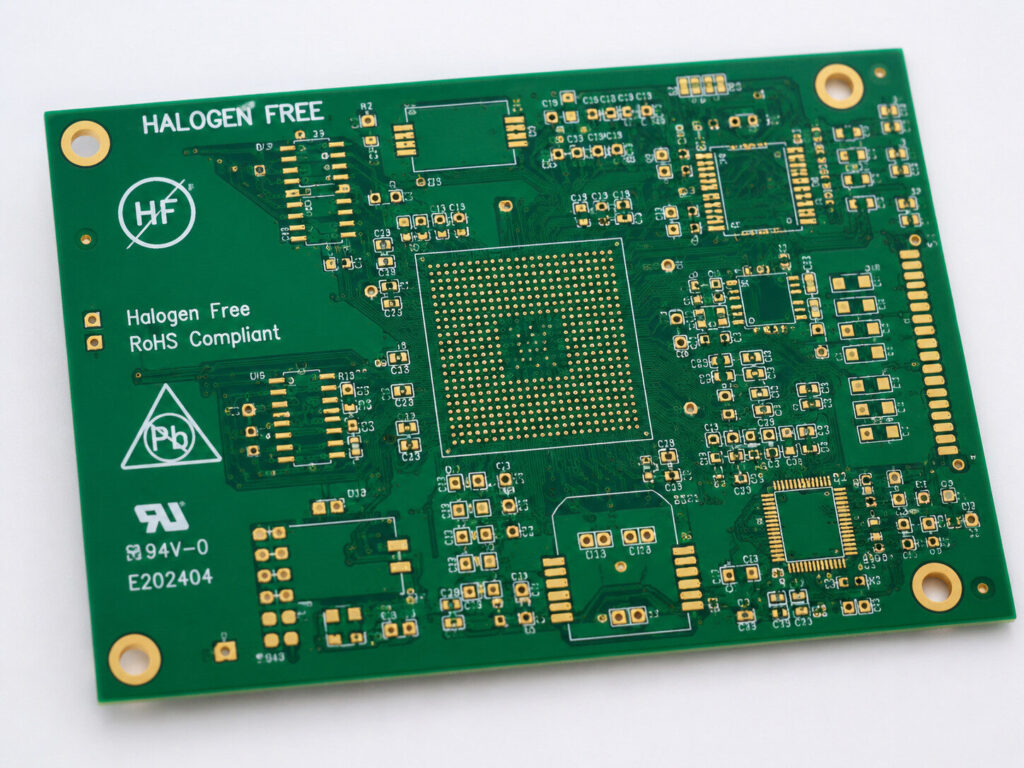
When making PCBs, many customers first focus on the number of layers, board thickness, copper thickness, impedance, and surface finish. But one important material requirement is often overlooked: whether the laminate is halogen-free.
A halogen-free laminate generally means that the PCB material system reduces the use of halogen elements such as chlorine and bromine. In the past, many standard FR-4 materials used brominated flame-retardant systems. These materials are mature, cost-effective, and stable in production. However, as environmental requirements, export standards, and brand customer controls become stricter, more and more products are now required to use halogen-free materials.
Halogen-free does not mean the board contains absolutely no halogens at all. It means the material must meet the relevant standards and customer requirements. For many export products, consumer electronics, medical devices, automotive electronics, and communication equipment, customers may clearly specify requirements such as “Halogen Free,” “HF,” or “Low Halogen” in their documents. If this is not confirmed at the early engineering stage, the finished board may work electrically, but still fail customer acceptance because the material does not meet the required specification.
So, is a halogen-free laminate only about environmental protection? Not really.
First, it is related to customer audits and product compliance. Especially for overseas projects, customers do not only check whether the board works. They also check the material system, environmental declarations, and supply chain documents.
Second, it affects long-term production stability. Halogen-free materials may differ from standard FR-4 materials in resin system, thermal performance, and processing characteristics. Drilling, lamination, reflow soldering resistance, CAF risk, and moisture absorption may all need to be evaluated based on the specific material.
Third, it affects engineering evaluation. Not every board can simply replace standard materials with halogen-free materials. For high-speed boards, impedance-controlled boards, multilayer boards, and HDI boards, changing the material may affect dielectric constant, dielectric loss, and stack-up structure. The impedance that was originally calculated may no longer be correct after changing the material.
That is why halogen-free laminates are not something purchasing can simply replace by changing a material code. They are also not something that production can casually substitute. A professional approach is to confirm the requirements at the design and quotation stage: whether the customer requires halogen-free materials, whether material certificates are needed, whether a specific brand is required, and whether there are impedance, thermal, certification, or environmental documentation requirements.
When we evaluate PCB projects, we do not only check the Gerber files. We also look at the application scenario, working environment, export destination, product industry, and whether the project will move into mass production. Sometimes a small saving on material cost in the early stage can lead to much higher costs later due to rework, remanufacturing, and revalidation.
This is especially important for industrial control boards, medical equipment boards, automotive electronics, and high-speed communication boards. For these products, it is not enough to ask whether the board can be made. We also need to know whether it can operate reliably for a long time, pass customer acceptance, and avoid hidden risks during mass production.
So, if your PCB project involves export requirements, brand customers, environmental compliance, or documents mentioning “Halogen Free,” “HF,” or “Low Halogen,” make sure to confirm this with the PCB manufacturer in advance. Do not wait until the boards are finished, assembled, and tested, only to find out that the material documents do not match the requirement.
A PCB is not only about making the circuit conductive. Choosing the right material is the first step toward stable mass production.