Many customers working with copper PCBs struggle with one question:
Should the surface finish be ENIG (Immersion Gold) or HASL (Hot Air Solder Leveling)?
Especially for high-power products like LED boards, automotive lighting, power modules, and industrial equipment, this is not a small decision. On the surface, it may look like just a different PCB finish, but in reality it affects soldering quality, heat resistance, oxidation resistance, long-term stability, and even the final product failure rate.
A lot of projects choose HASL at the beginning simply to save cost. The samples look fine, testing passes, and everything seems okay. But after the product runs in real working conditions for some time, problems begin to appear: oxidized pads, unstable solder joints, poor contact reliability, and higher repair rates. By then, changing the process usually costs much more in both time and money.
Let’s Talk About ENIG First
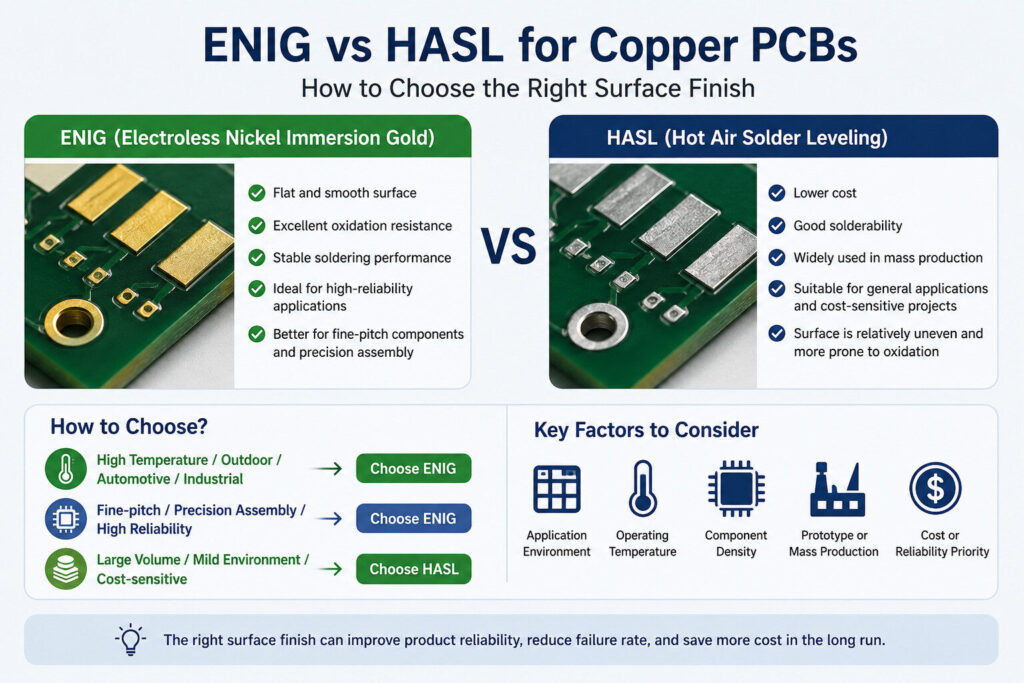
The advantages of ENIG are straightforward:
- Better surface flatness
- Strong oxidation resistance
- More stable solder pads
If your PCB has fine-pitch components, precision SMT assembly, or high soldering consistency requirements, ENIG is usually the safer choice.
Copper PCBs naturally generate more heat during operation, so when they work in high-temperature environments for long periods, ENIG performs much better in terms of oxidation resistance and long-term reliability.
For example:
- Outdoor lighting
- Automotive LED boards
- Industrial power boards
These products are not just about “working today.” Customers care whether they still run reliably after six months or one year. In these situations, ENIG may cost more upfront, but it usually reduces long-term risks.
Now About HASL
The biggest advantage of HASL is cost.
It is cheaper and still offers good solderability.
If the product works in a relatively mild environment, without continuous high temperatures or demanding SMT requirements, HASL can be a very cost-effective option.
Typical examples include:
- Standard LED boards
- Regular power supply boards
- Large-volume, cost-sensitive products
However, HASL also has limitations.
Its surface flatness is not as good as ENIG, and it is more likely to oxidize over time. If the PCB uses fine-pitch ICs, small-package components, or needs to operate under long-term heat, HASL should be considered carefully.
Many issues do not appear during prototyping. They only show up later during mass production or after the product reaches the customer.
So Which One Is Better?
In simple terms:
- High-temperature, outdoor, automotive, and industrial applications usually benefit from ENIG.
- Fine-pitch SMT assembly and high-reliability products also favor ENIG.
- Mild environments, large production volumes, and strict cost-control projects can consider HASL.
But don’t focus only on board price.
Copper PCBs are mainly used for heat dissipation and high-power applications. If the working conditions are already demanding, choosing the cheapest surface finish may save a little money upfront, but the cost often comes back later through repairs and after-sales issues.
How We Usually Recommend a Solution
We do not simply recommend the more expensive option, and we also do not suggest HASL only to reduce cost.
Before selecting the finish, we usually evaluate several factors:
- What product will the PCB be used in?
- What is the expected operating temperature?
- Will it be used outdoors?
- Are there fine-pitch components?
- Is this for prototyping or mass production?
- Is the customer prioritizing lower cost or long-term reliability?
Once these points are clear, it becomes much easier to choose the right process and avoid unnecessary problems later.
At the end of the day, there is no absolute “best” choice between ENIG and HASL. The right option depends entirely on the application.
Choose correctly, and the product stays reliable.
Choose poorly, and saving a little money at the beginning may create much bigger problems later.