Introduction
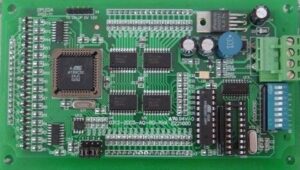
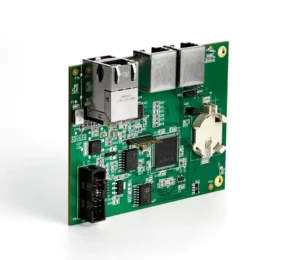
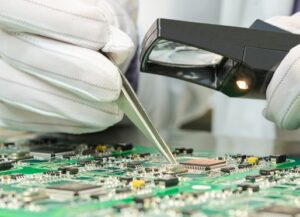
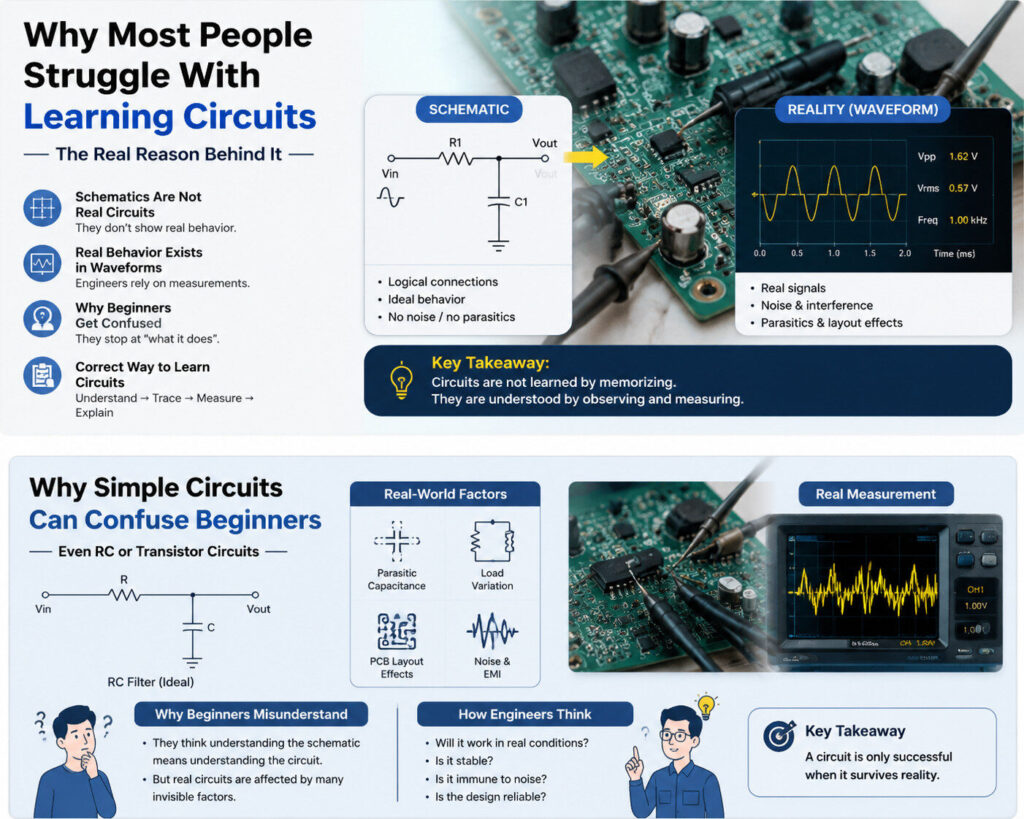
Many beginners spend a lot of time studying circuit theory, but still struggle when facing real hardware. They can understand schematics, memorize formulas, and even simulate circuits — yet still feel confused when debugging real boards.
The problem is not intelligence.
It’s the learning approach.
1. Schematics Are Not Real Circuits
A schematic only describes logical connections, not physical behavior.
It tells you:
- What components are used
- How signals are connected
- The intended function of the circuit
But it does NOT show:
- Noise behavior
- Parasitic effects
- Real voltage/current waveforms
- EMI interference
👉 In real hardware, these factors completely change circuit behavior.
2. Real Circuit Behavior Exists in Waveforms
Engineers do not rely only on schematics.
They analyze:
- Oscilloscope waveforms
- Signal integrity
- Power ripple
- Rise/fall time
- Noise coupling
👉 A circuit is only “understood” when its waveform is understood.
3. Why Beginners Get Confused
Most beginners stop at one question:
“What is this circuit for?”
But engineers go further:
“How does this circuit behave under real conditions?”
This difference is the key gap.
4. Correct Way to Learn Circuits
A practical learning flow should be:
- Understand circuit function
- Trace power and signal paths
- Identify key test points
- Observe real waveforms
- Go back to schematic for explanation
Conclusion
Circuits are not learned by memorizing.
They are understood by observing and measuring.
👉 Real engineering starts when theory meets hardware.