
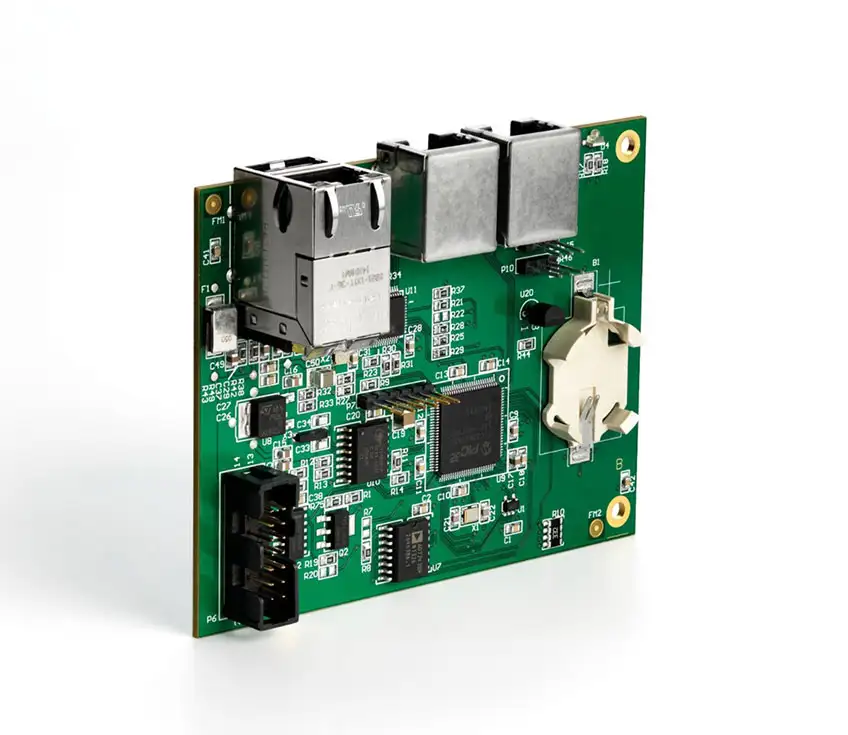
High-Tg PCB
Circuit boards must be flame-resistant and cannot burn at a certain temperature, but can only soften. The temperature point at this time is called the glass transition temperature (Tg point), and this value is related to the dimensional stability of the PCB board. The higher the TG value, the better the temperature resistance of the PCB
When the temperature rises to a certain area, the substrate will change from “glass state” to “rubber state”, and this temperature is called the glass transition temperature of the sheet (Tg). In other words, Tg is the highest temperature (℃) at which the temperature of the substrate is maintained. That is to say, ordinary PCB substrate materials will not only produce deformation, melting and other phenomena at high temperatures, but also a sharp decline in mechanical and electrical properties.
The increase of the Tg of the substrate will strengthen and improve the characteristics of the printed circuit board’s heat resistance, moisture resistance, chemical resistance, and resistance stability. The higher the TG value, the better the temperature and other properties of the board, especially in the lead-free manufacturing process, high Tg is more widely used.
High Tg refers to high heat resistance. With the rapid development of the electronics industry, especially electronic products represented by computers, the development towards high functionality and high multi-layer requires higher heat resistance of PCB substrate materials as an important guarantee. The emergence and development of high-density mounting technologies represented by SMT and CMT have made PCBs increasingly dependent on the support of high heat resistance of substrates in terms of small apertures, fine circuits, and thinness.
Therefore, the difference between general FR-4 and high-Tg FR-4 is that in the hot state, especially when heated after moisture absorption, the mechanical strength, dimensional stability, adhesion, water absorption, thermal decomposition, thermal expansion and other conditions of the material are different. High-Tg products are obviously better than ordinary PCB substrate materials.
Why High-Tg PCB?
High Tg PCB, that is, when the temperature rises to a certain range, the substrate changes from “solid” to “rubber state”, and this temperature point is called the glass transition temperature (Tg) of the circuit board.
Tg represents the temperature required for the material to change from “solid” to “rubber state”, measured in degrees Celsius. Generally, the Tg of the material is above 130°C, while high Tg is usually above 170°C, and medium Tg is about 150°C. PCBs with Tg of 170°C or higher are generally called high Tg PCBs.
High thermal conductivity
High Tg materials have high thermal conductivity and can dissipate heat more effectively. This property helps improve the stability and reliability of electronic devices, especially in high-temperature working environments.
High heat resistance
The higher the Tg value, the better the heat resistance of the material. High Tg materials can maintain good performance and stability in high-temperature environments and are suitable for high-temperature working environments.
Excellent mechanical properties
High Tg materials have high strength and stiffness and can withstand greater mechanical stress. This property allows high Tg materials to maintain stable performance even in harsh environmental conditions.
Good electrical properties:
High Tg materials have lower dielectric constants and loss tangents, which helps improve signal transmission quality and electromagnetic compatibility. This is especially important in high-frequency and high-speed signal transmission applications.
Common High-Tg PCB Material
Items | Methods | IT-180ATC |
Tg (℃) | DSC | 175 |
T-288 (w/ 1oz Cu, min) | TMA | 20 |
Td-5%(℃ ) | TGA 5% loss | 345 |
CTE (ppm/℃) | a1/a2 | 45/210 |
CTE (%), 50-260℃ | TMA | 2.7 |
Dk @ 1 GHz (RC 50%) | IPC TM-650 2.5.5.13 | 4.1 |
Df @ 1 GHz (RC 50%) | IPC TM-650 2.5.5.13 | 0.017 |
CTI (Volts) | IEC 60112 / UL 746 | CTI 3 (175-249) |
| Items | Method | Condition | Unit | Typical Value | |
|---|---|---|---|---|---|
| Tg | IPC-TM-650 2.4.24.4 | DMA | ℃ | 200 | |
| Tg | TMA | ℃ | 170 | ||
| Td | IPC-TM-650 2.4.24.6 | 5% wt. loss | ℃ | 350 | |
| CTE (Z-axis) | IPC-TM-650 2.4.24 | Before Tg | ppm/℃ | 45 | |
| After Tg | ppm/℃ | 210 | |||
| 50-260℃ | % | 2.3 | |||
| T260 | IPC-TM-650 2.4.24.1 | TMA | min | >60 | |
| T288 | IPC-TM-650 2.4.24.1 | TMA | min | 45 | |
| Thermal Stress | IPC-TM-650 2.4.13.1 | 288℃, solder dip | s | >100 | |
| Volume Resistivity | IPC-TM-650 2.5.17.1 | After moisture resistance | MΩ.cm | 2.5E+08 | |
| E-24/125 | MΩ.cm | 1.9E+06 | |||
| Surface Resistivity | IPC-TM-650 2.5.17.1 | After moisture resistance | MΩ | 3.3E+07 | |
| E-24/125 | MΩ | 2.4E+06 | |||
| Arc Resistance | IPC-TM-650 2.5.1 | D-48/50+D-4/23 | s | 146 | |
| Dielectric Breakdown | IPC-TM-650 2.5.6 | D-48/50+D-4/23 | kV | >45 | |
| Dissipation Constant (Dk) | IPC-TM-650 2.5.5.9 | 1GHz | — | 4.6 | |
| IPC-TM-650 2.5.5.9 | 1MHz | — | 4.8 | ||
| Dissipation Factor (Df) | IPC-TM-650 2.5.5.9 | 1GHz | — | 0.015 | |
| IPC-TM-650 2.5.5.9 | 1MHz | — | 0.009 | ||
| Peel Strength (1oz HTE copper foil) | IPC-TM-650 2.4.8 | A | N/mm | — | |
| After thermal Stress 288℃,10s | N/mm[lb/in] | 1.25[7.14] | |||
| 125℃ | N/mm | — | |||
| Flexural Strength | LW | IPC-TM-650 2.4.4 | A | MPa | 530 |
| CW | IPC-TM-650 2.4.4 | A | MPa | 410 | |
| Water Absorption | IPC-TM-650 2.6.2.1 | E-1/105+D-24/23 | % | 0.07 | |
| CTI | IEC60112 | A | Rating | PLC 3 | |
| Flammability | UL94 | C-48/23/50 | Rating | V-0 | |
| E-24/125 | Rating | V-0 | |||
Remarks:
1. Specification sheet: IPC-4101/126, is for your reference only.
2. All the typical value is based on the 1.6mm(16*2116) specimen.
| Items | Method | Condition | Unit | Typical Value | |
|---|---|---|---|---|---|
| Tg | IPC-TM-650 2.4.25 | DSC | ℃ | 180 | |
| IPC-TM-650 2.4.24.4 | DMA | ℃ | 185 | ||
| Td | IPC-TM-650 2.4.24.6 | 5% wt. loss | ℃ | 345 | |
| CTE (Z-axis) | IPC-TM-650 2.4.24 | Before Tg | ppm/℃ | 45 | |
| After Tg | ppm/℃ | 220 | |||
| 50-260℃ | % | 2.8 | |||
| T260 | IPC-TM-650 2.4.24.1 | TMA | min | 60 | |
| T288 | IPC-TM-650 2.4.24.1 | TMA | min | 20 | |
| T300 | IPC-TM-650 2.4.24.1 | TMA | min | 5 | |
| Thermal Stress | IPC-TM-650 2.4.13.1 | 288℃, solder dip | — | 100S No Delamination | |
| Volume Resistivity | IPC-TM-650 2.5.17.1 | After moisture resistance | MΩ.cm | 2.2 x 10⁸ | |
| E-24/125 | MΩ.cm | 4.5 x 10⁶ | |||
| Surface Resistivity | IPC-TM-650 2.5.17.1 | After moisture resistance | MΩ | 7.9 x 10⁷ | |
| E-24/125 | MΩ | 1.7 x 10⁶ | |||
| Arc Resistance | IPC-TM-650 2.5.1 | D-48/50+D-4/23 | s | 100 | |
| Dielectric Breakdown | IPC-TM-650 2.5.6 | D-48/50+D-4/23 | kV | 63 | |
| Dissipation Constant (Dk) | IPC-TM-650 2.5.5.9 | 1MHz | — | 4.8 | |
| IEC 61189-2-721 | 10GHz | — | — | ||
| Dissipation Factor (Df) | IPC-TM-650 2.5.5.9 | 1MHz | — | 0.013 | |
| IEC 61189-2-721 | 10GHz | — | — | ||
| Peel Strength (1Oz HTE copper foil) | IPC-TM-650 2.4.8 | A | N/mm | — | |
| After thermal Stress 288℃,10s | N/mm | 1.38 | |||
| 125℃ | N/mm | 1.07 | |||
| Flexural Strength | LW | IPC-TM-650 2.4.4 | A | MPa | 562 |
| CW | IPC-TM-650 2.4.4 | A | MPa | 518 | |
| Water Absorption | IPC-TM-650 2.6.2.1 | E-1/105+D-24/23 | % | 0.10 | |
| CTI | IEC60112 | A | Rating | PLC 3 | |
| Flammability | UL94 | C-48/23/50 | Rating | V-0 | |
| E-24/125 | Rating | V-0 | |||
Remarks:
- Specification sheet: IPC-4101/126, is for your reference only.
- All the typical value is based on the 1.6mm specimen, while the Tg is for specimen≥0.50mm.
Explanation: C=Humidity conditioning, D=Immersion conditioning in distilled water, E=Temperature conditioning
The first digit following the letter indicates the duration of preconditioning in hours, the second digit the preconditioning temperature in ℃ and the third digit the relative humidity.
| Items | Method | Condition | Unit | Typical Value | |
|---|---|---|---|---|---|
| Tg | IPC-TM-650 2.4.25 | DSC | ℃ | 180 | |
| IPC-TM-650 2.4.24.4 | DMA | ℃ | 185 | ||
| Td | IPC-TM-650 2.4.24.6 | 5% wt. loss | ℃ | 355 | |
| CTE (Z-axis) | IPC-TM-650 2.4.24 | Before Tg | ppm/℃ | 41 | |
| After Tg | ppm/℃ | 208 | |||
| 50-260℃ | % | 2.4 | |||
| T260 | IPC-TM-650 2.4.24.1 | TMA | min | >60 | |
| T288 | IPC-TM-650 2.4.24.1 | TMA | min | 30 | |
| T300 | IPC-TM-650 2.4.24.1 | TMA | min | 15 | |
| Thermal Stress | IPC-TM-650 2.4.13.1 | 288℃, solder dip | s | >100 | |
| Volume Resistivity | IPC-TM-650 2.5.17.1 | After moisture resistance | MΩ.cm | 8.7 E+08 | |
| E-24/125 | MΩ.cm | 7.2 E+06 | |||
| Surface Resistivity | IPC-TM-650 2.5.17.1 | After moisture resistance | MΩ | 2.2 E+07 | |
| E-24/125 | MΩ | 8.6 E+06 | |||
| Arc Resistance | IPC-TM-650 2.5.1 | D-48/50+D-4/23 | s | 133 | |
| Dielectric Breakdown | IPC-TM-650 2.5.6 | D-48/50+D-4/23 | kV | >45 | |
| Dissipation Constant (Dk) | IPC-TM-650 2.5.5.9 | 1GHz | — | 4.6 | |
| IPC-TM-650 2.5.5.9 | 1MHz | — | 4.9 | ||
| Dissipation Factor (Df) | IPC-TM-650 2.5.5.9 | 1GHz | — | 0.018 | |
| IPC-TM-650 2.5.5.9 | 1MHz | — | 0.015 | ||
| Peel Strength (1oz HTE copper foil) | IPC-TM-650 2.4.8 | A | N/mm | — | |
| After thermal Stress 288℃,10s | N/mm[lb/in] | 1.3[7.43] | |||
| 125℃ | N/mm | ||||
| Flexural Strength | LW | IPC-TM-650 2.4.4 | A | MPa | 567 |
| CW | IPC-TM-650 2.4.4 | A | MPa | 442 | |
| Water Absorption | IPC-TM-650 2.6.2.1 | E-1/105+D-24/23 | % | 0.08 | |
| CTI | IEC60112 | A | Rating | PLC 3 | |
| Flammability | UL94 | C-48/23/50 | Rating | V-0 | |
| E-24/125 | Rating | V-0 | |||
Remarks:
1. Specification sheet: IPC-4101/126, is for your reference only.
2. All the typical value is based on the 1.6mm(8*7628) specimen.
| Property | Typical Values |
|---|---|
| Tg (DMA) | 190°C |
| Tg (DSC) | 180°C |
| Tg (TMA) | 170°C |
| Td (TGA) | 340°C |
| CTE z-axis (50 to 260 °C) | 2.7% |
| T-260/ T288 | >60 min/ >15 min |
| Permittivity @1GHz(RC 50%) | 4.3 |
| Loss Tangent @1GHz(RC 50%) | 0.018 |
- Industry Approvals
- IPC-4101E Type Designation : /98, /99, /101, /126
- IPC-4101E/126 Validation Services QPL Certified
- UL Designation – ANSI Grade: FR-4.0
- UL File Number: E189572
- Flammability Rating: 94V-0
- Maximum Operating Temperature: 130°C
- Standard Availability
- Thickness: 0.002”[0.05mm] to 0.062”[1.58mm], available in sheet or panel form
- Copper Foil Cladding: 1/8 to 12oz (HTE) for built-up; 1/8 to 3oz (HTE) for double sides and H to 2oz (MLS)
- Prepregs: Available in roll or panel form
- Glass Styles: 106, 1080, 2113, 2116, 1506 and 7628 etc.