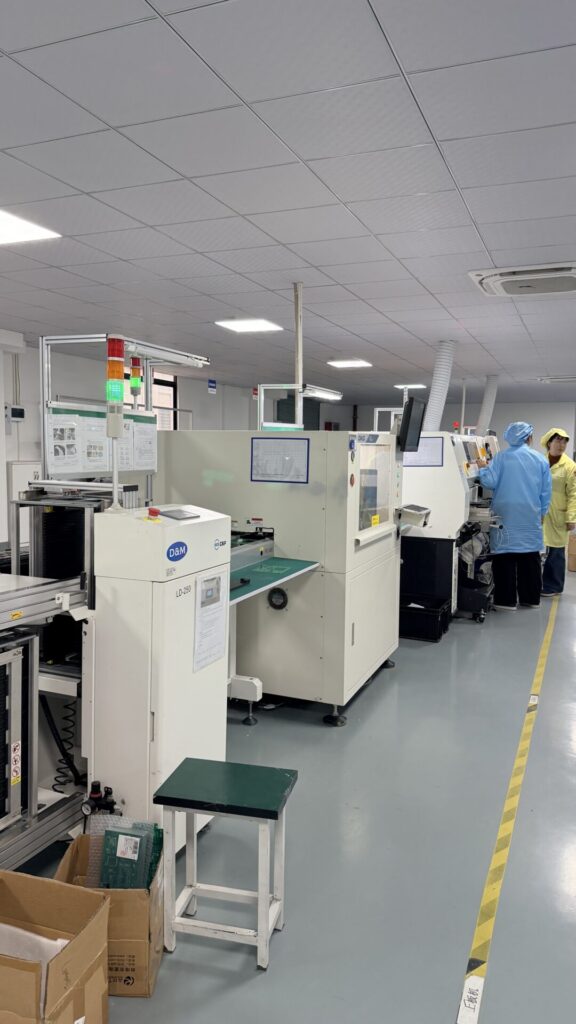
From Urgent Production to Legacy Board Recovery, What Can a PCBA Source Factory Help Customers Solve?
1. Many Customers Come to Us for More Than SMT Assembly
Some customers look for an SMT factory because they already have complete production files and need quick manufacturing.
But many other customers come to us because their projects are facing real problems.
For example:
The equipment needs to be delivered urgently, but the boards are not ready.
An old equipment circuit board is damaged, but there is no schematic.
Overseas replacement parts are too expensive, and the customer wants to reduce cost.
The original factory has discontinued the board, but the equipment is still in use.
The prototype works, but batch production is unstable.
These problems are difficult to solve through simple SMT assembly alone.
What customers really need is a complete PCBA solution.
2. Which Parts of the Project Can We Support?
As a PCB and PCBA source factory, we can support customers across multiple stages.
Our services include:
PCB file organization, BOM organization, PCB fabrication, SMT assembly, DIP soldering, IC programming, functional testing, prototype verification, batch production, old board analysis, circuit restoration, and documentation backup.
If the customer has complete production files, we can quickly move into manufacturing.
If the customer’s documentation is incomplete, we can also assist with circuit board analysis and help recover production data as much as possible.
3. Case Study 1: Urgent PCBA Production Helped the Customer’s Equipment Resume Operation
One customer urgently needed a batch of PCBA boards for automation equipment.
The schedule was extremely tight. If production followed the normal lead time, the equipment would remain idle, and the customer’s losses would continue to increase.
After receiving the request, we quickly evaluated the PCB files, BOM materials, SMT difficulty, and testing requirements.
Then we coordinated PCB fabrication, material preparation, SMT assembly, DIP soldering, and functional testing.
In a short period of time, we completed the urgent PCBA delivery.
After receiving the boards, the customer installed them into the equipment, and the equipment resumed normal operation.
This type of project tests more than SMT capability. It also tests the factory’s coordination ability, delivery capability, and engineering response speed.
4. Case Study 2: No Documentation for Old Equipment, Recovered the Circuit Board and Achieved Batch Production
Another customer had old equipment that was still in normal use, but the core control board had already been discontinued.
There were no original factory files, no schematic, no PCB layout file, and no BOM list. Once the equipment stopped, it would directly affect production.
The customer sent us a sample board. We first analyzed the board structure, layer count, circuit routing, key components, and interface definitions.
Then we organized the BOM, restored the PCB production data, made prototype boards, and supported the customer with machine testing.
After the prototype passed verification, the customer confirmed that it could be used normally in the equipment and later arranged batch production.
The value of this type of project is not only making another board. More importantly, it helps the customer rebuild repair and production documentation for old equipment.
5. Case Study 3: High Overseas Purchasing Cost, Reduced Cost Through Domestic Batch Production
Some customers used to rely on overseas suppliers for a long time. The unit price was high, and the delivery time was unstable.
This is especially common with industrial control boards, equipment supporting boards, and power supply boards. Overseas manufacturing and procurement costs are often relatively high.
After receiving the customer’s project data, we evaluate the PCB process, component selection, BOM purchasing, SMT assembly, and testing process.
Under the condition of ensuring function and quality, domestic source factory production can help customers reduce the overall cost.
For some batch production projects, the cost was reduced by about 2 to 3 times compared with the original overseas solution.
For customers, this is not simply changing to another assembly factory. It is rebuilding a more stable and more economical supply chain.
6. Why Is a Source Factory More Suitable for Long-Term Cooperation?
A PCBA project does not end after one production batch.
Many customers still need design revisions, repeat orders, alternative components, function optimization, cost reduction, and repair analysis later.
If every process is handled by a different supplier, communication becomes difficult and responsibility becomes unclear.
The advantage of a source factory is that PCB fabrication, SMT assembly, component sourcing, testing, prototype verification, and batch production can all be coordinated through one team.
Once a problem occurs, the cause can be found and solved more quickly.
This is very important for long-term stable production.
7. What Types of Customers Are Suitable for Our Services?
You can contact us if you have any of the following needs:
You have PCB files and need prototype or batch production.
You have a BOM list and need component sourcing and SMT assembly.
You have a sample board but no complete production files.
An old equipment circuit board is damaged and needs repair backup.
Imported equipment replacement parts are too expensive, and you want a localized alternative.
Your product is ready for mass production and needs a stable PCBA factory.
Your project schedule is tight and requires urgent production delivery.
8. Factory Visits and Inspections Are Welcome
We professionally undertake small and large batch PCB and PCBA manufacturing.
Our services include PCB fabrication, SMT assembly, DIP soldering, BOM matching, IC programming, functional testing, and batch production.
We are a source factory. Customers are welcome to visit and inspect our factory, or bring sample boards, files, and project requirements for face-to-face communication.
PCBA manufacturing is not only about soldering a board. More importantly, it is about helping the customer’s product run stably, deliver smoothly, and remain manufacturable for the long term.